





Author's Note: All previous volumes of this series are here. The first 56 volumes are compiled into the book "Bible Study For Those Who Don't Read The Bible." "Part Two," featuring volumes 57-113, was published in December 2022.
Happy Resurrection Sunday! In today’s study, I am not glorifying our Risen Lord Jesus with baskets of chocolate marshmallow eggs. Instead, I am interviewing Russ Breault, a renowned Shroud of Turin expert, speaker, author, and Bible scholar. Learn more about Russ and his Shroud Encounter ministry.
Before we start the interview with Russ about his new book, “Beneath the Surface: A Closer Look at the Shroud of Turin,” you should know that interest in the Shroud has reached an all-time high. After all, untold millions believe this linen cloth with an image of a crucified man was left by God as evidence that Jesus suffered, died, and was resurrected. Like Jesus, His burial Shroud symbolizes hope and His love for us when at the Cross He took on our sin debt.
That said, let’s welcome Russ Breault.
Myra Kahn Adams: Tell us about your third Shroud book.
Russ Breault: Thanks for the opportunity to address Townhall readers on the most important day in Christianity. My third book is a companion work to either one of my first two books, “Shroud Encounter” and “Understanding the Shroud of Turin.” My latest is a short book packed with over 40 color images. If Townhall readers are unfamiliar with the cloth, the Shroud has undergone thousands of hours of scientific analysis and is the most analyzed artifact in the world.
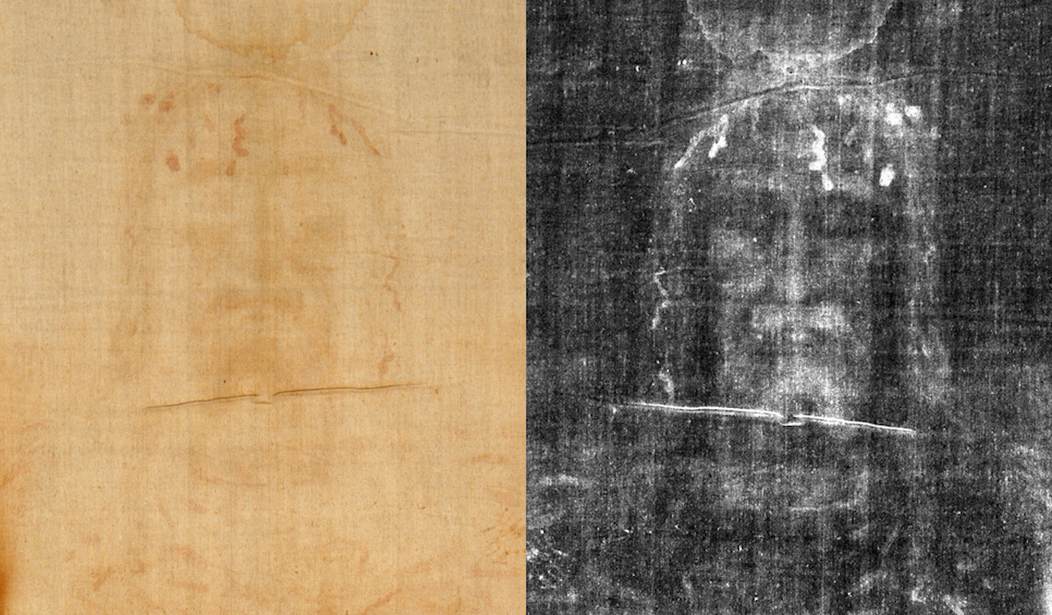
There are undisputed scientific facts about this 14-foot-long linen’s physical properties, including its blood stains and the faint front and back images of a crucified man. The man’s mysterious image is so superficial that it affects only the top 1 percent of the threads where it is visible, without any known artistic process. In other words, the Shroud image does not penetrate the cloth; it rests on top of it. That is why there is no visible trace of paint, ink, dye, pigment, or stain to explain the image, indicating that the Shroud is not the work of an artist.
MA: What is known about the blood that soaked through the linen Shroud cloth?
RB: The blood chemistry from the Shroud reveals 13 different blood components, including bile, bilirubin, hemoglobin, and serum albumin, and appears to be the exudate from actual wounds. Additionally, there is no image under the blood, indicating that the blood had soaked into the cloth before image formation. This makes sense if we assume the Shroud is the authentic burial cloth of the historical Jesus — crucified on Good Friday and risen on Easter Sunday. However, it makes no sense in the work of an alleged artist, as critics claim.
MA: Why is your new Shroud book different?
RB: In “Beneath the Surface,” I take a position that the Shroud is most likely authentic, so it is reasonable to ask, “What does it mean?” The phrase “Beneath the Surface,” in the context of this book, means going beyond basic facts to explore the Shroud’s true purpose and consider its implications.
For example, the entire Resurrection story begins with the Shroud. This is a vitally important point: John became the first of the Apostles to believe that Jesus had risen, and that belief was based on seeing the empty linen cloth lying in the tomb, as recorded in John 20:1-9. It is not reasonable to think the linen cloth left behind in the tomb was only for the benefit of Peter and John. As a “gospel written on linen,” it was left for the entire world.
In his 1998 address at the Turin Cathedral, Pope John Paul II described the Shroud as a "mirror of the gospel.” I have always found this description intriguing. The Shroud perfectly reflects everything that happened to Jesus according to the written record. It is how we can answer the question: “Could the man on the Shroud be Jesus?”
MA: How does the Shroud augment the gospel accounts of Jesus’s torment?
RB: I am glad you asked, because, curiously, Scripture does not provide a graphic portrayal of what happened. Perhaps this was intentional to focus on the theological implications rather than the gruesome details of his horrific public execution. However, the Shroud, fulfilling its role as a “gospel written on linen,” or a “mirror of the gospel,” fills in major blanks needed for a complete understanding of this violent ordeal. If a picture is worth a thousand words, then the Shroud is an encyclopedia.
MA: Could you elaborate on the important point about the “mirror”?
RB: What is intriguing about a mirror is that it can also magnify and reveal details that are not visible in a standard reflection. In fact, the Bible is remarkably understated. “Then Pilate had Jesus scourged” (John 19:1). That’s it? Yet the Shroud reveals the massive whipping inflicted upon him. The extent of the full-body scourging seen on the man in the Shroud often brings believers to tears.
“Then they twisted together a crown of thorns and placed it on his head and mocked him as King of the Jews” (Matthew 27:29). Over 30 puncture wounds on the Shroud reveal where the soldiers beat the thorns into his head with sticks.
“Finally, Pilate handed him over to them to be crucified” (John 19:16). On the Shroud, we see the nail wounds in the feet. Also seen is the nail wound in the wrist, consistent with medical experiments showing that a nail through the palm of the hand will not hold the weight of a crucified man for very long. No thumbs are visible, only four fingers. The same experiments show that a nail through the wrist would cut the median nerve, causing a reflexive retraction of the thumb into the palm.
MA: Besides the greatest mystery of how the image of a crucified man was formed, the second greatest is the photographic image. Can you elaborate on that?
RB: In 1898, the Shroud was photographed for the first time. When it was developed in a “darkroom,” the image appeared clearer and more lifelike on the “photo negative” than on the Shroud cloth. The “photo negative” looks like a black-and-white positive image, and today, what is called the “Holy Face” speaks to people and is one of the most reproduced images in the world. This black-and-white Shroud image, which had remained hidden until the new technology of photography was applied in 1898, remains an unexplained phenomenon that propelled the Shroud into the scientific arena.
MA: What is your Easter message to Townhall readers? (Besides, read your three books to learn more.)
RB: It is common to hear that the Shroud was the “first selfie,” given its unforgettable face of peace and dignity, a nanosecond before Resurrection. But above all, think of the Shroud as a gospel written on linen uniquely preserved by God and revealed for our day, especially for unbelievers. As Jesus said to Peter, in a verse often associated with the Shroud, ask yourself: “Who do you say that I am?”
MA: Russ, on behalf of Townhall, thank you for your thoughts as we celebrate Resurrection Sunday.
Special note: If you're planning a trip to Orlando, Florida, before the end of September, I encourage you to visit a Shroud exhibit that I produced at Mary, Queen of the Universe Basilica. Admission is free, and the exhibit is open daily from 10 to 4. Russ Breault loaned us a three-foot panel from a table on which the Shroud rested for 120 hours in 1978. You can touch this piece of steel that touched Jesus if you believe that the Shroud is His burial cloth.
Myra Kahn Adams is a conservative political and religious writer. Her book "Bible Study For Those Who Don't Read The Bible" reprints the first 56 volumes of this popular study. "Part 2," reprints Vols. 57 –113. Order it here.
Myra is also the Executive Director of the National Shroud of Turin Exhibit. You can help support our new six-month exhibit at the Basilica in Orlando, Florida. Contact: Myraadams01@gmail.com
Editor’s Note: Do you enjoy Townhall’s conservative reporting that takes on the radical Left and woke media? Support our work so that we can continue to bring you the truth.
Join Townhall VIP and use promo code FIGHT to receive 60% off your membership.

Join the Conversation
VIP members get the ability to comment on articles.