





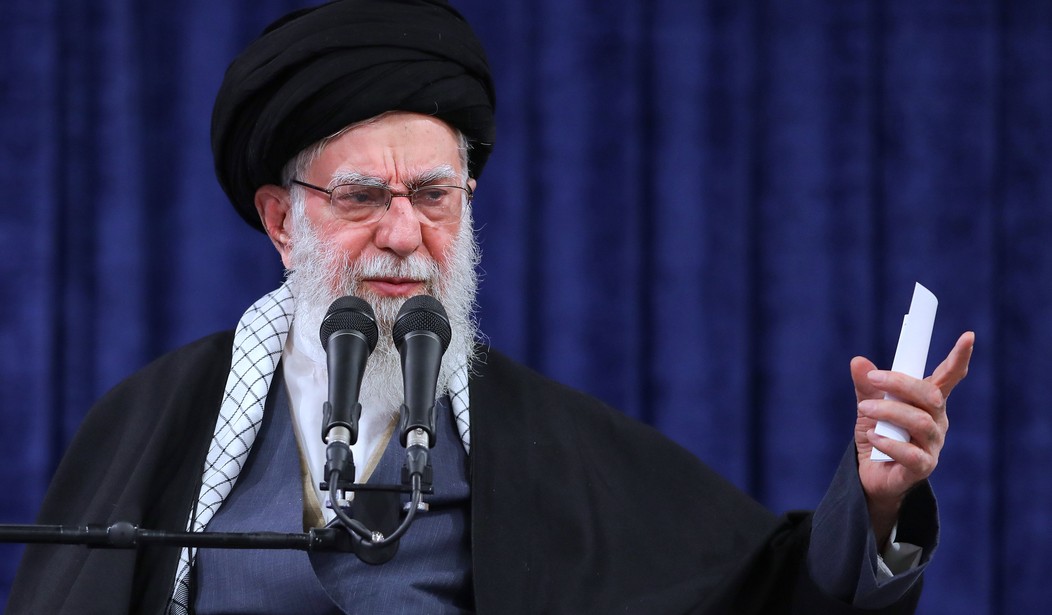
Ayatollah Ali Khamenei, Iran’s Supreme Leader for more than three decades, is dead at 86.
Within hours, major American newspapers did what they often do when a powerful authoritarian dies. They reached first for tone and texture. One headline described him as the “hard-line cleric who made Iran a regional power.” Another obituary noted his “bushy beard,” fondness for Persian poetry and classic Western novels.
At Townhall, we are not interested in literary garnish.
Ali Khamenei was not simply a “hard-liner.” He was the central figure in a theocratic regime that brutalized its own citizens, exported terrorism, and made hostility toward the United States and our allies a governing principle.
His regime armed proxies whose explosives tore through American armored vehicles in Iraq. The consequences were measured in folded flags and grieving families. That record belongs to him.
The hands of his corpse are permanently stained with innocent American blood.
If we are going to write honestly about his life, we begin with the victims.
During Khamenei’s tenure, student protesters were shot and jailed. Demonstrations in 1999, the Green Movement in 2009, nationwide unrest in 2017 and 2019, and the uprising that followed the death of Mahsa Amini were all met with force. Women were beaten and imprisoned for defying compulsory veiling laws. Dissidents disappeared into prisons such as Evin, where torture has been widely documented. Religious minorities, including Baha’is and Christians, faced systematic persecution.
This was not an incidental feature of his rule worthy of merely a footnote in The New York Times. It was the system he relied upon for total theocratic control.
Yes, Iran "expanded its regional influence" under Khamenei. That influence came through Hezbollah in Lebanon, Shiite militias in Iraq, direct support for Bashar al-Assad in Syria, and backing for the Houthis in Yemen. It came through weapons, training, financing, and a strategy of proxy warfare that destabilized neighbors and threatened American interests.
Iranian-supplied explosives killed American service members in Iraq. Israeli civilians endured rocket fire funded and armed by Tehran. Gulf allies faced constant subversion. The regime’s chants of “Death to America” were not rhetorical flourishes. They reflected an ideological posture that defined the Islamic Republic for decades.
Calling that record the construction of a “regional power” may be descriptively accurate. It is not morally neutral.
Elite media institutions tend to assess leaders through the lens of state power and geopolitical impact. Did he consolidate authority? Did he expand influence? Did he alter the balance of power in the region?
Those are fair questions. They are not the only ones that matter. More importantly, they have no place in a legacy-defining obituary. Save that navel-gazing drivel for a barely-read think-piece two weeks from now.
Power without liberty is not an achievement. Influence built on repression is not a legacy to admire. Effectiveness in consolidating control does not elevate a ruler into a statesman.
At Townhall, we are unapologetically pro-American. We are unapologetically pro-Western. And we are unapologetically on the side of the Iranian people, heirs to one of the world’s great civilizations, who have endured decades of clerical rule that denied them basic freedoms and economic opportunity.
Khamenei claimed divine authority and ruled as though accountable only to heaven. The result was not renewal but decay. Under his grip, Iran endured economic stagnation, entrenched youth unemployment, and waves of capital flight brought on by corruption, sanctions tied to regime aggression, and suffocating state control. Young Iranians grew up under censorship, morality patrols, and an intelligence apparatus that monitored thought as much as action. The nation’s most talented engineers, doctors, and entrepreneurs did not see opportunity in Tehran. They saw escape routes. A regime confident in its legitimacy does not hemorrhage its own future. His did.
These are undeniable facts. It is the only way to eulogize a monster like him.
Instead, what we saw from the dying legacy news at The New York Times and the Washington Post was the editorial instinct to soften hard facts, providing a cosmetic treatment of a bloody history. You can practically hear the voices in the editorial team's Slack workspace screaming, "Who are WE to judge???"
Ali Khamenei ruled through repression. He sustained a revolutionary ideology openly hostile to the United States. He oversaw a security apparatus that answered not to voters but to a rigid theocratic vision.
When the facts are this stark, anything less than plain language misleads.
His death does not require romantic language. It requires clarity.
If there is hope in this moment, it lies not in the record of the Supreme Leader, but in the courage of the Iranian people who have repeatedly risked their lives to demand something better.
They are the story.
Not the poetry. Not the headlines about power.
The people who endured him are the measure of his rule.
At Townhall, we will continue to cover events like this with clear eyes and unapologetic allegiance to America and her allies, a perspective that would never survive the editorial meetings of The New York Times, and we thank God for that.
Editor’s Note: Do you enjoy Townhall’s conservative reporting that takes on the radical Left and woke media? Support our work so that we can continue to bring you the truth.
Join Townhall VIP and use promo code FIGHT to receive 60% off your membership.


Join the Conversation
VIP members get the ability to comment on articles.