





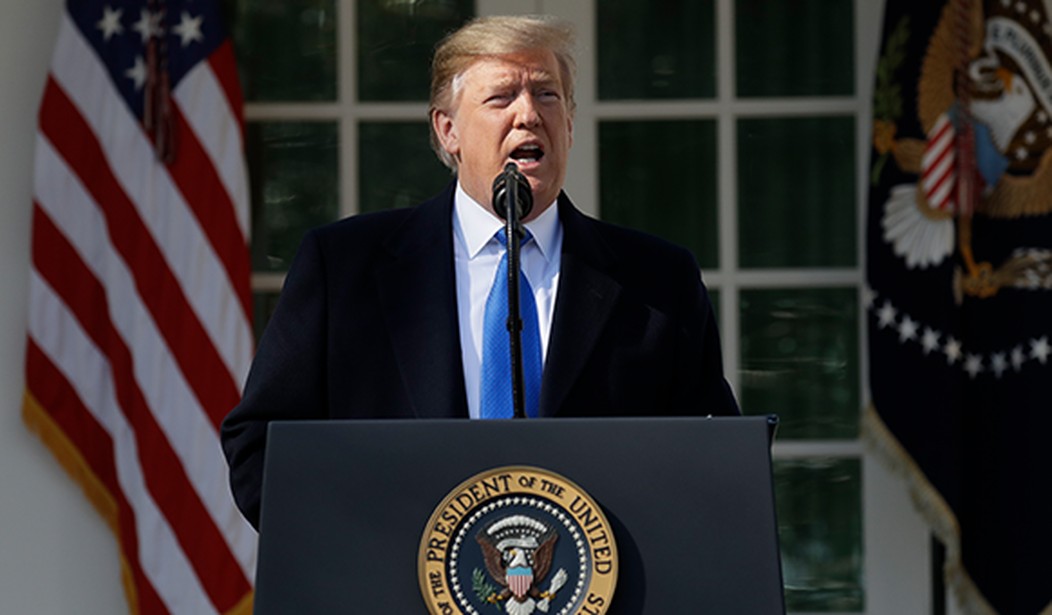
The president's decision to declare a national emergency at the southern border was an act of weakness, not strength.
I understand that's not the party line, but it's an obvious political fact. When Barack Obama used his pen to give "Dreamers" a reprieve from prosecution, it was an act of weakness, too.
Powerful presidents enact their agendas through Congress, not executive orders. It's why they usually manage to get their big-ticket items passed shortly after an election, when they can declare a mandate. Executive orders aren't as lasting because they can be overruled by Congress and future presidents.
President Trump declared an emergency in part to conceal his weakness. The bipartisan deal to provide even less funding for border security than what was offered to the White House before the shutdown was an unadulterated defeat for the president. If Trump hadn't declared a national emergency the same day he signed the legislation, all of the headlines would reflect that. It was an effective way of changing the subject.
It's also grotesque.
Yes, the White House has better legal arguments than many of Trump's most vociferous opponents claim. Since the National Emergencies Act of 1976 was signed by Gerald Ford, there have been 58 national emergencies declared under the law, and 31 of them are still in effect.
As Trump noted in his Rose Garden announcement, "there's rarely been a problem" with past emergency declarations. "They sign it; nobody cares. I guess they weren't very exciting. But nobody cares. They sign it for far less important things in some cases -- in many cases."
But that's the point. Most emergency declarations haven't been very exciting, precisely because they were uncontroversial, dealing mostly with such things as narrow sanctions on international crime.
Under a different emergency power, President Obama declared a national emergency in 2009 to combat the swine flu. The logic was that Obama needed flexibility to act quickly, without waiting for Congress, and was based on the assumption that if Congress were capable of acting quickly, it would have approved the measure.
That's not the situation here. Congress did act. In a bipartisan vote, it expressed its will on what should -- and should not -- be done at the border.
The president could have vetoed the deal, shutting down the government for a second time. But he didn't. Instead, Trump signed the legislation, then announced that he was unilaterally going to do what he wanted to do anyway.
I don't like the legislation, and I certainly do not blame Trump for disliking it. But that's beside the point. Congress had spoken.
The president's formal justification is that the situation at the border is a national security emergency requiring a military response. But as constitutional lawyer (and my National Review colleague) David French pointed out, our border arrangement with Mexico is a civilian enterprise.
The border wall isn't a military fortification, and the border is policed by civilian agents. Crime prevention in the U.S. is not a military mission. "The president waving his hands and citing 'national security' doesn't change any of these facts," French wrote.
Trump even admitted that the whole thing is a farce, that it's not really an emergency. "I didn't need to do this," he told NBC's Peter Alexander, "but I'd rather do it much faster." You could almost hear the cheers ringing out from all the lawyers gearing up to challenge this in court.
All the emergency-power laws that Congress has passed over the decades give the executive branch powers it should not have. But with a few exceptions, they've been more annoying than dangerous. Not so here.
Trump has decided that not getting a political win from Congress justifies the use of monarchical powers to deploy the military on U.S. soil. It is, flatly, an abuse of power.
The fact that so many Republican members of Congress are fine with it is further evidence that both Congress and the Republican Party have become a nest of capons -- and even weaker than that strutting rooster in the Rose Garden.



Join the Conversation
VIP members get the ability to comment on articles.