







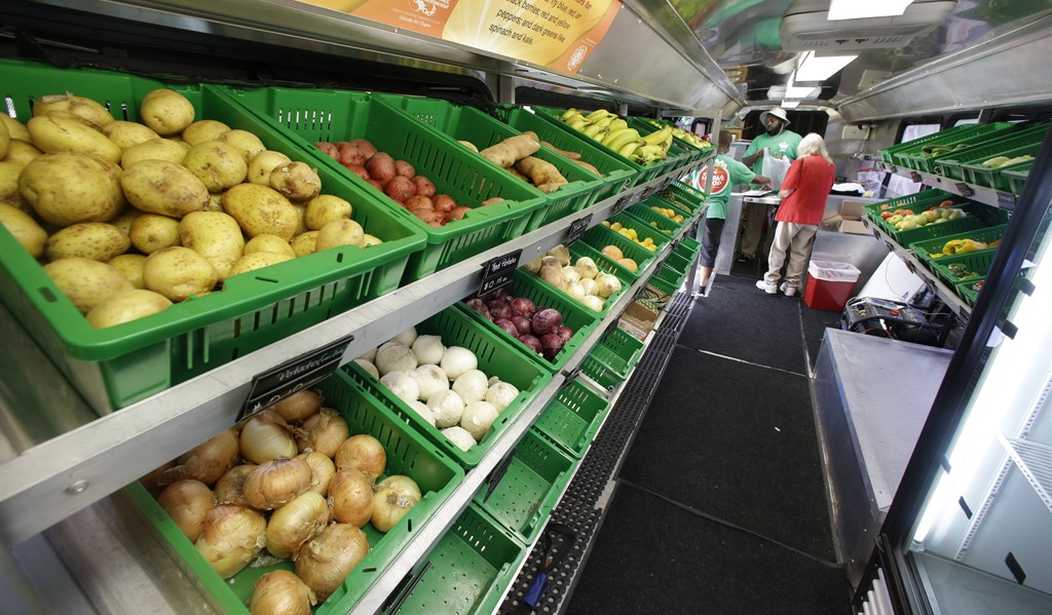
President Joe Biden says 24 million Americans "suffer from food insecurity!"
News anchors were shocked that there is "food insecurity in the richest country in the world!" ABC hosts turned "insecurity" into "hunger."
But in my new video, Rachel Sheffield, who researches welfare policy at the Heritage Foundation, explains, "Food insecurity is not the same thing as hunger. It just means that they had to rely on cheaper foods, store-brand alternatives ... or reduce variety."
Really? The alarm about "food insecurity" is based on that? Well, yes. Even the U.S. Department of Agriculture, in its fine print, admits that "for most food-insecure households, the inadequacies were in the form of reduced quality and variety of food rather than insufficient quantity."
"They always want to create a crisis," I say to Sheffield.
"Government programs want to keep themselves going," she replies.
She's talking about the Supplemental Nutrition Assistance Program; the Women, Infants and Children program; the National School Lunch Program and the other constantly growing handouts that make up America's welfare system.
The biggest effect of these handouts is to harm the people they want to help. They harm people by making them dependent on government.
Before government's War on Poverty began, Americans were steadily lifting themselves out of poverty. Year after year, the number of people living below the poverty line dropped.
That natural progress wasn't good enough for us.
We (I include myself because I believed it, too) who wanted to reduce poverty declared "War on Poverty." Welfare checks poured out. The poverty rate continued to drop for seven years. But then progress stopped.
What happened? Why did progress stop?
Because handouts taught people to be dependent.
Welfare payments did something remarkable. They created a new class of dependent people -- a nearly permanent "underclass," where generation after generation lives in poverty.
Today, government does things to perpetuate that, like claiming millions of Americans are "food insecure." Charities raise money using the same language.
But the opposite is true.
"Americans consume too many calories," says Sheffield. "Food insecure" adults are more likely to be obese.
When that became obvious, activists promoted a new myth: Poor people are overweight because they live in "food deserts," neighborhoods where healthy foods are much less available. Michelle Obama talked about that a lot. She claimed some poor people had to take three busses to buy healthy food.
Nonsense.
When government officials first labeled "food deserts,' they deviously ignored small stores, only counting stores with more than $2 million in sales. It's true that one "food desert" Obama visited didn't have a supermarket. But it had multiple smaller businesses selling fruits and vegetables. Government officials just didn't count them.
Now the media claim college students are food insecure.
But most college goers gain weight at school! At school!
It's bizarre that when obesity is the bigger problem, government hypes food insecurity. But of course, "that creates the rationale for expanding food assistance programs, expanding the welfare system," explains Sheffield.
Expanding welfare seems to be the government's goal. "We've spent more on the War on Poverty than all the military wars combined in the United States without any success," says Sheffield.
Really? More than all our wars combined? Well, yes. We've spent $23 trillion on the War on Poverty. So far.
"Actually," says Sheffield, "it's been a success in one way. It increases dependence on the federal government." That's what bureaucrats consider success.
The handouts are good for the people who dole out the money. They're good for politicians who get to look like "good guys."
But they're bad for poor people.
Before government handouts began, private charities helped people escape poverty. They encouraged people to learn how to take care of themselves. Work gradually lifted people out of poverty. "Work also has a lot of other benefits," Sheffield points out. "It builds a greater sense of community, gives people access to resources and friend networks that help them improve in their lives."
Encouraging self-sufficiency is so much better than what government does.


Join the Conversation
VIP members get the ability to comment on articles.