





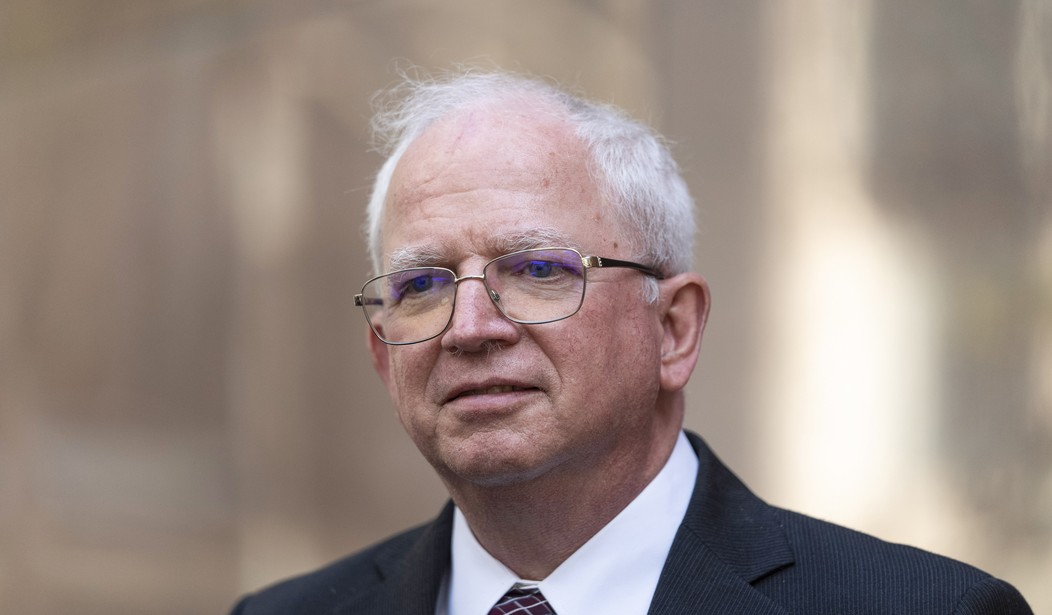
Months ago, we told you the fight to defend Professor John Eastman was headed to the Supreme Court of the United States. Today, the American Center for Law and Justice (ACLJ) filed a petition for a writ of certiorari asking the Supreme Court to review — and reverse — the disbarment of Professor Eastman by the State Bar of California, a decision the California Supreme Court summarily let stand without so much as an opinion.
This is not a case about relitigating the 2020 election. It’s a case about whether a state can strip a lawyer of his license — and his livelihood — because government officials disagreed with the legal arguments he made on behalf of his client. If that can happen to John Eastman, it can happen to any attorney in America who takes on an unpopular cause.
In the wake of the 2020 election, Professor Eastman, a constitutional scholar and former law school dean, represented President Trump in a number of election-related challenges involving issues of first impression upon which no court had weighed in. He was thereafter disbarred by the California Bar following disciplinary proceedings arising from his legal advice, public advocacy, court filings, and speeches regarding the 2020 presidential election. That decision was erroneously upheld by the California Supreme Court.
No court sanctioned Professor Eastman for any of his legal positions, yet the California Bar disbarred him anyway. In essence, Professor Eastman was disbarred for exercising his free speech rights and providing legal counsel to President Trump in the aftermath of the election.
Our petition emphasizes:
"Censorship at its most pernicious targets not merely disfavored ideas, but the persons who dare to voice them. And since attorneys are often essential advocates for disputed propositions, censoring their arguments is especially effective, and therefore especially dangerous. This Court’s review is crucial to halt the rising trend of politicized bar disciplinary proceedings."
Here is the heart of our petition. The California Review Department itself acknowledged that Professor Eastman’s charged statements involved core political speech and that strict scrutiny — the most demanding standard in constitutional law — applied. But in the same breath, it said its “focus” would remain on whether Professor Eastman’s statements violated professional-conduct rules, regardless of what strict scrutiny required. It then evaluated his conduct not by asking whether California had proven a compelling interest and narrow tailoring for each statement, but by asking whether his conduct was “objectively reasonable” for an attorney.
That’s not strict scrutiny. That’s a negligence standard dressed up in constitutional language. As the Supreme Court held just last year in Chiles v. Salazar, the First Amendment “is no word game” — a state cannot relabel a speech restriction as professional-conduct regulation to dodge the scrutiny the Constitution demands. The Review Department did exactly what Chiles forbids: It treated the constitutional standard as optional and substituted a deferential, after-the-fact reasonableness inquiry for the individualized, statement-by-statement analysis strict scrutiny requires.
Worse, the Review Department expressly refused to evaluate the charged statements one by one. It said it would not “compartmentalize” Professor Eastman’s conduct — even though the Supreme Court has long required precision of regulation whenever protected advocacy is intertwined with alleged misconduct. Ten counts, different forums, different audiences, different legal theories, all blended into one undifferentiated judgment and one maximum sanction: permanent disbarment.
A second, equally fundamental error runs throughout the decision below. The California Bar and the Review Department treated Professor Eastman’s contested constitutional arguments — regarding the vice president’s role under the 12th Amendment and the Electoral Count Act, about the significance of competing slates of electors — as knowing factual misrepresentations. But the Constitution has never allowed the government to punish a legal opinion by calling it a lie simply because it lost.
The Supreme Court has always drawn a sharp line between statements of fact, which can be proven true or false, and legal argument or opinion, which cannot. Professor Eastman’s theories had scholarly support in law review articles written well before 2020, including from scholars who ultimately disagree with his conclusions. Lawyers advance untested, even long-shot, arguments all the time — it’s called advocacy.
Treating a losing legal argument as evidence of moral turpitude punishes the very process by which constitutional law develops and gives no lawyer fair notice, in advance, of where protected advocacy ends and career-ending discipline begins.
This case is not about whether you agree with Professor Eastman’s legal theories. It’s about whether the government can weaponize a lawyer’s license against him because officials didn’t like the side he was on. If the decision below stands, no attorney will be able to know, in advance, where zealous advocacy ends and professional ruin begins. Lawyers will think twice before representing an unpopular client, testing a novel constitutional theory, or petitioning government officials on a contested matter of public concern — exactly the representation our adversarial system depends on.
We’ve seen where this leads elsewhere in the world, where regimes go after the lawyers first because silencing counsel is the most effective way to silence a cause. That is not the model for the United States. The Constitution does not allow state bars to punish attorneys for the arguments they make on behalf of their clients, only for genuine fraud, deceit, or misconduct — and California proved none of that here.
We said:
"The First Amendment forbids what California has done. This case is not about one attorney or one State’s disciplinary judgment. It is about whether lawyers across the Nation may be ejected from their profession for taking the “wrong” side of a public controversy. If California’s decision stands, then every lawyer who represents an unpopular client, presses a contested theory, or petitions government officials in a politically charged matter will practice under the shadow of professional ruin. The unmistakable message: advocate for the disfavored side, and a state bar may recast your arguments as dishonesty, fraud, or moral turpitude. That threat imperils the independence of the bar and chills zealous representation in the cases where it is needed most."
We are asking the Supreme Court to grant review, reverse the decision below, and make clear that the First Amendment means what it says — even, and especially, when the speech is unpopular.
Take action with us at the Supreme Court. Sign our petition: Stop the Left From Disbarring Conservative Lawyers.



Join the Conversation
VIP members get the ability to comment on articles.