







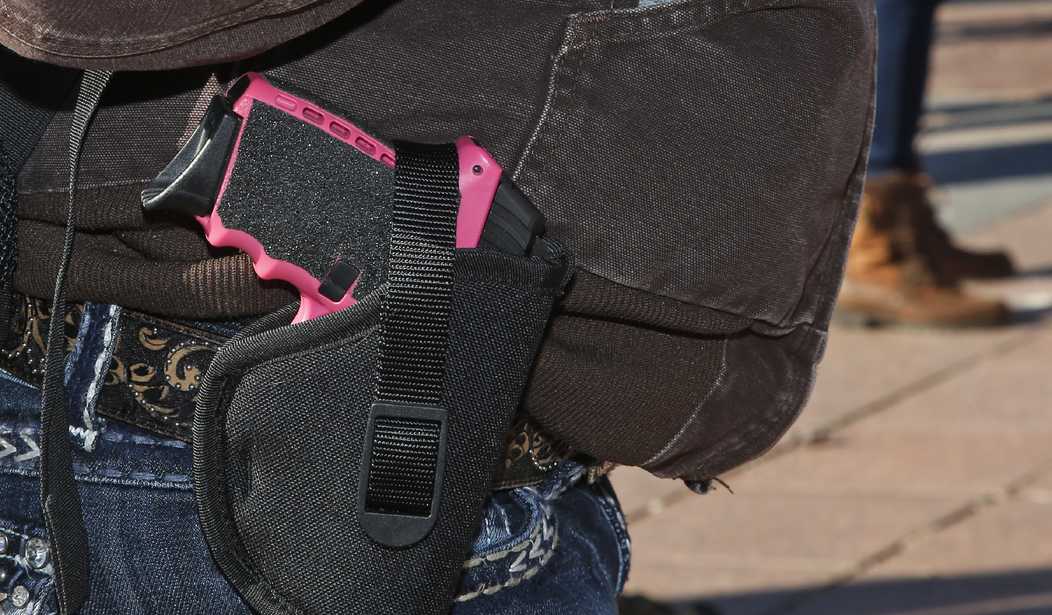
Most states respect the constitutional right to carry guns in public for self-defense, which the Supreme Court upheld in June. But some states are only pretending to comply with the Second Amendment, as illustrated by the law that New York passed after that decision and a similar bill that legislative leaders in New Jersey introduced last week.
In an Oct. 6 ruling, U.S. District Judge Glenn T. Suddaby rejected New York's attempt to defy the Constitution and the Supreme Court. Although New York eliminated a demand that carry permit applicants show "proper cause," which the Court said gave licensing officials too much discretion, the state retained and elaborated on a requirement that applicants demonstrate "good moral character."
That amorphous standard, Suddaby noted, is based on "undefined assessments" of "temperament," "judgment" and trustworthiness. New York "has replaced its requirement that an applicant show a special need for self-protection with its requirement that the applicant rebut the presumption that he or she is a danger," he wrote, "while retaining (and even expanding) the open-ended discretion afforded to its licensing officers."
Under New York's law, the assessment of "good moral character" includes an examination of the applicant's online comments. As the gun owners who are challenging the law see it, that inquiry violates the right to freedom of speech as well as the right to bear arms, making the latter contingent on how applicants have exercised the former.
Suddaby issued a temporary restraining order against enforcement of the "good moral character" criterion, including the state's demand for information about applicants' social media accounts. He also took a dim view of New York's sweeping, location-specific bans on firearm possession, which made it legally perilous even for permit holders to leave home with a gun.
Applying the standard prescribed by the Supreme Court, Suddaby said many of those restrictions seemed inconsistent with "this Nation's historical tradition of firearm regulation." He concluded that the state's prohibition of guns in settings such as bars, restaurants, entertainment venues, gambling facilities, stadiums, parks, playgrounds, zoos, libraries, museums and public transportation probably failed that test.
Unfazed by that warning, New Jersey Senate President Nicholas Scutari (D-Linden) and Assembly Speaker Craig Coughlin (D-Woodbridge Township) have unveiled legislation that closely resembles the law that Suddaby deemed constitutionally dubious. Like New York's law, their bill would impose a subjective standard for carry permits and ban guns from myriad places where people might want to carry them for self-protection.
To obtain a carry permit, an applicant would have to persuade the police that he does not pose a threat to himself or others. Toward that end, he would have to undergo an interview and submit any information that local or state police officials deemed relevant, including "publicly available statements posted or published online by the applicant."
Suddaby explicitly rejected both of those requirements in New York. And while the threat assessment that Scutari and Coughlin imagine may not be quite as open-ended as New York's "good moral character" test, it likewise gives licensing authorities wide discretion to reject applications based on subjective judgments, including inferences from opinions an applicant has expressed.
Scutari and Coughlin's list of gun-free locations is even longer than New York's, and it includes many restrictions that Suddaby thought the state had failed to justify. In addition to banning guns in specified places, the bill would prohibit them on private property, including homes as well as businesses, unless the owner expressly allows them and posts a sign to that effect -- another rule that Suddaby rejected.
These regulations, Democrats bragged, will make New Jersey "the toughest in the nation when it comes to concealed-carry laws." Coughlin said, "We're doing this because we know gun safety does not conflict with safe gun ownership."
Despite Coughlin's assurances, his idea of "gun safety" plainly conflicts with what the Supreme Court has said about the right to bear arms. He may find that judges cannot be fooled as easily as he hopes.


Join the Conversation
VIP members get the ability to comment on articles.