







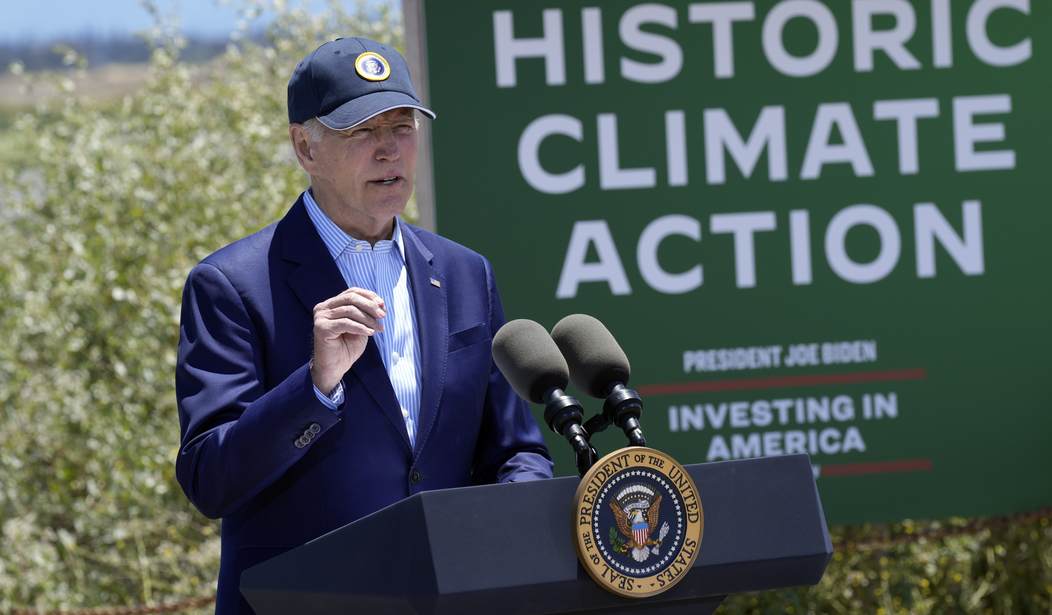
Preservationist environmentalists believe the U.S. faces an existential climate crisis through continued fossil fuel use. They decry opposition to net-zero goals as heresy and say we’re complicit in destruction.
But what if these preservationist “clean energy” policies are inviting an actual environmental crisis?
The Biden administration desires to go fully net-zero by 2050 and reduce emissions by 1.5 degrees Celsius, although this transition would result in a measly 0.2 degree Celsius reduction by 2100. All the while collapsing our economy.
They’re adamant about decarbonization at all costs–no matter the ecological and economic impacts.
Scaling up offshore wind is a big Biden White House priority. They want to harness 30 gigawatts of offshore wind by 2030,
Offshore wind, however, isn’t doing so hot these days–even with “Inflation Reduction Act” subsidies. This week, Connecticut’s proposed Avagrid project was canceled. Bloomberg News reports, “Avangrid Inc. agreed to pay $16 million to exit contracts for a New England offshore wind farm that has become “unfinanceable” after inflation and supply-chain issues drove up costs…” This is just one of many Atlantic Coast projects that have been canned.
And while the Biden administration claims whale deaths aren’t connected to offshore wind exploration, even NOAA scientists like Sean Hayes aren’t taking the bait. In a May 2022 letter, he wrote: “The development of offshore wind poses risks to these species…”
I highlighted this paradox in my latest CFACT Conservation Nation video report this week, interviewing stakeholders - including recreational fishermen - who worry the wind will negatively impact their livelihoods and ocean access.
Environmentalist groups don’t mind wind developers requesting 40 Incidental Harassment Authorizations (IHA) to the detriment of the Marine Mammal Protection Act (MMPA) since 2016. Endangered and non-endangered whales be damned!
Like offshore wind, onshore wind is equally problematic. Two conservation documentarians, Yucca Films’ Ron Kendall and Eli Rosen, recently captured footage of the “world’s largest collection of unwanted wind turbine blades” in Sweetwater, Texas. The party responsible is Global Fiberglass Solutions, a company formerly contracted with General Electric (GE) to dispose of blades.
Kendall explained in a recent District of Conservation podcast episode, “One particular video we did was in Sweetwater, Texas, showing it’s around a 20-acre graveyard…And we're seeing, you know, in the Sweetwater area, that wind turbine farm is just around ten years old. So we're seeing about a 10-year lifespan on these blades.”
Texas Monthly caught wind of their footage and reported last month: “GE says it paid the company $16.9 million to recycle about five thousand wind turbine blades, but that GFS instead stockpiled them at facilities in Sweetwater and Iowa.” But the Texas publication added GE cleaning up the blades “wouldn’t clean up the giant dump” because “blades manufactured by other companies would still remain.”
Onshore wind projects come with many negative tradeoffs: disrupting wildlife corridors, tainting underwater aquifers, encroaching on sacred ground, and destroying high-value agricultural land.
“Wind turbine blades make noise as they turn in the wind, and some people do not like the sound. Birds and bats can be injured or killed if turbine blades hit them. These deaths may contribute to declines in the population of species…,” cautioned the U.S. Energy Information Agency (EIA). “Most land-based wind power projects require service roads that add to the physical effects on the environment. Producing the metals and other materials used to make wind turbine components also impacts the environment, and fossil fuels may be used to produce the materials. Although most of the materials used to make wind turbines can be reused or recycled, turbine blades, as most are currently constructed, cannot be recycled.”
Scaling up solar “farms” (solar energy facilities) is also problematic. Like wind, solar lacks a 24/7 energy baseload. It’s also expensive to install. These facilities do occupy and destroy acres of high-value land.
A 2022 RealClear Investigation report revealed scaling up these facilities could lead to deforestation and destruction of land spanning 3,900 square miles. Princeton University also warned acreage for solar facilities, equivalent to the size of Virginia, would be destroyed to achieve net-zero goals by 2050.
There’s another dark side of solar: its photovoltaic (PV) panels boast hazardous waste materials containing heavy metals. CNBC revealed 90% of end-of-life solar panels “end up in landfills, largely because it costs far less to dump them than to recycle them.”
Ironically, for clean energy proponents, a 2019 study warned between 2030 and 2060, “9.8 million metric tons of solar panel waste are expected to accumulate.” And lest we forget, threatened desert tortoises could lose critical habitat if these projects proceed.
The hasty push to transition from reliable conventional energy to costly, unreliable renewables could spur an environmental crisis of epic proportions. No amount of wishcasting, storytelling, or subsidies can conceal the ugly truth about solar and wind.
We don’t need to destroy the environment in order to “save” it.



Join the Conversation
VIP members get the ability to comment on articles.