





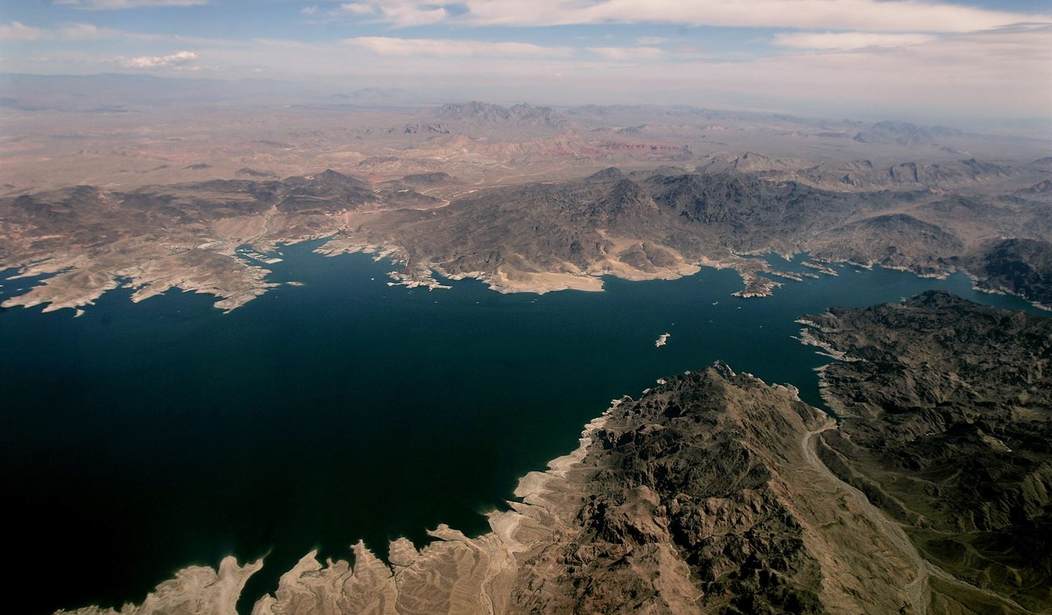
Back in May, Lake Mead had already dropped to 1,050 feet above sea level, which was 25 feet below its critical level of 1,075 feet. The huge reservoir, held in place by Hoover Dam, was just below 1,040 feet as of August 13. When the lake level falls to 1,035 feet, Hoover Dam will have to cut its power generation by 70 percent.
Upstream on the Colorado River, Lake Powell, held by Glen Canyon Dam, is at 3,520.37 feet, 179.63 feet below full. The lake holds just 22.6 percent of full capacity and is predicted to remain at near historic lows. The water level is just 30.37 feet above the minimum depth below which Glen Canyon Dam would have to restrict generating hydroelectric power.
Glen Canyon Dam’s eight generators normally provide about 5 billion kilowatt-hours of electric power (as much as 1,320 megawatts) to about 5 million people, including 53 tribes, across six states. Hoover Dam’s generators serve about 1.3 million people and businesses in California, Arizona, and Nevada.
Lake Mead provides irrigation and municipal water that supports about 30 million people and supports crop production across more than 5 million acres of farmland that helps grow food for an estimated 60 percent of the United States.
As Lake Powell is primarily a storage reservoir that releases water downstream, most direct large-scale irrigation diversions happen downstream via river intakes, canals, and projects. The combined contents of Lakes Powell and Mead have not been this low since before Glen Canyon Dam began filling in 1963; since 2000, water use has exceeded total system inflow in most years.
The dual water-power crisis prompted the U.S. Bureau of Reclamation to issue a Final Environmental Impact Statement on July 31 that designates a preferred course of action for future management of Lake Powell and Lake Mead. The Bureau admits that drought conditions in the Colorado River Basin over the past 25 years, combined with expectations of continued dry conditions, make development of future operating guidelines particularly challenging.
When the Colorado River Compact was created in 1922, 7.5 million acre-feet (maf) was apportioned to both the Upper and Lower Basins based on estimated pre-compact average inflow (1906-1921) of 18 maf. Inflows from 2000 to 2024 averaged only 12.9 maf, and the unregulated inflow into Lake Powell (based on 7 months) for 2026 is estimated to be just 3.5 maf.
During 2020-2024, average consumptive use in the Colorado River Basin was 13.1 maf, of which 1.4 maf went to Mexico, 1.4 maf was lost to evaporation, 6.5 maf (49 percent) went to the Lower Basin, and 3.8 maf (about half its original allocation) went to the Upper Basin (29 percent). Simply put, the West has a water problem that has also created a power generation threat.
The Bureau’s preferred alternative establishes an adaptive decision framework for developing operating guidelines to ensure reliable operations in the basin while maintaining flexibility to respond to changing conditions through 2036. The Bureau left room for the states to work towards consensus agreements that could be incorporated into future operations.
Sideboards in the proposed framework (key thresholds and ranges) provide for annual releases from Lake Powell between 5.0 and 12.0 maf, lower Basin shortages of up to 3.0 maf, the ability to store up to 8.0 maf (Lake Powell) and 3.0 maf (Lake Mead) of conserved water for future use, and the opportunity for voluntary Upper Basin conservation up to 200,000 acre-feet. Operating guidelines would be revised biennially in the absence of consensus-based agreements.
The Bureau’s action did not please Arizona and Nevada officials, upset that the proposal included up to 3 maf in annual Lower Basin water usage reductions – a move that (while perhaps necessary) could severely impact California farmers (and food prices).
Arizona Senate President Warren Petersen said that, while Arizona recognizes the inflow shortfalls, “What we will not accept is a federal plan that protects some states while placing a devastating and disproportionate burden on Arizona.” Negotiations among Compact states have failed repeatedly to meet deadlines, prompting several states (including Arizona) to build legal teams for potential litigation over the river’s water sharing.
By contrast, the Colorado River Board of California was sanguine about the proposal. Board chair JB Hamby said that communities and economies in impacted states have already grown while using less Colorado River water. “California’s use has fallen to its lowest level since 1949,” but the state and communities served by the river have grown to 19 million people and a $1.6 trillion Southern California economy.
The impacted states are not the only critics of the Final EIS. John Berggren, a spokesperson for Western Reserve Advocates, said “I’m glad Reclamation is doing something,” even though “it’s not the silver bullet.” Berggren had hoped for a “holistic, robust set of guidelines that puts the Colorado River on a sustainable path,” but called the proposal “a good step in the right direction.”
Despite Hamby’s optimism, California farmers could be forced to reduce acreage, switch from high-water-use crops (almonds, rice, some fruits) to less water-intensive crops, or let fields lie fallow. Livestock producers could face higher feed costs if hay and forage supplies tighten. Reduced yields and acreage could also lower farm revenues, especially for small and medium-sized operations and lower production could impact regional and national commodity prices.
CalMatters water reporter Rachel Becker called the Bureau’s plan a “band-aid, not a cure, that leaves states guessing every 2 years.” The plan suffers from the reality that, while the Interior Department can force cuts in water allocations to Lower Basin states, it has no comparable authority to impose cuts in Upper Basin states. “This,” concluded Becker, “isn’t the long-term plan that California’s water suppliers were hoping for.”
Should water levels fall further, forcing cutbacks in power generation at Hoover and Glen Canyon Dams, utilities will have to rely on more expensive fuels and would likely raise electricity prices – and electricity reliability — for millions of customers. Longer-term shortfalls could force utilities to invest in energy storage, transmission upgrades, and alternative generation.
Editor’s Note: Do you enjoy Townhall’s conservative reporting that takes on the radical Left and woke media? Support our work so that we can continue to bring you the truth.
Join Townhall VIP and use promo code FIGHT to receive 60% off your membership.



Join the Conversation
VIP members get the ability to comment on articles.