







According to the latest Department of Labor (DOL) report, 861,000 Americans filed initial unemployment claims for the week ending February 13. DOL also revised the previous week’s figure from 793,000 to 848,000.
This means over the past two weeks 1.7 million Americans have filed for first-time unemployment benefits.
Given the abysmal employment situation in the United States, due mostly to fallout from the coronavirus pandemic, the last thing Congress should do is more than double the national minimum wage.
However, that is a topic of contention on Capitol Hill.
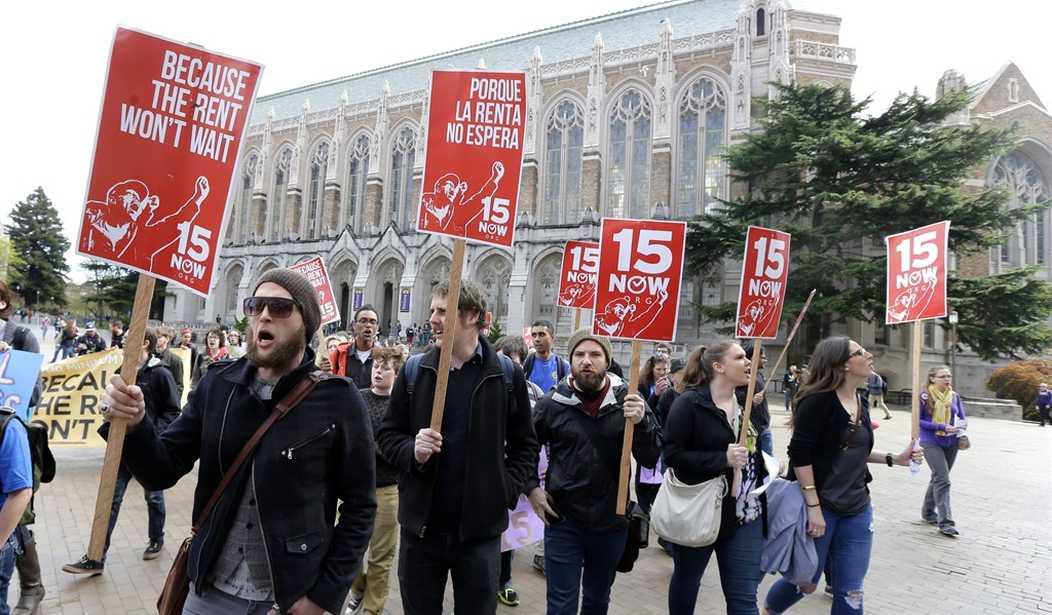
On January 26, Democrats in the U.S. House and Senate reintroduced the Raise the Wage Act, which would raise the federal minimum from $7.25 to $15 per hour.
According to Rep. Bobby Scott (D-VA), chairman of the Education and Labor Committee, “Even before the COVID-19 pandemic, the $7.25 federal minimum wage was economically and morally indefensible. Now, the pandemic is highlighting the gross imbalance between the productivity of our nation’s workers and the wages they are paid.”
Rep. Scott fails to articulate how the $7.25 minimum wage is economically indefensible because it is not. In fact, a national minimum wage makes little sense anyways.
Just think about it. A $7.25 minimum wage in rural Mississippi is very different from a $7.25 minimum wage in a place like New York City.
Instead of setting an arbitrary minimum wage that must be enforced throughout the nation, it would make much more sense for states and local governments to determine if a minimum wage is necessary in the first place.
And in terms of morality, one can make a strong case that a $15 federal minimum wage is immoral and would inflict more harm than good. From a utilitarian and practical perspective, a $15 national minimum wage is a terrible idea.
According to a recent report from the Congressional Budget Office, “In 2025, when the minimum wage reached $15 per hour, employment would be reduced by 1.4 million workers (or 0.9 percent), according to CBO’s average estimate.”
That is just the tip of the iceberg. “CBO estimates that there is a one-third chance of that effect’s being between about zero and 1.0 million workers and a one-third chance of its being between 1.0 million and 2.7 million workers.”
In other words, raising the minimum wage to $15 per hour would put at least 1.4 million Americans out of work, with a 33 percent chance of putting 2.7 million Americans out of a job.
How is that morally defensible?
Alas, that is not even the worst of it. According to CBO, “Young, less educated people would account for a disproportionate share of those reductions in employment.”
So, raising the national minimum wage to $15 would sideline millions of workers, including an outsized amount of young and less educated workers. Why in the world would the U.S. government do something that would adversely impact those who are trying to get a toehold in the workforce? It makes absolutely no sense.
CBO also estimates that, “Under the bill, Medicaid spending would increase,” as would, “Spending for unemployment compensation would increase under the bill because more workers would be unemployed.”
Furthermore, “Higher wages would increase the cost to employers of producing goods and services. Employers would pass some of those increased costs on to consumers in the form of higher prices, and those higher prices, in turn, would lead consumers to purchase fewer goods and services. Employers would consequently produce fewer goods and services, and as a result, they would tend to reduce their employment of workers at all wage levels.”
Across the board, a $15 national minimum wage would spell doom for the U.S. economy. It is neither economically nor morally defensible.
It would make it more difficult for young Americans to secure entry-level jobs, where they typically learn invaluable lessons. It would also put millions out of work while driving price increases for goods and services, ensuring that Americans, especially those at the bottom of the income ladder, struggle even more to make ends meet.
It is easy for out-of-touch politicians like Rep. Scott to pontificate about the wonders of a $15 national minimum wage. However, it would be terribly difficult for Americans to deal with the consequences that a $15 federal minimum wage would inflict upon an economy already teetering on the brink.
Chris Talgo(ctalgo@heartland.org)is an editor at The Heartland Institute.

Join the Conversation
VIP members get the ability to comment on articles.