







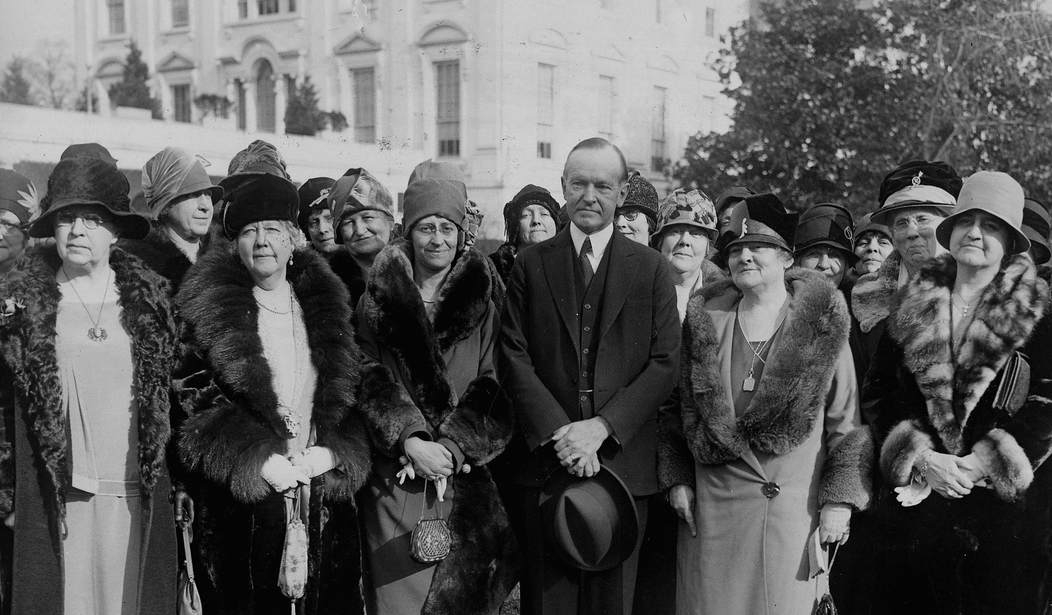
Last week's symposium in Washington, D.C., that marked the beginning of a year-long observance commemorating the 100th anniversary year of Calvin Coolidge becoming president contained too many important reminders of what the past can teach the present to be included in a single column.
Some of it has been posted on the Calvin Coolidge Presidential Foundation website, which sponsored the event.
There seems to be a certain conceit among some that the past is irrelevant to modern challenges. The opposite is true.
Activists, who are busy tearing down statues and renaming roads because of connections to slavery, and who support high taxes, would do well to consider the remarks of former Rep. Chris Cox (R-CA), who was among the event's speakers.
"America at the end of the Wilson administration," he said, "was beset with race riots, runaway inflation, violent strikes, and the federal government's trampling of civil liberties. In practice, progressive initiatives such as the income tax and Prohibition were proving to have very different effects on middle-class lives than progressive theory had anticipated. "
By the early 1920s there were 56 income tax brackets. What backers of a federal income tax had promised - that taxes would be paid only by "the rich" - proved untrue as those making as little as $20,000 a year had to pay.
Here is another lesson from Cox that ought to remind us Washington often contributes to more problems than it solves: "The difference between the ideal of Prohibition and the reality was just as jarring. It was supposed to reduce crime and corruption, and remedy all manner of social ills. But enforcement proved to be far beyond the capabilities of the federal government. And instead of solving old social problems, it created new ones."
Speaking of statues and names of streets, Woodrow Wilson's name has not been removed from the Woodrow Wilson Center and neither have streets named after him been changed. Lee Highway in Northern Virginia (for Robert E. Lee) is now Langston Boulevard, named for abolitionist John Langston.
Wilson opposed women's suffrage, while Coolidge supported it. Wilson supported segregating federal employees. As Cox reminded his audience: "(A) Wilson cabinet member, Josephus Daniels, had published the leading newspaper in Wilson's former home state of North Carolina. With that megaphone he promoted the notorious White Supremacy campaign that fomented the Wilmington Riots, killing more than 60 Black people in one day. Daniels celebrated the result with a jubilee. Wilson made him publicity chair for the 1912 presidential campaign, before appointing him secretary of the Navy."
On June 6, 1924, Coolidge spoke at Howard University in Washington. While the Ku Klux Klan was flourishing in parts of the country, Coolidge opposed the racist organization and was ahead of his time on civil rights: "...we are able now to be confident that this race is to be preserved for a great and useful work. If some of its members have suffered, if some have been denied, if some have been sacrificed, we are able at last to realize that their sacrifices were borne in a great cause. They gave vicariously, that a vastly greater number might be preserved and benefited through them. The salvation of a race, the destiny of a continent, were bought at the price of these sacrifices."
While critics claim Coolidge didn't follow through, preferring simply to articulate his idealism, he was nevertheless saying things opposed by many white Southern Democrats and the Klan. Some could credibly argue his words laid a foundation for the civil rights movement to come.
As Chris Cox noted: "Coolidge, upon taking office, saw what Wilsonian progressivism, if not the ideal of progressivism, had wrought. He also understood the popular mood that soundly rejected the results. When he and (President Warren) Harding were elected, it was with the greatest popular vote landslide in a century."
Is history repeating itself in our day with the failures of progressivism? If it is, will history repeat next year should voters reject the progressive agenda?



Join the Conversation
VIP members get the ability to comment on articles.