





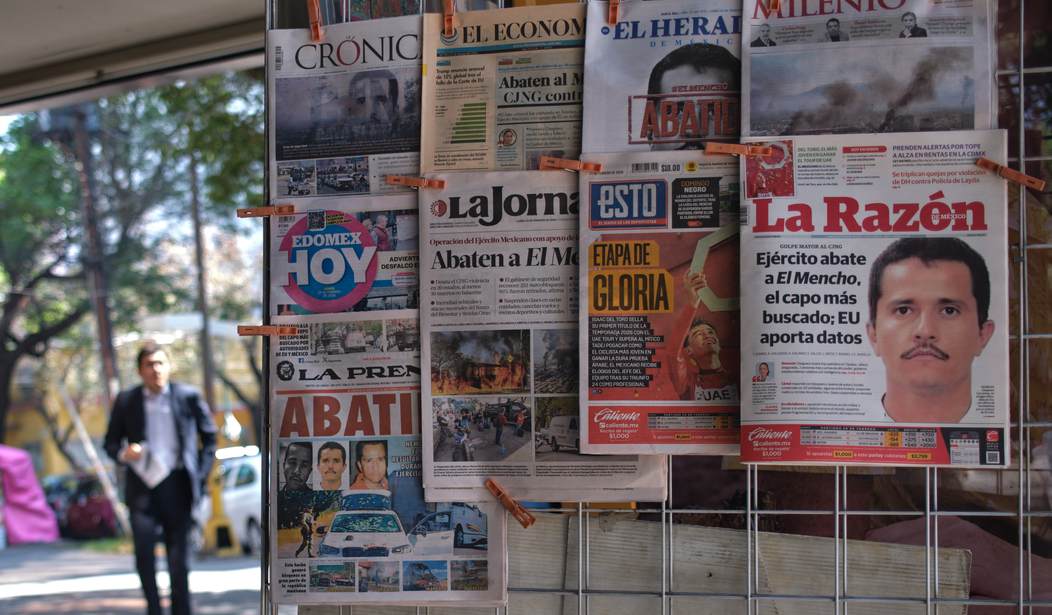
Anyone claiming that the killing of “El Mencho” in Jalisco on February 22 marks the end of organized crime in Mexico is sorely mistaken.
It is a major blow, without question. It carries enormous symbolic and operational weight. It also shatters part of the government’s previous narrative built around absolute sovereignty and categorical rejection of binational cooperation in confronting criminal groups designated as terrorist organizations.
But to assume this represents “the end” is, at best, naive.
Organized crime in Mexico is not a single entity. It is not a homogeneous bloc nor a vertical structure that collapses automatically when its visible head falls. It operates more like Mexico’s own political system—multiple groups, intersecting interests, tactical alliances, temporary pacts, and deep rivalries.
Sinaloa, the Gulf Cartel, Michoacan-based groups, CJNG, and previously, Los Zetas—each with its own internal dynamics and varying degrees of proximity to political power.
Removing a leader does not dismantle a criminal economy that moves billions of dollars, controls vast territory and logistical routes, maintains financial structures, deploys armed wings, and embeds corruption throughout different levels of the state.
This episode also carries a personal and political dimension that cannot be ignored. El Mencho once attempted to assassinate Omar García Harfuch. Today, Harfuch, serving as President Claudia Sheinbaum’s National Security Secretary, leads the state’s security response. There is an unmistakable narrative of institutional retaliation. CJNG is now reacting with open confrontation against the state.
The government will understandably frame this as a decisive cleansing operation, the beginning of a new chapter.
But the structural reality is more complex.
If recent history has taught us anything, it is that when the head of a criminal organization falls, the vacuum does not go unfilled. Leadership of the organization is contested. And those contests are often more violent than the criminal stability that preceded them.
Sinaloa offers a clear example. For more than a year and a half, instability in that state has not been driven exclusively by federal pressure, but largely by internal conflict between its own factions—effectively a civil war within the same cartel. Leadership structures that operated with relative cohesion for decades are now fighting one another. The result has not been dissolution, but fragmentation and a prolonged wave of violence.
Historically, Sinaloa has demonstrated the deepest and most enduring level of political penetration. Since its consolidation over 30 years ago, it operated with varying degrees of coordination with federal power structures, particularly during the PRI era. The rupture that followed, especially during the PAN administration, fractured a national equilibrium that, though corrupt, had been stable. From that rupture emerged splinter groups, shifting alliances, and a cycle of violence that reshaped the country’s criminal landscape.
Jalisco, by contrast, long functioned as the disruptive actor, the organization that challenged that equilibrium. It was the principal enemy of Sinaloa, not its structural ally. Its open confrontation with both the state and rival groups altered the illicit balance of power. But the disappearance of its leader does not erase its structure; it forces it to reorganize.
And that is the central point. What we are witnessing is not necessarily the end of organized crime, but a reconfiguration of criminal equilibrium.
There will be internal reshuffling. Territorial disputes. Financial power struggles. Demonstrations of force. And the government will present this as a strategic victory.
Yet as long as financial networks continue operating, as long as international trafficking routes remain active, as long as consumer markets persist, and above all, as long as political corruption links are not dismantled, the phenomenon will endure — albeit in new forms.
Organized crime in Mexico does not depend on a single person. It depends on an ecosystem. An economic, territorial, and political ecosystem that has proven extraordinarily adaptive.
Declaring “the end” may be politically convenient. But strategically, it would be a mistake to assume the conflict is over and that the cartels are finished.
More likely, we are witnessing the beginning of a new balance of power within the same system.
Alice Galván is the Fellow for U.S.-Mexico Relations at the Texas Public Policy Foundation. Galván is the Founder and President of Fundación Patria Unida por un México Valiente. She has developed her professional life in public life, advising legislators in the legal and legislative field, both in the Chamber of Deputies and in the Senate of the Republic of Mexico.
She holds a Law Degree and a Master’s Degree in Government and Public Policy from the Universidad Panamericana, and is currently pursuing a Master’s Degree in Family Sciences.
Editor's Note: With President Trump back in the White House, the state of our Union is strong once again.
Support Townhall's coverage of the president's State of the Union Address and help us report the truth the radical Left doesn't want you to hear. Join Townhall VIP and use promo code POTUS47 to get 74% off your VIP membership.

Join the Conversation
VIP members get the ability to comment on articles.