





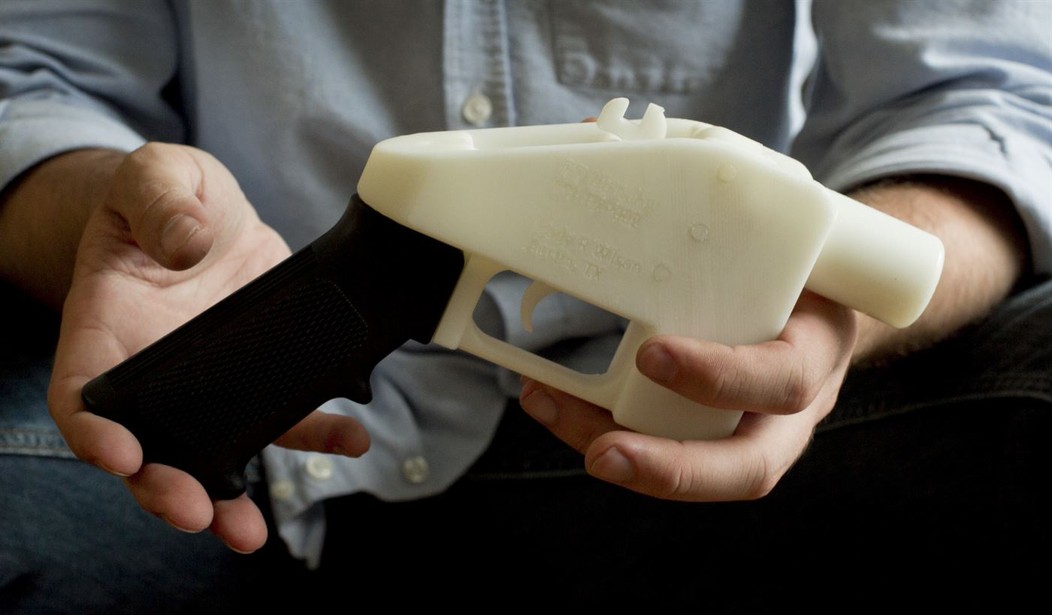
Since the term "ghost gun" first popped up in the zeitgeist, such firearms have been demonized as being easily accessible to criminals. Despite them existing for decades, they only started popping up at crime scenes after leftist politicians and their media allies started losing their minds over them.
And the popularity of 3D printers has only made it worse, but understand something. The assault on "ghost guns" is about more than guns.
See, as it stands, anti-gun jihadists in states like Washington and California aren't just interested in banning people from making their own firearms. They want to ban people from even owning the files, and that's troubling to not just gun rights supporters.
The tech community has concerns about it, too.
Washington State in March quietly crossed a line that may seem small on paper but feels significant to me—a longtime member of the 3D-printing community—in practice. With the passage and signing of House Bill 2320, the state didn’t just target untraceable firearms. It reached upstream into the ecosystem that makes them possible, regulating digital firearm files, restricting their distribution, and explicitly pulling 3D printers and CNC machines into the legal framework.
California has already moved in a similar direction with AB 1263, which expands liability for those who facilitate or distribute digital firearm manufacturing code, and with the proposed AB 2047, which would require 3D printers sold in the state to include blocking technology capable of detecting and preventing the production of firearm components. Colorado’s HB26-1144, on its way to the governor for his signature, takes a more direct route, criminalizing the manufacture of certain firearms and parts using 3D printing.
Meanwhile, in both California and New York, lawmakers are exploring proposals that would require printers themselves to recognize and refuse to produce weapons components. If these bills pass, uploaded parts files will be reviewed by AI programs, with an additional layer of human intervention.Ghost guns, which are unserialized weapons, are difficult to trace, increasingly accessible, and growing in number. But the methods being deployed to stop them raise a broader question that extends well beyond firearms: When a general-purpose tool like a 3D printer is asked to decide what it is allowed to make, where does regulation end and state control begin? Lawmakers are no longer just regulating finished products, but the inputs and processes that create them.
From my vantage point, state governments don't just want to ban ghost guns. They want to control your 3D printer. This should alarm advocates of both the First and Second Amendments.
The courts have long held that computer files were, in essence, a form of speech. That's why someone can have a digital download of, say, The Anarchist's Cookbook, which includes recipes for explosives, many of which actually work quite well, from what experts on the subject have said. You can't lawfully do anything with that information, but you can absolutely have it at your fingertips, because free speech is free speech, even if it's in the form of computer data.
Likewise, having files on your computer to make a firearm with a 3D printer doesn't inherently mean you're going to, and banning people from possessing them means speech is being restricted.
Plus, this idea that we can somehow tell printers what they can and can't produce is putting the government inside of a growing industry and allowing them to restrict what parts are acceptable. Since many gun parts are similar to parts used for non-firearm products, how is this AI going to know what your intention actually is?
It can't.
Besides the civil rights questions, which are enormous, there's the simple fact that 3D printers allow small businesses to get into manufacturing for a reasonable price. Small companies can buy a number of printers, put them in a printer farm, and produce any number of products they can turn around and sell. There's no need for multi-million dollar investments just to try to introduce a product to market, and no need for similar investments to bring a second one to the consumers.
But the government is trying to get inside of these devices and tell people what they can and can't make, even though so-called ghost guns are still only a tiny fraction of the firearms recovered at crime scenes, and there's absolutely no evidence that their availability has any negative impact on the crime rate.
It's the left trying to tell people what they can and can't do simply because they feel like they should have that kind of authority over everything.
And even people who might favor gun control need to step back and recognize that this won't stop with guns.


Join the Conversation
VIP members get the ability to comment on articles.