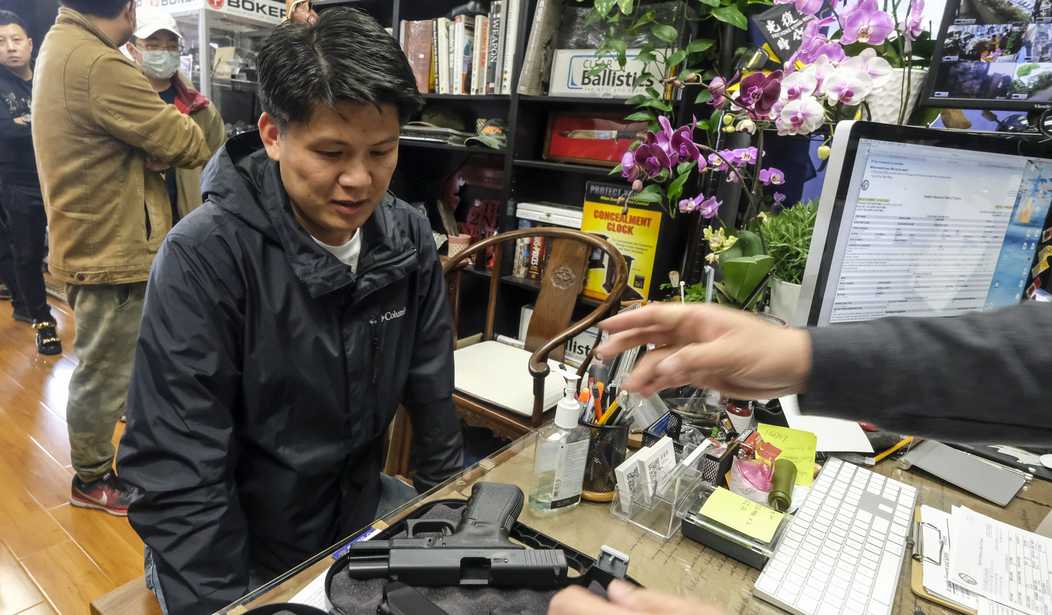
Gun control advocates routinely gripe about the fact that the firearm industry has a certain degree of protection from civil lawsuits. They act like this is unprecedented and unwarranted, but the truth is that the Protection of Lawful Commerce in Arms Act (PLCAA) exists for a reason.
And one of those reasons is when anti-gunners try to act like Mexico is the moral center of the gun universe or something.
The National Shooting Sports Foundation's Larry Keane took to The Hill to set the record straight a bit:
A unanimous 9–0 decision in Smith & Wesson v. Mexico confirmed what Congress made clear two decades ago: The Protection of Lawful Commerce in Arms Act of 2005 bars attempts to blame gun manufacturers for gun crimes committed by third parties.
Yet judging by his recent op-ed, Jonathan Lowy, the lawyer behind that spectacular failure, is back for an encore — this time targeting Arizona gun retailers. His Nov. 30 op-ed in The Hill, with co-author Pablo Arrocha Olabuenaga, also pitches Mexico as a global champion against gun violence. He seems to be hoping it will distract media and especially donor attention away from the legal brick wall into which he just sprinted headlong.
Mexico, of course, has more so-called gun violence than most anywhere else you care to name that isn't an active war zone.
And it probably has more than some of those war zones, if we're being honest. The cartels control massive swaths of Mexican territory, and many of the guns they use were obtained via the Mexican military and police. After all, corruption isn't a problem in Mexico. It's a way of life.
Yet Mexico has also tried to pin all the blame for its woes on the United States and has done so with the complicity of people like then-President Barack Obama, who was ironically responsible for arming the cartels via Operation Fast and Furious.
The PLCAA was enacted to prevent those kinds of lawsuits because, while none of those that existed previously had any merit, they were an attempt to bankrupt the firearm industry via a "death by a thousand cuts" strategy. The goal was to make it too expensive to sell guns to private citizens at all.
Does Lowy know this, though? Well, let's see:
Lowy knows this, because he helped engineer the original wave of such lawsuits in the late 1990s and early 2000s. Back then, big-city mayors and trial lawyers were conspiring to sue gun makers into submission. Congress shut that down with bipartisan fervor. The 2005 federal law did not create “sweeping immunity,” as Lowy now claims, but it did reaffirm common sense.Legal scholars broadly agree with this perspective. Victor Schwartz, author of the leading tort law textbook, calls the Protection of Lawful Commerce in Arms Act “a common-sense law that protects against unsound attempts to change liability principles.” Jonathan Turley of The George Washington University notes that even without this statute, courts have “uniformly and correctly” rejected these types of claims.
Lowy’s assertion that lawsuits could curb illegal trafficking “where other efforts have failed” collapses under scrutiny. Every retail gun sale already requires an FBI background check and completion of ATF Form 4473, wherein buyers attest that they are not straw-purchasers. To lie on that form is a federal felony punishable by 15 years in prison. For 25 years, the firearms industry has partnered with ATF on the “Don’t Lie for the Other Guy” campaign to warn the public about these penalties.
As it stands, any gun manufacturer or store that breaks the law can be held liable for their own failings. They can be sued if the product is defective. They can be sued if any rational grounds for a lawsuit exist.
But Lowy and his friends spend their time suing everyone and their brother because criminals got guns illegally, then used them illegally, despite no evidence that these companies had done anything wrong. They were being punished for the aftermath of something they had no role in. To use a well-worn comparison, it was like suing Toyota because of a drunk driver.
Over and over again, they created a situation that tried to undermine the Second Amendment. The basic idea was that there was no need for gun control if there were no guns available for purchase. It doesn't matter what the rules are if a company is too afraid to sell to you.
Lowy claims that lawsuits would curtail illegal trafficking, but the truth is that if he could prove these companies were involved in trafficking efforts, he'd have grounds to sue as things currently stand.
He and people like him are why the PLCAA exists, and they're why it's not going to go anywhere anytime soon.