







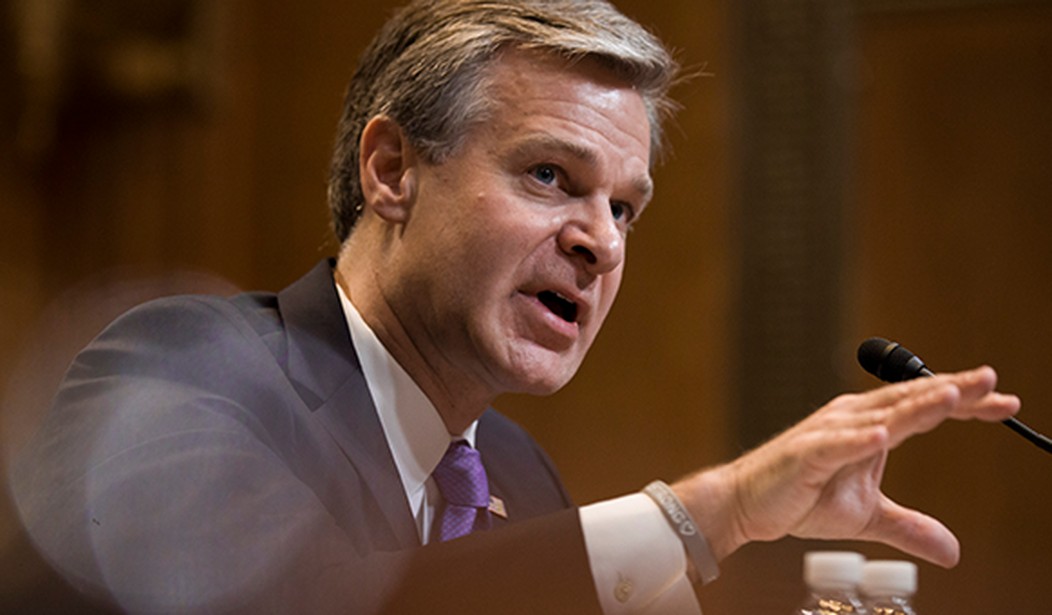
In his testimony Wednesday before the House Judiciary Committee, FBI Director Christopher Wray revealed a few new details gleaned from his agency's probe of the attempted assassination of former President Donald Trump.
When asked whether the FBI had success learning more about the shooter from his devices and digital footprint, Wray explained that what had been collected still didn't provide much information on motive.
"We have been able to get into and exploit a number of electronic devices," Wray reported. That included getting access to some of the shooter's "various accounts" while the FBI "may never get access to" some "because of the encryption issue." Wray described that issue as an "increasingly vexing barrier" for law enforcement.
"A lot of usual repositories of information have not yielded anything notable in terms of motive or like ideology," Wray explained. "Having said that, it does appear fairly clear that he was interested in public figures, kind of more broadly."
Wray also shared that, "starting somewhere around July 6 or so, [the shooter] became very focused on former President Trump and this rally" that was held in Butler, Pennsylvania, on July 13.
"One of the things that I can share here today — that has not been shared yet," Wray offered, "is that we've just in the last couple days found that from our review — to your point about devices, analysis of a laptop that the investigation ties to the shooter — reveals that on July 6 he did a Google search for 'How far away was Oswald from Kennedy.'"
Wray called the discovery of the shooter's Google search about the Kennedy assassination "is significant in terms of his state of mind." The date of the search, added Wray, "is the same day that it appears that he registered for the Butler rally."
WATCH:
Wray reveals that "on July 6, [the would-be Trump assassin] did a Google search for 'How far away was Oswald from Kennedy?'"
— Townhall.com (@townhallcom) July 24, 2024
That was also the same day he registered for the Butler rally. pic.twitter.com/blpMPQ5shf
Wray's hours-long testimony continues as he faces questions in his role helming the lead agency on the investigation of the July 13 attack on Trump's rally that saw the former president shot, rally attendee Corey Comperatore killed, and two other supporters critically wounded.


Join the Conversation
VIP members get the ability to comment on articles.