





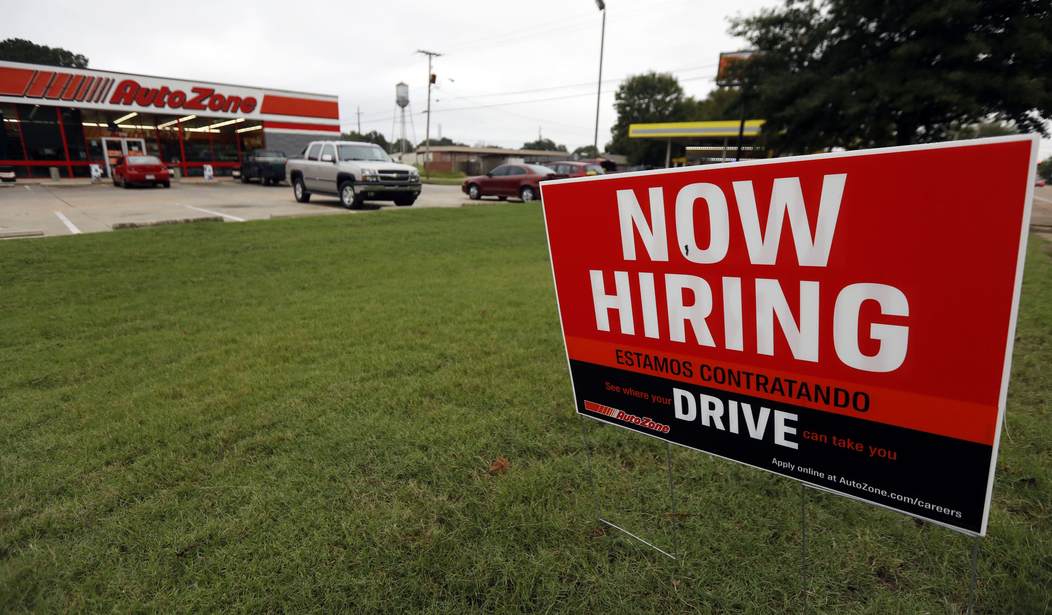
Unemployment data calculated by the Bureau of Labor Statistics showed 467,000 jobs were added to the American economy in January, while the unemployment rate ticked up to 4 percent in the first month of 2022.
Payroll employment rises by 467,000 in January; unemployment rate changes little at 4.0% https://t.co/1Y9cSWJUIB #JobsReport #BLSdata
— BLS-Labor Statistics (@BLS_gov) February 4, 2022
Many Americans seem to have said "enough" of Wuhan coronavirus nonsense in January and gone back to work through some of the 10 million job openings in the United States. With many Americans vaccinated and the Omicron variant proving more contagious yet generally more mild than other strains of COVID, the workforce is apparently acting on a desired return to normalcy. That reality is also borne out in the economic sectors in which job gains occurred.
According to BLS, "Employment in leisure and hospitality expanded by 151,000 in January, reflecting job gains in food services and drinking places" while "professional and business services added 86,000 jobs" and "Retail trade employment rose by 61,000 in January."
The increased employment also comes in a month where President Biden's vaccine mandate for large employers was delayed and eventually struck down by the Supreme Court, before which employers had already started to rescind their requirement for employees to get vaccinated in order to retain their employment.
Even still, BLS reported that "the number of persons jobless less than 5 weeks increased to 2.4 million and accounted for 37.0 percent of the total unemployed," showing that there are still a significant number of Americans who have been out of work for an extended period of time.
Another driver behind the added jobs is inflation. As prices continue to rise for Americans on everything from groceries to gas to streaming subscriptions, taking an open position has become for many Americans more of a necessity and likely made unemployed Americans less selective in the offers they accept out of a need to make ends meet.
Economists predicted around 150,000 new jobs would be added in January due to the Omicron surge and based on what the White House said in trying to temper expectations due to concern over people being out of work due to the Wuhan coronavirus. But again, Jen Psaki and the White House economists who presumably gave her their fearful expectations for the jobs report were wrong when it came to their forecast.
As Vespa covered earlier this week, White House Press Secretary Jen Psaki was clearly bracing for yet another rough jobs report when she tried to claim that people being out sick with the Omicron variant of the Wuhan coronavirus may drive up the number of unemployed Americans — fear-mongering that turned out to be pointless.
"Because Omicron was so highly transmissible, nearly nine million people called out sick in early January when the jobs data was being collected" Psaki asserted on Monday. "The week the survey was taken, the week of January 12th, was at the height of the Omicron spike." Apparently Psaki thought people calling out sick are indistinguishable from those who are unemployed?
In preparation for job numbers to be released, Psaki makes it clear that 9 million people called out sick because of omicron at the time data was taken. pic.twitter.com/j1fsJGwWfK
— MRCTV (@mrctv) January 31, 2022
Psaki went on to say she "just wanted to kind of prepare people to understand how the data is taken, what they're looking at, and what it is an assessment of, and as a result the month's jobs report may show job losses, in large part, because workers were out sick from Omicron at the point when it was peaking, during the period, when the week, where the data was taken."


Join the Conversation
VIP members get the ability to comment on articles.