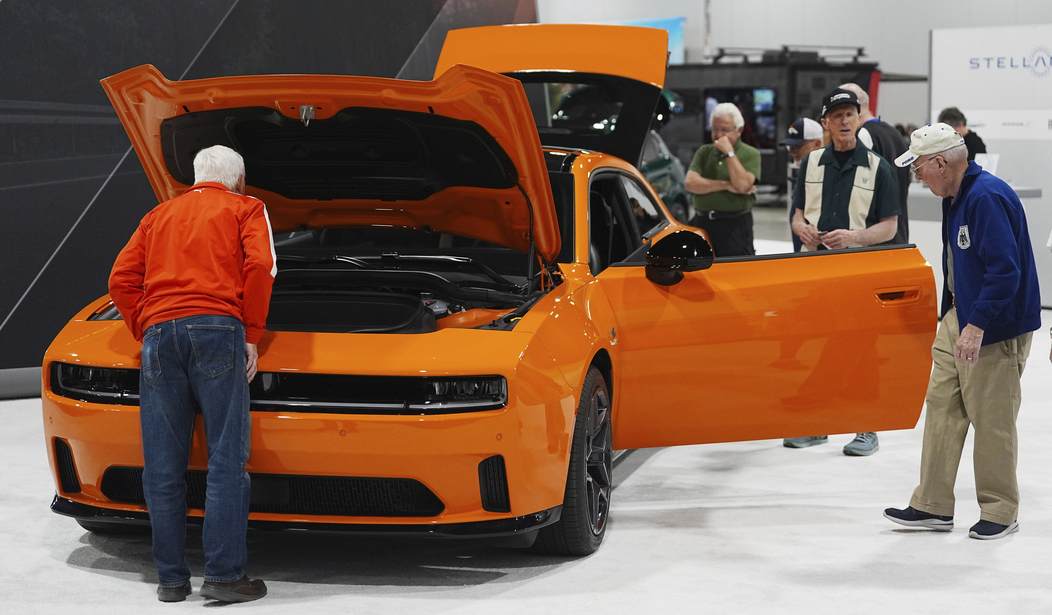

The average transaction price of a new car broke $50,000 in 2025, but that price might drop after President Donald Trump’s administration cut federal vehicle emission standards this week.
The Environmental Protection Agency eliminated the Obama-era 2009 Greenhouse Gas Endangerment Finding and all subsequent federal greenhouse gas emission standards for all vehicles and engines of model years 2012 to 2027 and beyond.
The endangerment rule inspired Former President Joe Biden’s electric vehicle mandate, which sent automakers scrambling to create expensive vehicles like the F-150 Lightning, a $60,000 now-stalled product that few people wanted.
President Trump has ENDED the “Green New Scam”. Today’s repeal of the 2009 Obama EPA Endangerment Finding eliminates what has been referred to by some as the “Holy Grail” that empowered the nation’s most extensive regulatory overreach. pic.twitter.com/hoOKuA3n7H
— Lee Zeldin (@epaleezeldin) February 12, 2026
The action also eliminates all off-cycle credits, including the start-stop feature. In 2013, the average transaction price of a new vehicle was about $33,000, according to Cox Automotive.
BREAKING: President Trump: “These crippling restrictions were a major factor in driving up car prices to unprecedented levels, and the car you were getting was not nearly as good... Effective immediately, we are repealing the endangerment finding and terminating all additional… pic.twitter.com/o414ZxCBzJ
— RedWave Press (@RedWave_Press) February 12, 2026
The action should allow automakers to create more affordable vehicles, including trucks. Those regulations gave lawmakers, not consumers, the power to dictate what features vehicles have.
Consumers must either place a substantial down payment on a new or used vehicle or finance it. The average monthly car payment in 2025 hit $750. Granted, newer vehicles have much better safety features than vehicles made in the early 2000s, such as blind spot sensors, collision warning systems, and automatic braking, but many people don't want those. Many people can only spend a few thousand dollars on a vehicle that can get them from point A to point B.
Even used cars are expensive, with an average transaction price of $26,000, in 2026, according to Kelley Blue Book.
The Fed reports auto loan balances have crossed $1.6 trillion, with average monthly payments hitting a record $750.
— unusual_whales (@unusual_whales) July 28, 2025
Ford CEO Jim Farley said that “the customer has spoken” when it comes to electric vehicles, as consumers mostly rejected them and automakers recently ate billions of dollars in losses.
WATCH: Ford Motor announced it would discontinue multiple electric-vehicle models and absorb a $19.5 billion write-down due to slumping demand and the Trump administration's rollback of EV incentives in the US https://t.co/V64xXaXowK pic.twitter.com/lkiV6su6Nl
— Reuters Business (@ReutersBiz) December 16, 2025
Big Three automaker Stellantis lost $26 billion, Ford Motor Company lost $11 billion and will carry losses through 2029, while General Motors claimed $7 billion in EV losses.
While these companies are recovering from their electric vehicle nightmares, they should prioritize creating basic models that young adults or other people strapped for cash can buy without absorbing crushing debt.
Some of the most popular vehicles in the Midwest are the Ford F-series, the Toyota Rav4, the Honda CRV, and the Chevy Silverado. Trump's administration cutting emissions regulations and other red tape should be another step toward more affordable cars and trucks.