





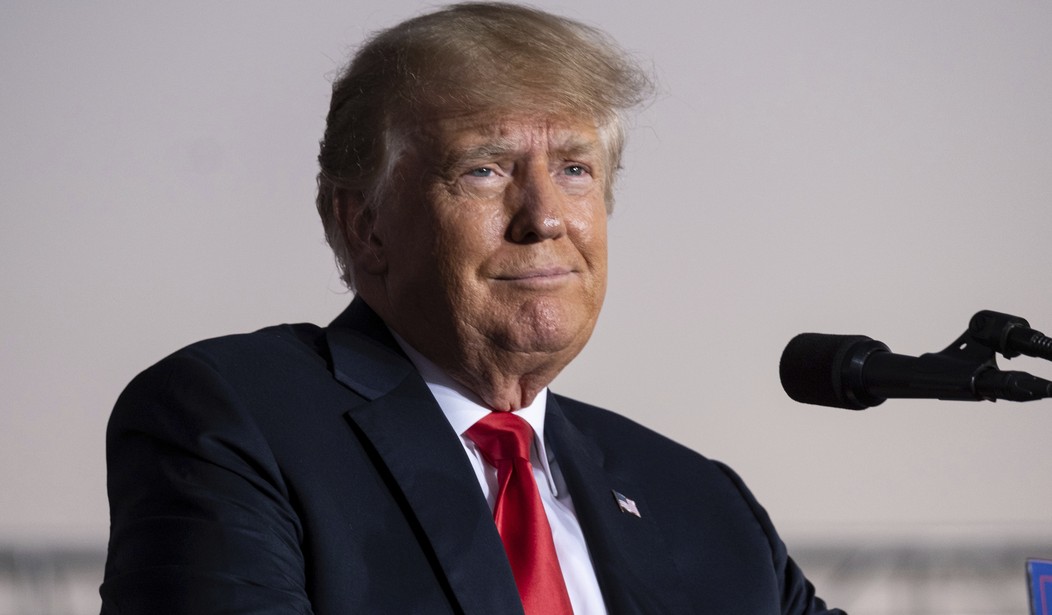
It's been a busy few days for the January 6 select committee, and it's only likely to get busier. On Thursday, the three-judge panel D.C. Circuit Court of Appeals ruled against former President Donald Trump. His lawyers argued that Trump could claim executive privilege to prevent the Biden administration from sharing documents from the Trump administration with the select committee. The court's opinion pointed out that Trump was asking the court to "override President Biden's decision not to invoke privilege."
In finding against the former president, the court wrote:
On the record before us, former President Trump has provided no basis for this court to override President Biden’s judgment and the agreement and accommodations worked out between the Political Branches over these documents. Both Branches agree that there is a unique legislative need for these documents and that they are directly relevant to the Committee’s inquiry into an attack on the Legislative Branch and its constitutional role in the peaceful transfer of power.
In the subsequent paragraph, the court's opinion expanded upon Trump's failure to establish harm when listing out reasons why the former president had failed to achieve a likelihood of success:
...Mr. Trump’s failure even to allege, let alone demonstrate, any particularized harm that would arise from disclosure, any distinct and superseding interest in confidentiality attached to these particular documents, lack of relevance, or any other reasoned justification for withholding the documents. Former President Trump likewise has failed to establish irreparable harm, and the balance of interests and equities weigh decisively in favor of disclosure.
After temporarily blocking the documents last month, the court's decision this time affirmed a previous ruling from U.S. District Judge Tanya Chutkan.
The select committee "applaud[ed]" what it called a "decisive ruling," also vowing "Our work moves ahead swiftly" and "We will get to the truth."
We applaud the Appellate Court’s decisive ruling, which respects the Select Committee’s interest in obtaining White House records and the President’s judgment in allowing those records to be produced.
— January 6th Committee (@January6thCmte) December 10, 2021
Our work moves ahead swiftly. We will get to the truth.
That is not to say that the select committee will immediately start receiving records from the National Archives. The panel gave Trump's lawyers 14 days to appeal to the Supreme Court.
As mentioned in a footnote:
This court’s administrative injunction, entered November 11, 2021, will be dissolved in 14 days, reflecting the amount of time the former President’s counsel requested to file a petition for a writ of certiorari and an accompanying motion for an injunction pending review with the Supreme Court... But if such a motion is filed, the administrative injunction will dissolve upon the Supreme Court’s disposition of that motion.
Trump's spokesperson, Liz Harrington, tweeted out that "this case was always destined for the Supreme Court."
Regardless of today’s decision by the the appeals court, this case was always destined for the Supreme Court. President Trump’s duty to defend the Constitution and the Office of the Presidency continues, and he will keep fighting for every American and every future Administration
— Liz Harrington (@realLizUSA) December 9, 2021
Trump has made claims of executive privilege a theme in arguing he does not have to comply with the select committee. His chief of staff on January 6, Mark Meadows, has asserted such a privilege, as one of the first key figures subpoenaed by the select committee back in September.
While it appeared at one point that Meadows might comply with the subpoena, he has ultimately decided not to. Instead, on Wednesday, lawyers filed a lawsuit on Meadows' behalf against House Speaker Nancy Pelosi (D-CA), all nine members of the select committee, and the select committee itself.
The select committee also tweeted on Thursday that on Monday night it will be voting on a report to recommend that the U.S. House of Representatives hold Meadows in contempt of Congress.
??? Monday, December 13th at 7:00 PM
— January 6th Committee (@January6thCmte) December 9, 2021
The Select Committee will vote on a report recommending that the House of Representatives cite Mark Randall Meadows for criminal contempt of Congress and refer him for prosecution.
As Dan Mangan reported for CNBC on Thursday, House Majority Leader Steny Hoyer (D-MD) indicated the House will be considering such a proposal.
In October, the U.S. House of Representatives voted to find strategist Steve Bannon, who was also among the first to be subpoenaed, in contempt of Congress. Bannon was soon after indicted by the Department of Justice. He pled "not guilty" and may face jail time and fines for not complying with the subpoena.

Join the Conversation
VIP members get the ability to comment on articles.