





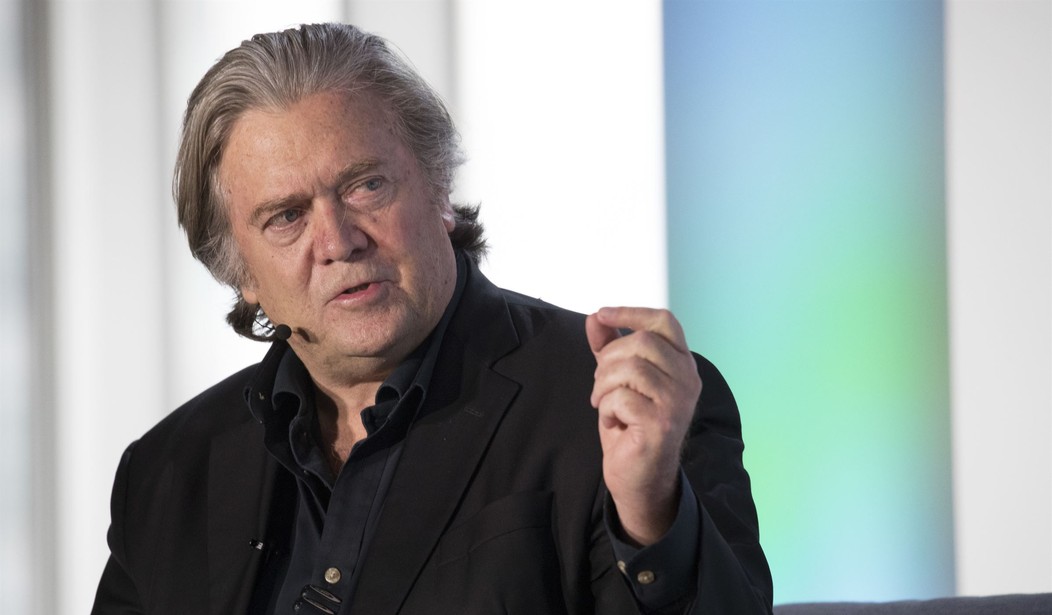
After speculation about what the January 6 Select Committee would do about those subpoenaed figures who indicated they would defy the subpoena, Rep. Bennie Thompson (D-MS), the committee's chairman has an answer. On Thursday afternoon, the committee announced it was referring Steve Bannon for criminal contempt.
BREAKING: Chairman @BennieGThompson announces the Select Committee will move forward with proceedings to refer Mr. Bannon for criminal contempt. Read the full statement: https://t.co/NzwmvR09pa
— January 6th Committee (@January6thCmte) October 14, 2021
A press release included a statement from the chairman, who indicated the committee is not messing around:
“Mr. Bannon has declined to cooperate with the Select Committee and is instead hiding behind the former President’s insufficient, blanket, and vague statements regarding privileges he has purported to invoke. We reject his position entirely. The Select Committee will not tolerate defiance of our subpoenas, so we must move forward with proceedings to refer Mr. Bannon for criminal contempt. I’ve notified the Select Committee that we will convene for a business meeting Tuesday evening to vote on adopting a contempt report.
“The Select Committee will use every tool at its disposal to get the information it seeks, and witnesses who try to stonewall the Select Committee will not succeed. All witnesses are required to provide the information they possess so the Committee can get to the facts. We’re grateful to the many individuals who are voluntarily participating and to witnesses who are complying with subpoenas, including several who met the deadline to begin producing materials to the Select Committee. We’re moving ahead quickly to get answers for the American people about what happened on January 6th and help secure the future of American democracy.”
To justify their authority, the press release also includes relevant United States Code:
Any person who willfully refuses to provide testimony or documents subpoenaed by Congress, including committees of the House, is potentially liable for contempt of Congress under 2 U.S.C. §§ 192, 194. Contempt of Congress is a crime that may result in a fine and between one and twelve months imprisonment.
Contempt of Congress begins with a “formal action” by the Select Committee, i.e., a business meeting at which a contempt report is adopted. If a witness fails to appear, produce documents, or refuses to answer any question “pertinent to the question under inquiry,” the Select Committee then writes a report documenting the inquiry, the attempts to accommodate the witness’s production or testimony, and the failure by the witness to appear, produce, or answer a pertinent question. The report also contains the text of the resolution recommending the full House hold the witness in contempt.
After the Select Committee has adopted a contempt report, it is referred to the House for a vote and, upon its adoption, the Speaker certifies the report to the United States Attorney for the District of Columbia. Under 2 U.S.C. § 194, following such certification it is the “duty” of the United States Attorney to “bring the matter before the grand jury for its action.”
As The Washington Post covered on Wednesday night, which I referenced in my own reporting, there are options the committees could take for such defiance, including how:
- "First, they vote to hold someone who doesn’t comply in contempt of Congress"
- "Congress often stops there, but they don’t have to," which would involve taking that to the DOJ and charging the person with a crime.
In Rebecca Beitsch's reporting for The Hill, she breaks down further the legal path that this could take:
Following a vote from the House, a referral would put the ball in the Justice Department's court, requiring the executive branch to determine how aggressive it wants to be in pursuing Bannon.
The decision to act would likely be made by the U.S. attorney’s office in Washington, D.C., and lawyers at the highest levels of the main Justice Department.
Lawyers would need to determine if there’s probable cause — a likely determination given that experts say Bannon's and Trump's executive privilege claims have little merit — and whether the case can be proved in court. The department could take into consideration the gravity of the situation, in that officials would be charging an aide to a former president of the opposite party.
As I covered last month, Bannon was included in the first batch of key figures subpoenaed. These subpoenas for various individuals and organizations have been coming for the past three weeks.
Last week, as I also covered, POLITICO obtained a letter from former President Donald Trump's lawyer citing executive and other privileges in ordering these figures to defy the subpoenas. As CNN reported, Bannon indicated he would indeed defy the subpoena.
Bannon had been ordered to provide documents last week, on October 7, and appear for a deposition today, October 14.


Join the Conversation
VIP members get the ability to comment on articles.