

Pieces of our nation line the perimeter of the Great American State Fair, welcoming families, friends, and tourists to sample all the idiosyncrasies of American culture. Visitors can taste the savory, sweet saltwater taffy from the Jersey Shore before heading over to Montana's rodeo fence to explore the evolution of the American cowboy. Smoke from authentic Texas Brisket fills the air, a reminder of the hometowns that make up the Land of the Free, each represented by the same Star-Spangled Banner. The banner for which men and women have sacrificed their lives, which stands for the same values now as it did at America's founding, and the banner that one man has dedicated his life to painting and will paint for the next two and a half weeks at the Great American State Fair.
Scott LoBaido is a 61-year-old activist artist from Staten Island, New York, who has spent his life painting renditions of the American flag and portraits of President Trump, one of which he presented to him after the attempted assassination in Butler, Pennsylvania. Scott has dedicated his career to countering the hostile, "Anti-American" sentiment that permeates the art world and much of modern culture, earning himself a name and the opportunity to paint an American flag at the Great American State Fair.
For the next few weeks, Scott will be at the fair painting the largest oil canvas painting of the American Flag in the "Made in America" Pavilion. He spoke about the kind of preparation involved in the nine-by-15-foot portrait, saying, "There's a lot of discipline involved, and the canvas cost me an extreme amount of money to have it built. They don't make canvases like this."
Scott got his artistic start, like many others, in Manhattan, where he discovered the art world's disrespectful attitude toward the flag and the country. "The creative community has more rights than anybody in this country. But they are the people that have that freedom, biting the hand, stepping on the flag, desecrating our veterans."
I don't want any part of this. I'm going to take this a different level. I'm going to take this flag that represents everything that's great in this country, my freedom, and I'm going to promote it, celebrate it. I'm going to display it far and wide on the sides of buildings on cars and premises until it catches on, and it took forever, and at the same time I also watched political correctness and wokism pop their ugly head. I started fighting against that, and warning people. I'm not a prophet, but I'm an artist, and I see a vision, and I see that we are letting this happen.
He used his hometown as an example of the erasure of values, saying, "New York City is the perfect example. Milk and honey that we have too much of have given us a reason to sit down on that recliner and not do anything."


Many of his fans, including President Trump, call Scott a patriot. Scott, however, considers himself to be a messenger. "I don't think about myself as being a patriot. I think the men and women who sacrificed, and who still do today, who give me the right to be this crazy son of a b***h that I am, those are the patriots. I'm just a messenger," he said.
As for his muse, the flag, he says, is the most stunning piece of artwork he has ever seen. "I've seen all the masters, and it's wonderful, it's inspiring, right? But, there's nothing more powerful, more meaningful, provocative, more sexy, more humanitarian than the American flag. I didn't create her, I'm just celebrating her."
He hopes to draw people into that same love and appreciation for the flag by highlighting its best features and inviting families to introduce it to their children. "Little kids might say, 'Oh, that's a flag on a pole,' but when they see my painting, they say, 'Whoa! Look at all those colors, why is it so colorful?' It gets them intrigued, and their parents will tell them that it's the American flag, and it represents us all.'"
Scott's favorite thing about America is the freedom. "I am the epitome of freedom...I get to think what I want when I want. It's a struggle of a lifetime to get here, but that's the American dream, the freedom. That's what these men and women died for."
While he is upset about the people who have taken the country for granted, Scott says he is hopeful that the values that set America in the oath to perseverance 250 years ago will return. "When they burn down the forest, it has to rejuvenate and grow back to its original form. I'm confident that will happen, and it can only happen in this country. That's the greatest part."
As individuals filter in and out of the fair, Scott will take breaks to meet his fans and get to know his fellow Americans — and his mission is clearly resonating. One couple, Sandy and Dee Adcock, got a taste of his personality and reflected on his work. "He immediately is very personable, and obviously gifted beyond," Sandy said. "He incorporates these various things, like the cross with the flag, and the sacrifices that were made for America. That's what speaks to me right there, and how appreciative we should be as a nation."
The Adcocks are from Philadelphia, where they serve as board members for Life Turning Point of Philadelphia, an organization that houses homeless women and children. Scott and his work embody the same values of "life, liberty, and the pursuit of happiness," said Dee, which he and his wife prioritize in their work and lives, and that they hope to see prosper over the next 250 years.
Scott and his team are not yet sure where his painting will end up, but they hope someone will fall in love with it and purchase it for their home or a museum. Scott's work is front and center inside the Made in America Pavilion, which he described as being amazing. "It's the greatest Fair, the biggest, longest birthday party the world has ever seen, two weeks straight."
Scott emotionally gave his glory to God, saying, "I'm blessed with this gift that God gave me. I didn't go to school for this, you know. God gave me this gift, and I choose to use it."
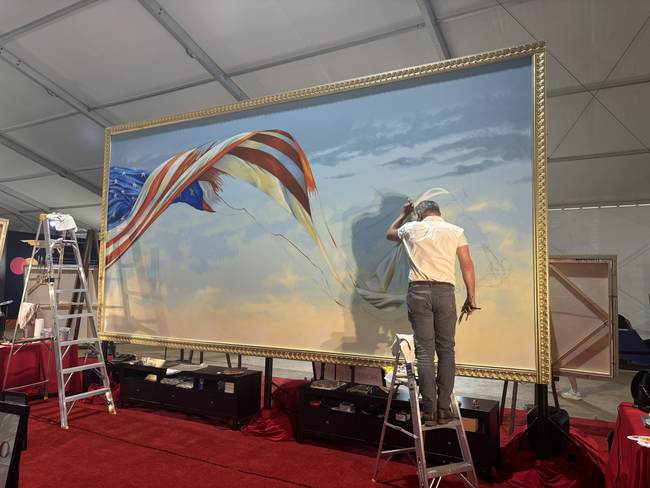
Julia Cassidy / Townhall