





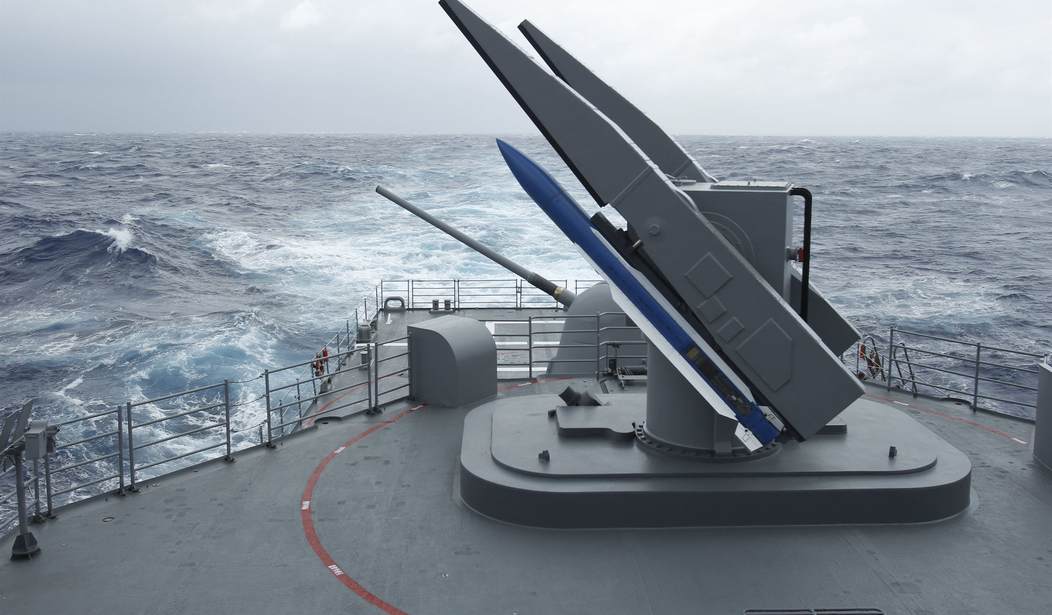
Taiwan has intensified its annual “war games” military exercises following the U.S. declaration opposing China’s encroachment in the South China Sea and an arms sale to Taiwan. The Han Kuag series, running from July 13-17, involves joint operations between each of Taiwan’s military branches.
“We are testing the preservation capabilities of our forces in such a scenario and how ready our reserve forces would be,” an unnamed source told the South China Morning Post.
Taiwan President Tsai Ing-Wen, inaugurated for a second term on May 20, has opposed reunification with mainland China despite pressure from Beijing.
While Taiwan instituted the Han Kuag exercises in 1984 to simulate Taiwan’s response to a potential Chinese invasion, this is only its second year to deploy cooperative battalions. In addition, Taiwan has never before this year conducted live-fire drills.
In a drill on Wednesday, Taiwan fired surface and underwater target (SUT) heavyweight torpedoes for the first time in 13 years, Taiwan News reported. The torpedoes successfully struck and downed the target ships.
The United States recently approved a $180 million torpedo sale to Taiwan, replacing the obsolete German SUTs.
Troop mobilization capacity would also be stressed, Taiwan News said.
At the #Hankuang36 exercise today, I was glad to see that our reserve forces now play an expanded role. Integrating reserves & standing forces is one of the focal points of our current military reforms, strengthening our defensive capabilities & enhancing national security. pic.twitter.com/ZByOYvOndo
— ??? Tsai Ing-wen (@iingwen) July 15, 2020
“The reserve force is undersized and undertrained, and thus lacks the deterrent punch it should carry,” Michael Mazza, a visiting fellow at the American Enterprise Institute (AEI), a D.C.-based think tank, said back in April. “Now is the time to begin addressing these deficits.”
Chinese analysts claim that Taiwan’s show of military clout will only serve to jeopardize its independence from the PRC, rendering the nation a victim to American ambitions.
“Among them, the most concerning factor is the collusion between the United States and Taiwan region in an attempt to strengthen cooperation on military security, which in turn escalates the China-U.S. strategic rivalry and undermines peace and stability across the Taiwan Straits,” says Zhang Hua of the Chinese Academy of Social Sciences.
News agencies reported sighting both Chinese and American reconnaissance missions monitoring the exercises.
China began a 79-day training exercise involving live fire on May 14.
Song Zhongping, a military analyst, told Lianhe Zaobao, a Sigapore-based Chinese daily, that the unusual timing and duration indicate China may be attempting to reinforce its dominance and deter any Taiwanese separatist aspirations.
“To Beijing, Taiwan appears to have ventured further on the road to independence and at a faster pace,” reports Beijing correspondent Yu Zeyuan. “It can be inferred that these exercises are conducted to ensure that mainland China has the determination and capability to handle the Taiwan issue by non-peaceful means, should Taiwan overstep mainland China’s Anti-Secession Law.”
Taiwan’s Ministry of Foreign Affairs released a statement on Tuesday urging contending parties to resolve conflicts in the South China Sea according to the requirements of international law and include Taiwan in the process.
“We firmly oppose any attempt by a claimant state to resolve disputes in the South China Sea by means of intimidation, coercion, or force,” the statement reads.

Join the Conversation
VIP members get the ability to comment on articles.