





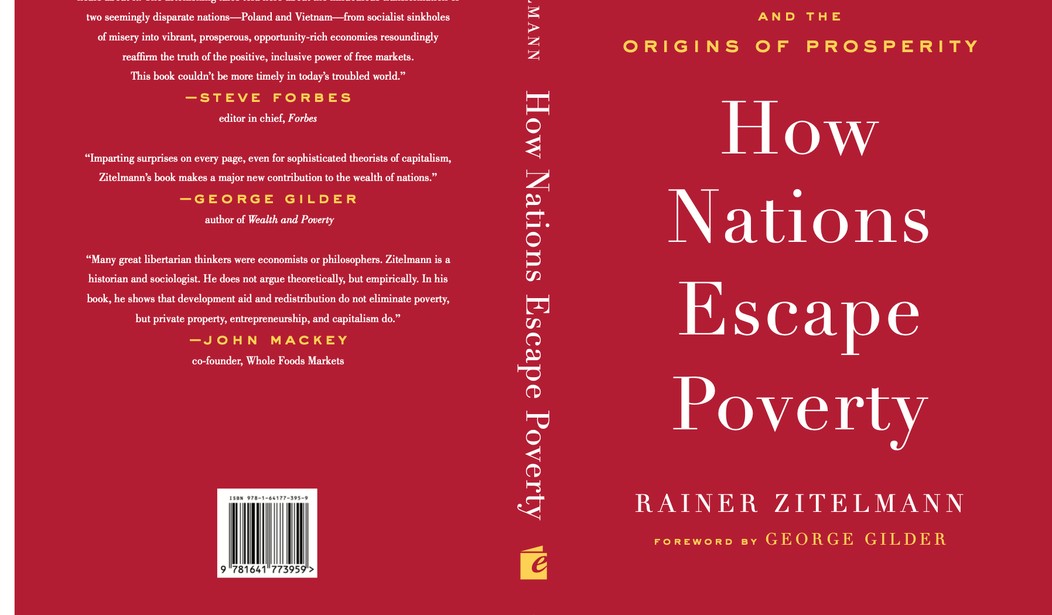
When it comes to defending and promoting the virtues of capitalism, few in recent history have done so as effectively as German historian Rainer Zitelmann. In his latest book “How Nations Escape Poverty,” the prolific author puts Vietnam and Poland under the microscope to examine how the two nations—devastated by war and occupation—were able to break free from the hell socialist planned economies ushered in. Not only did they both experience tremendous economic growth, but their living standards also improved drastically.
Importantly, these gains were not achieved through development aid, which has proven detrimental to the economic growth of nations, as Zitelmann discusses. Rather, improvements in poor countries have happened organically.
Vietnam provides the perfect example of this. It went from being one of the poorest nations in the world in 1990, to today being among the “most dynamic countries with a vibrant economy that creates great opportunities for hardworking people and entrepreneurs,” Zitelmann writes.
But it was a long road.
After the Vietnam War, a socialist planned economy was introduced and the people suffered greatly for it, with most living in extreme poverty. But in the countryside, there were pockets of resistance to the Soviet model. By the ‘80s, the market economy reforms that took place were in essence the formal sanctioning of what was already occurring spontaneously in many villages. The ‘opening up’ of Vietnam in the ‘90s and 2000s with foreign investment, free trade agreements, and through joining the World Trade Organization further propelled the nation’s economic growth.
Change took place slowly, but in time, Vietnam’s GDP grew, its poverty rate plummeted, and its life expectancy rose sharply.
Zitelmann also highlights an interesting cultural aspect to the nation, which has no doubt played a role in the country’s economic advancement—they are a forward-thinking people, many of whom view the rich and capitalism favorably, much like in Poland.
“Vietnam calls itself socialist and the ruling party communist. However, you are far less likely to find a Marxist at a university in Vietnam than at a university in the USA or Europe,” Zitelmann told Townhall. “The people of Vietnam and Poland that my book focuses on have been cured of Marxist ideas; they have seen that these ideas only lead to poverty, not prosperity.”
Poland’s economic transformation was more sudden, though market-economy structures, like in Vietnam, had already cropped up at the grassroots level. While Poland also suffered from the problems associated with a planned economy, it had “rampant inflation and a mountain of debt” to address as well. Under the vision and leadership of economist Leszek Balcerowicz, who served as Deputy Prime Minister and Finance Minister from 1989-1991, the country underwent “rapid, comprehensive, and radical reforms in all sectors of the economy,” Zitelmann writes.
There was a difficult phase for a couple years after the reforms, but economic growth soon followed and “many people were swept away by the new spirit of capitalism…including children."
“Previously hidden unemployment became open unemployment, and companies that were not competitive on the international stage collapsed,” Zitelmann told Townhall. “However, this so-called shock therapy ultimately proved to be effective, propelling Poland to become Europe’s growth champion for decades.”
“How Nations Escape Poverty” is not just a historical account of how two countries drastically turned their economies around. It is just as much a cautionary tale for people and nations around the world about what not to do. Argentina and Venezuela provide glaring examples of how previously rich nations fell into poverty, with the latter showing that “even prosperous, democratic countries are not immune from losing their prosperity and freedom in a matter of just a few years,” he explains in the final chapter.
The world is now watching whether Argentina will be able to turn around under the shock approach president and economist Javier Milei is undertaking and if the people will have the patience required to undo decades of mismanagement.
Indeed, forgetting the reasons why nations prospered in the first place is a danger Zitelmann warns countries, including the U.S., about.
In America, where positive views of capitalism have declined sharply in recent years among young adults, books like “How Nations Escape Poverty” and Zitelmann’s newly revised “The Power of Capitalism” are more important than ever and why he hopes Townhall readers will share his work with their children.
“Students in schools and universities are not being educated on the history of socialism, which is why I write my books,” he said. “How many young people are aware that before capitalism, 200 years ago, 90 percent of the global population lived in extreme poverty, whereas today that number has decreased to less than 9 percent? To portray a system like capitalism, which has freed so many people from poverty, as ‘inhumane’ and a system like socialism, which has been responsible for more than 100 million deaths in the last 100 years, as ‘humane,’ you have to be a PR- and marketing genius. We can learn a lot from the anti-capitalists, who have proven to be far superior in public relations and marketing.”



Join the Conversation
VIP members get the ability to comment on articles.