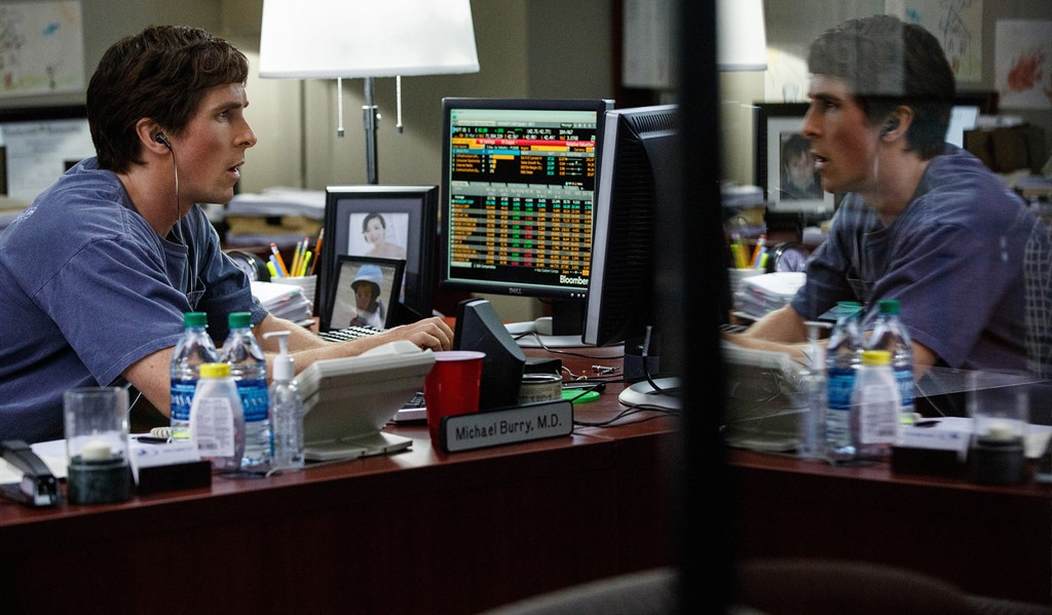

Michael Burry, the investor who predicted the subprime mortgage collapse in 2008, has made a move that could be a major warning sign about the economy.
Burry famously made $100 million at the time and earned $700 million for clients by shorting the 2007 mortgage bond market. His prediction inspired Michael Lewis to write the bestseller, “The Big Short: Inside the Doomsday Machine," which was later made into a 2015 film.
According to Security Exchange Commission filings posted on Monday, Burry’s Scion Asset Management bet more than $1.6 billion on a Wall Street crash.
Burry started betting against the stock market in the second quarter of this year, and his bets were aggressive. Scion invested $1.6 billion (94% of its assets) in put options on index funds that track the S&P 500 and the Nasdaq-100, according to the most recent Form 13F. A put option confers the right to sell a security at a predetermined strike price, so purchasing a put option only makes sense when the security is expected to lose value.
In this case, Burry is betting the S&P 500 and the Nasdaq 100 will decline, which is tantamount to betting against the U.S. stock market, especially the technology sector. (The Motley Fool)
Michael Burry places a huge leveraged short position on the stock market with put options.
— Wall Street Silver (@WallStreetSilv) August 14, 2023
The Big Short Version 2.0 😳 pic.twitter.com/8SHtZ0r4V9
Shark Tank's Kevin O'Leary called Burry's bet "very risky."
"People that try to live off market timing have a very hard time. You get lucky once as he did with housing syndication in mortgage debt, but this is a whole different kettle of fish he's playing with," O'Leary said Wednesday on Fox News.
"What he's doing now is completely different. The S&P 500 has 500 mega-cap companies in it in 11 sectors of the economy, real estate only being one of them," O'Leary continued. "You would need every single sector to falter or at least the valuations of every company in the S&P to significantly go down at the same time to win on that bet."
While the "Shark Tank" star said Burry will likely "be right one day," the timing is a big unknown.
"And how much pain he will have to take along the way, and does he have enough dry powder, as they like to say, at the margin desk? Because every time that market goes up another 1-2%, that phone is ringing and they're saying 'send in some more cash,'" O'Leary added.
Others were skeptical about Burry's latest bet.
For everyone getting crazy about Michael Burry's trades pic.twitter.com/4CjDNGWrpD
— sphinx (@protosphinx) August 15, 2023
MICHAEL BURRY IS SHORT THE MARKET 1.6 BILLION!!
— Joseph Carlson (@joecarlsonshow) August 14, 2023
not really... Here's what missing with these shocking headlines. pic.twitter.com/QIv1eybDHO