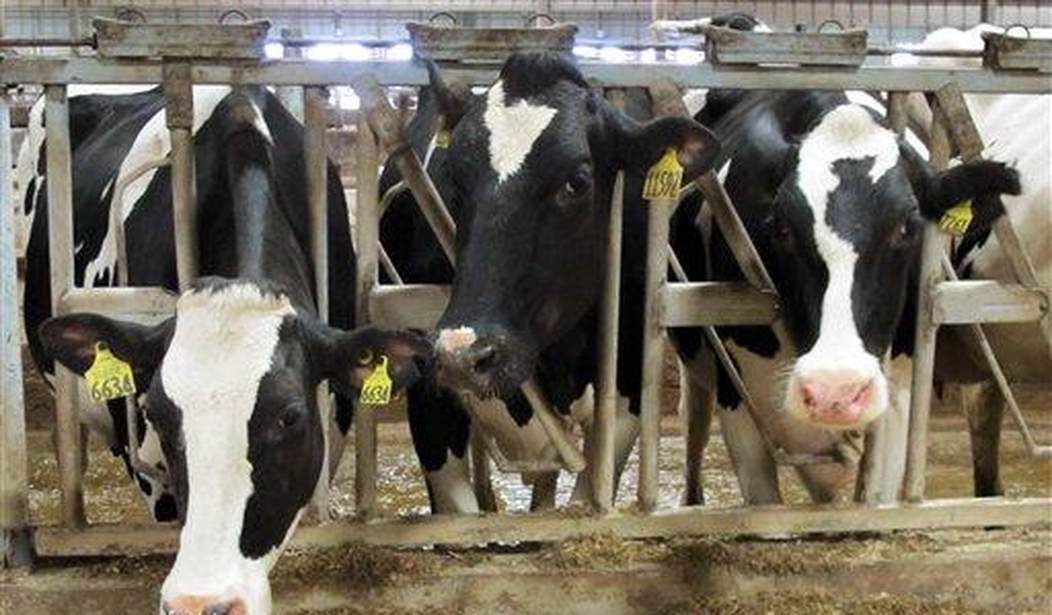

French dairy giant Danone announced plans this month that could easily be mistaken for a story from The Babylon Bee. In an effort to curb methane emissions by 30 percent in the next seven years, the company said it would undertake changes to the way its cows are raised and milked.
The animals have become a target for climate zealots since their burps and manure release methane.
Danone’s goal for a 30 percent methane reduction—a target in line with the Global Methane Pledge—will be sought by using a different cow breed that emits less methane gas, changing the cows’ diets, and capturing emissions from manure to use for biogas, AFP reports. Other “innovative” solutions include strapping a special gas-trapping mask on the animals.
A report published on Danone’s site last year said the company’s venture capital arm invested in a startup called Zelp, which specializes in wearable technology for cows that mitigates methane – a cow mask, if you will.

In an FAQ on its website, Zelp emphasizes cow burps are bigger methane producers than their farts.
"About 95% of the methane is expelled through the mouth and nostrils of cattle, via exhalations and belching," Zelp's website states. "Contrary to common belief, only a small percentage of methane is produced in the cows’ large intestine and then expelled. Remember – it’s the burps, not the farts!"
Commenting on the idea on "Tucker Carlson Tonight," farmer Stephanie Nash blasted the company's plan while explaining how her farm works to reduce emissions.
"We have ruminants on our farm that can digest byproducts. A good example is we feed our cows soybean meal that comes from soy oil production," she explained. "And you have to ask yourself, millions of tons per year – if we don't have cows to digest that byproduct, it has to go somewhere. It has to go to a landfill. It has to go on, you know, into a waste management. And that's going to be very harmful. That's going to leave an imprint, you know, for our country and gases going into our environment."
While more than 100 countries signed on to the Global Methane Pledge in 2021, China, Russia, Iran, and India—some of the world’s biggest methane emitters—did not.