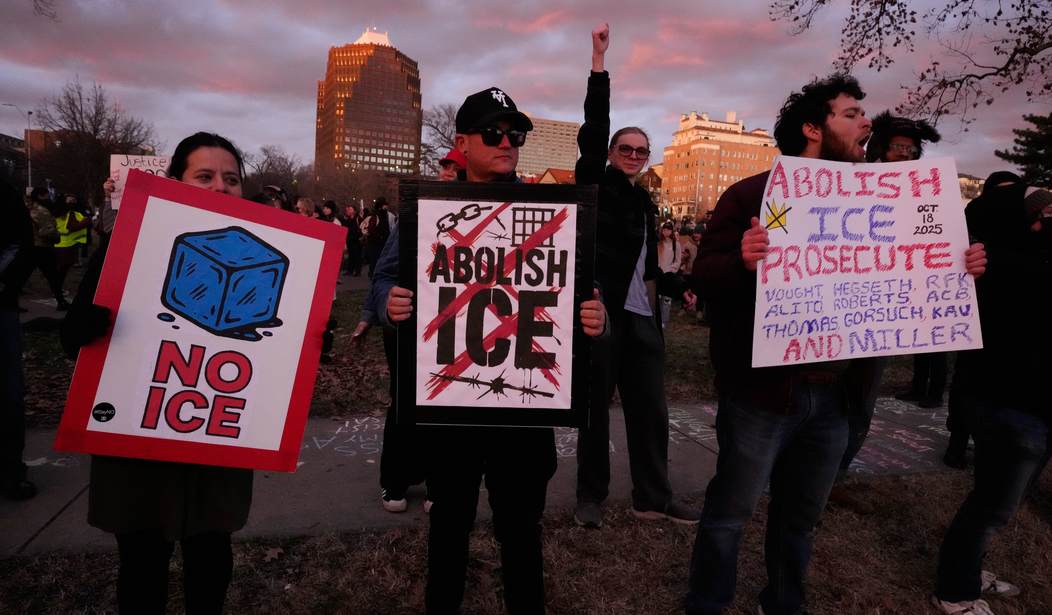
Democratic lawmakers in Massachusetts and Maryland are considering legislation that would limit federal immigration enforcement operations in their states.
Maryland’s state senate discussed two separate bills on Thursday that would place restrictions on Immigration and Customs Enforcement (ICE), The Daily Record reported.
The state Senate debated two bills Thursday that seek to limit both Maryland’s interaction with Immigration and Customs Enforcement and their officers’ ability to wear masks in the course of duty.
Speaking to both bills at the start of Thursday’s floor session, Senate Judicial Proceedings Committee Chair Will Smith, D-Montgomery, said “this is a disorienting time in our politics” — not just people in his district, but across the state.
“I think just the pace of events in the last couple of weeks, Mr. President — from Renee Good to Alex Pretti to a five-year-old, Liam, who was separated from his family now in a detention center. From the Baltimore City detention center and the human rights violations that continue to go on. To masked agents dragging people from their cars and from their homes without a judicial warrant. From families being separated and communities being fractured, what is happening is not sustainable,” Smith said as he addressed Senate President Bill Ferguson, D-Baltimore City.
The Senate first took up Senate Bill.
Sponsored by Senate President Pro Tem Malcolm Augustine, D-Prince George’s, the legislation would mandate the Maryland Police Training and Standards Commission to establish a uniform policy prohibiting law enforcement officers — including ICE — from wearing face coverings in the normal course of duty. It would provide carveouts, including for officers who are undercover and in the case of cold weather.
The legislation was amended in committee to make its violation a $1,500 civil citation— an arrestable offense — subject to police discipline. It initially would have been considered a criminal offense punishable by up to two years in prison or a $2,000 fine. The bill was also amended so that the policy preempts those set by localities.
Maryland’s Senate is also considering another bill that would prevent local law enforcement from collaborating with ICE in its enforcement actions.
The Senate also debated Senate Bill 245, which would prohibit local law enforcement from entering into 287(g) agreements, or partnerships, with ICE.
Sponsored by Smith, the legislation was amended ahead of its committee vote to prohibit law enforcement and employees in state-run facilities and local jails from taking actions related to ICE unless a detained individual has been charged with or convicted of a felony, and that data regarding these interactions is made available to the public.
In Maryland, eight counties cooperate with ICE via 287(g) programs. Several employ the Jail Enforcement Program, allowing them to alert the agency when people who entered the U.S. illegally are held in their facilities for breaking state laws. Of those jurisdictions, five — Allegany, Carroll, Garrett, St. Mary’s and Washington counties — participate in the Warrant Service Officer Program, which allows law enforcement to serve and execute administrative warrants in county jails.
There are other 287(g) models local jurisdictions don’t participate in, including the delegation of certain immigration enforcement powers to local officers.
During Thursday’s floor debate, Senate Minority Whip Justin Ready, R-Carroll and Frederick, asked if the legislation would “eliminate” ICE enforcement or immigration detainers in Maryland.
In Massachusetts, Gov. Maura Healey signed an executive order prohibiting new immigration enforcement agreements except under certain circumstances, NEPM reported.
Gov. Healey has signed an executive order intended to ban new 287(g) immigration enforcement agreements "unless there is a public safety need," prohibit ICE from making civil arrests in non-public areas of state facilities, and ban the use of state property for immigration enforcement staging.
Healey also announced she is filing legislation that her office says is designed "to keep ICE out of courthouses, schools, child care programs, hospitals and churches; make it unlawful for another state to deploy its National Guard in Massachusetts without the Governor’s permission; and allow parents to pre-arrange guardianship for their children in case they are detained or deported."
The governor's office called the measures "the most comprehensive effort in the country to protect against ICE activity in sensitive locations." President Trump's administration over the past year has gone on a deportation offensive, riling immigrant communities, splitting up families and drawing backlash over ICE agent tactics.
"Over the past year, President Trump has sent federal agents into communities, cities and states around the country, and what we have seen week after week, month after month, are federal agents instigating antagonizing and, yes, causing violence in communities," Healey said at a press conference at the State House. "People have been killed. Others have been shot. We see mothers and fathers ripped out of cars and from the arms of their children. United States citizens have been stopped, arrested and detained."
"Our action today is actually in line with what was long established federal policy," Healey said. "It used to be that federal agents and partners in law enforcement recognized those sensitive spaces, and they, in fact, used to designate them as sensitive locations that were protected from enforcement action."
Democrats might be selling their voters on the notion that this will prevent the Trump administration from arresting and deporting illegal immigrants. But each of these measures are sure to face serious legal challenges from a Constitutional perspective.
These laws could violate the Constitution’s Supremacy Clause, which establishes federal law as the highest law of the land. It means that in most cases, when state law conflicts with federal law, the federal law takes precedence.
The Supreme Court ruled Arizona v. United States that the federal government has broad authority over immigration. This means states are prohibited from creating immigration laws that conflict with federal enforcement.
Still, states do enjoy a level of protection under the anti-commandeering doctrine. The Supreme Court ruled in cases like Printz v. United States that Congress cannot force state and local officials to carry out federal programs or aid federal authorities in their activities.
This means that while states can’t directly block immigration agencies, they can refuse to assist their operations or allocate other resources for federal use. Several states have already passed laws to this effect.