





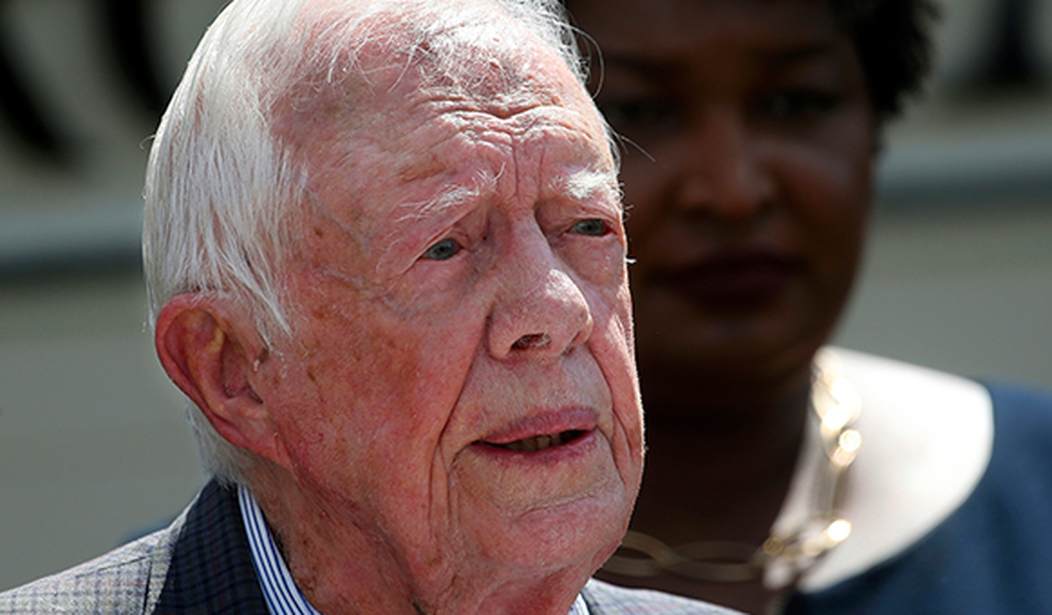
CNN’s Scott Jennings minced exactly no words when discussing former President Jimmy Carter, who recently passed away at the age of 100.
During a panel discussion on the president, Jennings criticized Carter’s approach to foreign policy – especially after his stint in the White House. “He was a terrible president,” Jennings said. “That’s why he lost in a landslide after his one term.”
Jennings continued, saying that Carter was an “even worse ex-president because of his meddling in US foreign policy, because of his saddling up to dictators around the world, because off he vehement…anti-Israel views, and more than dabbling in anti-Semitism over the years.”
The commentator further stated that Carter “believed that he was uniquely positioned” to intervene in foreign policy even after leaving the White House.
One of the other guests acknowledged that Carter “was meddlesome to his successors” and “forgot sometimes that he still wasn’t president.”
However, he insisted that this “shouldn’t mar the record of global humanitarian good that he did.”
Jennings stuck to his guns, using the Persian Gulf War as an example of Carter’s meddlesome tendencies. “He wrote letters to all of our allies and to Arab states, asking them to abandon their cooperation and coalition with the United States of America.”
He added: “If it’s not treasonous, it’s borderline treasonous”
Jennings concluded his remarks by noting that Carter’s conduct “showed that he cared more about his own legacy than he did about the country, and I think that is wrong.”
Scott Jennings slams President Jimmy Carter for being a "terrible president."
— Jeff Charles, Doni's St. Bernard🏴 (@jeffcharlesjr) December 31, 2024
"That's why he lost in a landslide after his one term." pic.twitter.com/GAPRBLhDul
Jennings is right. While the copy of Carter’s letter has not been publicized, reports suggest that the president did urge U.S. allies not to vote in favor of a resolution against Iraq if it continued threatening Kuwait.
A prime example of Carter's insistence on his rectitude can be seen in his November 20, 1990, letter to members of the U.N. Security Council just before the Persian Gulf War erupted, attempting to thwart the Bush administration's request for U.N. authorization of hostilities against Iraq. President Bush's criterion for proceeding with a war was the exhaustion of "good faith talks," and Carter placed his interpretation of that standard above the administration's.
Carter insisted that “There were never any good faith talks, as a matter of fact, and we attacked Iraq without them.”
President George H.W. Bush is quoted as saying, “I recognized [Carter’s] right to speak out” but that “What I violently disagreed with was his writing to heads of foreign governments, urging them to stand against what we were trying to do in the U.N.”
Carter also came under fire for his virulent anti-Israel stance and was accused of harboring antisemitic ideas.
He undid much good will with Jews in the United States, however, with his 2006 book, Palestine: Peace Not Apartheid. It compared Israel's treatment of Arabs in the West Bank to South Africa's system of racial segregation, which was brought down in 1994. While promoting the book, Carter said U.S. Mideast policy is influenced too much by lobbying by American Jewish groups, leading some to accuse him of anti-Semitism.
Controversy erupted anew in June, when Carter labeled Israel's 2-year-old blockade of Gaza an "atrocity" and said people there were being treated like animals.
Carter also received criticism for his role in Venezuela’s 2004 recall election, which saw authoritarian socialist leader Hugo Chavez retain power. The former president was invited to observe the process of recalling Chavez. The outcome saw Chavez receiving about 59 percent of the vote, with the Carter Center endorsing the results despite claims of voter fraud.
Yes, Carter did fight in favor of human rights. But this does not mean he does not have skeletons in his closet, a fact that folks on the left would rather not discuss. Despite his ineptitude as president and his meddling after leaving office, he has largely escaped criticism. But now, it appears more information is coming out that went largely ignored in the past.

Join the Conversation
VIP members get the ability to comment on articles.