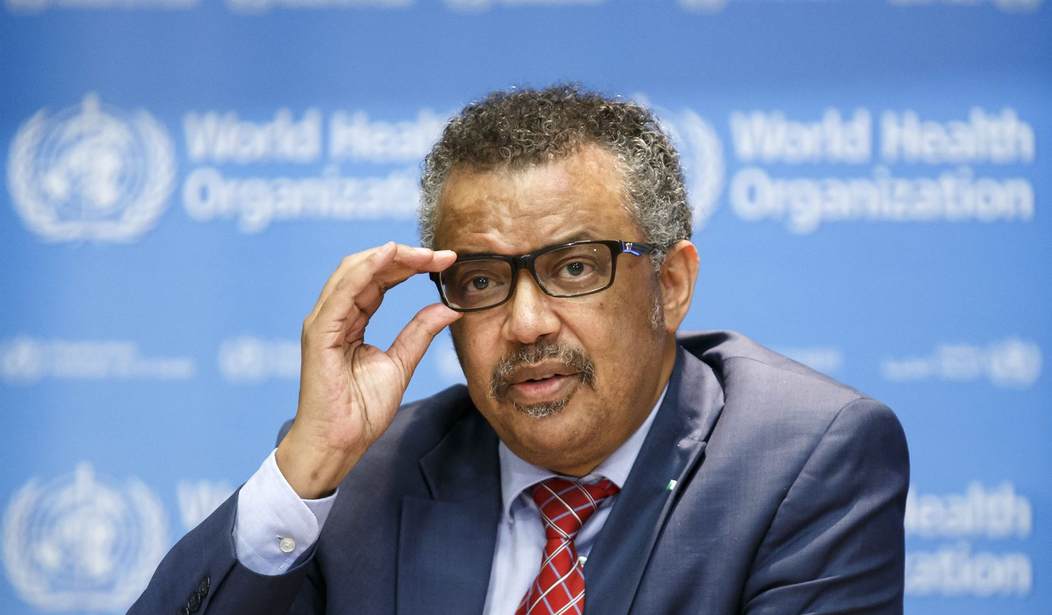

The Trump administration suspended financial assistance to the World Health Organization (WHO) after the extent of the group's complicity and supine lapdoggery vis-a-vis Beijing started to come into clearer focus. As evidence mounted, WHO treachery continued, and pointed challenges weren't satisfactorily answered, the US severed further ties. Trump critics objected, with many arguing that despite the China "issue," the WHO's mission and work remained too important to abandon or freeze out altogether. This, despite the organization's parroting of dangerously false information at a key juncture regarding human-to-human transmission of coronavirus. With that background in place, this story made the rounds on the internet on Monday -- in which the WHO appeared to contradict a key piece of information about the spread of the virus:
Correction: Asymptomatic spread of coronavirus is "very rare," the WHO says. https://t.co/pRihr1ZMxE
— CNBC (@CNBC) June 8, 2020
Coronavirus patients without symptoms aren’t driving the spread of the virus, World Health Organization officials said Monday, casting doubt on concerns by some researchers that the disease could be difficult to contain due to asymptomatic infections. Some people, particularly young and otherwise healthy individuals, who are infected by the coronavirus never develop symptoms or only develop mild symptoms. Others might not develop symptoms until days after they were actually infected. Preliminary evidence from the earliest outbreaks indicated that the virus could spread from person-to-person contact, even if the carrier didn’t have symptoms. But WHO officials now say that while asymptomatic spread can occur, it is not the main way it’s being transmitted. “From the data we have, it still seems to be rare that an asymptomatic person actually transmits onward to a secondary individual,” Dr. Maria Van Kerkhove, head of WHO’s emerging diseases and zoonosis unit, said at a news briefing from the United Nations agency’s Geneva headquarters. “It’s very rare.”
I called the 180 "headspinning" because the contagiousness of asymptomatic people has been a central tenet of the argument behind so many mitigation efforts and restrictions. In light of the WHO's dodgy track record on this virus (particularly its spread), and given the overall trust gap that only seems to be growing, I expressed skepticism about whether or not we should believe this:
Who and what are we supposed to trust? Setting aside all the problems at WHO.
— Guy Benson (@guypbenson) June 9, 2020
And now...oops, never mind:
A top World Health Organization official clarified a claim made just Monday that asymptomatic spread of the coronavirus is “very rare.” Instead, they said models predict asymptomatic spread could be responsible for as much as 40 percent of Covid-19 transmission in a press conference Tuesday morning...“I was responding to a question at the press conference, I wasn’t stating a policy of WHO or anything like that,” Kerkhove said Tuesday. “In that, I used the phrase ‘very rare’ and I think that’s misunderstanding to state that asymptomatic transmission globally is very rare.” “Some estimates of around 40% of transmission may be due to asymptomatic, but those are from models, so I didn’t include that in my answer yesterday, but wanted to make sure that I covered that here,” Kerkhove added.
We haven’t seen a lot of evidence of fully asymptomatic people transmitting to many others (though admittedly these tracing studies are hard to do). Pre-symptomatic transmission, on the other hand, is why SARS-CoV-2 has been harder to control than SARS-CoV. 2/3
— Natalie E. Dean, PhD (@nataliexdean) June 8, 2020
Are these models correct, though? We don't know. Maybe she'll turn out to be right, at least partially, which would be good news. But jumping ahead of actual findings and making a confusing and optimism-inducing statement, then walking it back, contributes to the distrust that led me to be reflexively suspicious of the claim in the first place. This is correct:
Don’t let Trump hating on the WHO distract you from the WHO being terrible at key aspects of its job https://t.co/FX3cpdASlN
— Josh Barro (@jbarro) June 9, 2020
I'll leave you with yet another example of a jarring about-face from an erstwhile performative COVID preener:
UPDATE: The lawyer, Daniel Uhlfelder, who dressed up as the Grim Reaper and stalked the Florida beaches as death personified because the threat was so grave —> This is him now: pic.twitter.com/ZAF9BdMVra
— Thomas Chatterton Williams ?? ?? (@thomaschattwill) June 8, 2020
Dude was handing out body bags to beachgoers in late May, and now he's social justicing in large groups. Amazing. And also read this:
I had a chance to check in with my reader who is the head of research for a top-ten hospital in this country, getting a sense of where the country stands in the fight against the coronavirus as we head into summer.https://t.co/ja3qZFQxP4
— Jim Geraghty (@jimgeraghty) June 9, 2020
"It is evidence that social distancing still is necessary," Geraghty's source says. Well, the last week or so has been a giant science experiment, with results pending.