





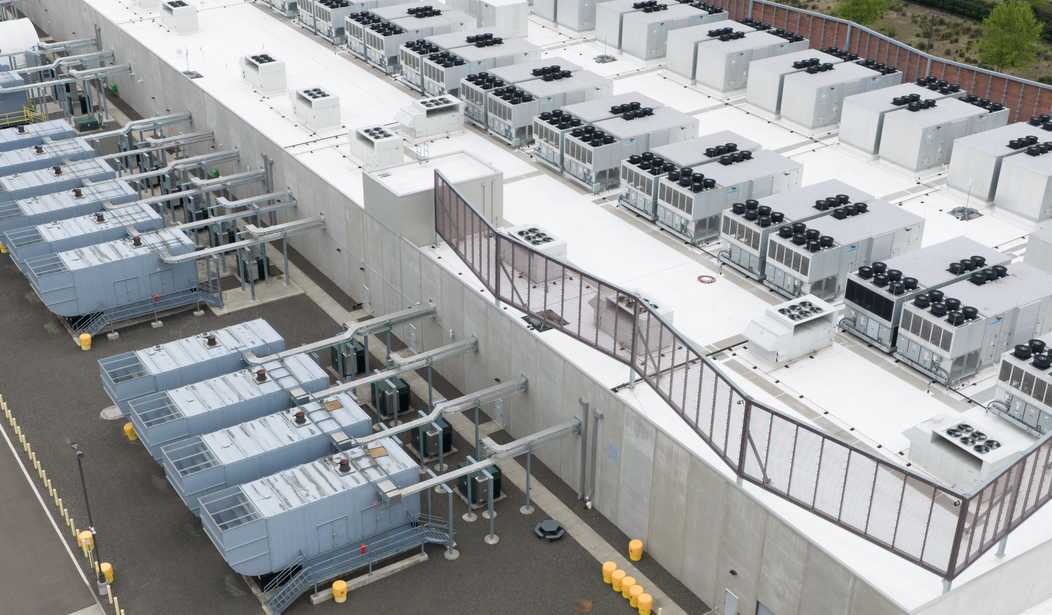
Data centers remain one of the most contentious issues in the United States, as Republicans and Democrats alike have taken to opposing their construction.
This is not a simple issue with bland, unimportant consequences. The construction of data centers is set to lay the foundation for America's performance in the next great economic and technological contest with our foreign adversaries, the race for dominance on the frontier of artificial intelligence. It will also help determine which economic system Americans ultimately embrace, especially amid the rise of socialism on the left and the troubling adoption of socialist language on the right in some of its criticisms of AI.
First, most people would be surprised to learn where the global epicenter of AI data centers actually is. It isn't in some anonymous, forgettable area of the country; it resides in Loudoun County, Virginia, the wealthiest county in the entire nation. And far from being a burden on that wealth, data centers are one of its primary sources.
Second, the discussed economic strain on resources that people regularly cite in their opposition to data centers is simply false.
When it comes to data centers, the benefits outweigh the risks.
— Manhattan Institute (@ManhattanInst) July 8, 2026
It's true that data centers can be unsightly and emit noise. But to improve that, you can simply move them down the road. And that's exactly what's happening; if you look at local approvals, more and more data… https://t.co/VoNc8kKA0H pic.twitter.com/Vi3llq2voF
"Most of the opposition to data centers is based on simply incorrect ideas about their water usage or their electricity cost," Judge Glock, the director of research and a senior fellow at the Manhattan Institute, said. "Water usage in data centers is unbelievably minimal. It's less than half a percent of all U.S. freshwater usage, and in many places, a big data center will use less water than a single square mile of farmland. Data centers have little to no effect on local electricity prices. Electricity prices in America are generally set in large regional markets, and a single factory or single data center will have little to no effect on those general regional markets and almost certainly will have no effect on a local market that approves them."
Not only do data centers fail to generate the resource strain many believe they do, they also end up being one of the largest tax contributors in the local community they're built in. In Loudoun County, the nearly 200 data centers generate roughly half of the county's entire tax revenue. And for every dollar those data centers generate in taxes, they consume only four to five cents in local services. In other words, data centers could serve as the modern equivalent of the factories and manufacturing plants many Americans still feel nostalgic for, the kind of single dominant employer that once anchored small towns across the country. Only this time, instead of clinging to the industries of the past, these facilities will drive the advance of American technological power into the future.
As for the legitimate concerns surrounding data centers, Glock named only a few, and they mostly concern the sheer unattractiveness of the buildings themselves.
"If you're near one, they tend to have an overbearing appearance," he said. "They can be almost 100 feet tall in some cases and often they're rather unsightly concrete boxes. Data centers can also emit kind of a low buzzing noise and a hum that can even penetrate some local homes."
Fortunately, the solution is a simple one: "Mov[e] them a little further down the road."
The conversation surrounding AI data centers has not been one where the vast majority of people have acknowledged their importance while raising genuine, good-faith concerns. It has instead become a legitimate assault on the veracity of the free market and private industry, a shocking embrace of the socialist worldview that insists the wealth and power generated by tech must be reined in, contained, and redistributed by someone other than the people who built it.
As I wrote yesterday, the market checks itself, especially when the government doesn't get involved in the industry. And in a sector like artificial intelligence, which currently stands as one of the purest forms of a free market left in America, government checks are wholly unnecessary. And yet even the Trump administration has toyed with socialist policy, musing over taking stake in AI companies, a proposal that differs from those of Bernie Sanders by mere degree, not ideology.
Strip away the data center-specific complaints, and what's left is socialism's oldest instinct: success this large cannot be allowed to exist without the state's permission.
Editor’s Note: Thanks to President Trump’s leadership and bold policies, America’s economy is back on track.
Help us continue to report on the president’s economic successes and combat the lies of the Democrats. Join Townhall VIP and use promo code FIGHT to receive 60% off your membership.

Join the Conversation
VIP members get the ability to comment on articles.