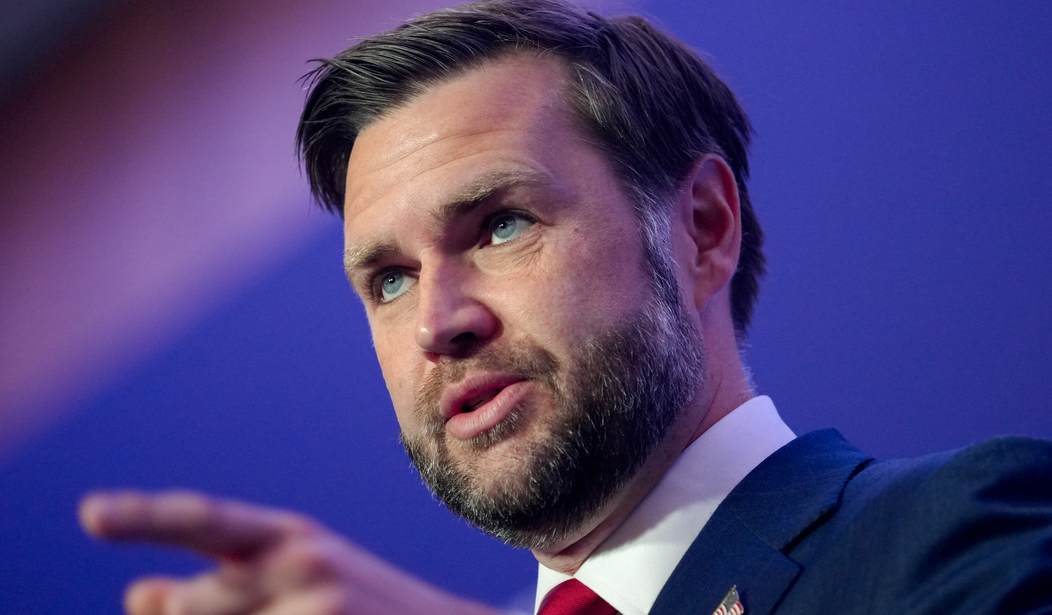

Vice President JD Vance recently declared the age of Milton Friedman over. He's wrong, and worse, he's wrong at exactly the moment conservatives can least afford to be.
In an interview with conservative commentator and Daily Wire host Michael Knowles, Vance argued that conservatives must move toward a more "Hamiltonian" view of economics, one built on economic nationalism, state-assisted industrial development, and a slew of protectionist policies, including tariffs. In simpler terms, it places the federal government as the guiding hand of the economy. To any genuine free-market conservative, that should sound less like a new direction and more like a familiar mistake.
Milton Friedman is not some relic of an older era. He was one of the foremost conservative economists of the 20th century, an influential advisor to the Reagan administration's economic agenda, and a fierce defender of free markets. Not simply as an engine of prosperity, but as a form of protection against government tyranny. And amid the rise of socialism in the United States, declaring his ideas, and those of laissez-faire capitalism more broadly, obsolete plays right into their hands.
VP @JDVance tells @michaeljknowles that the economic position of the Republican party has moved from Milton Friedman to Alexander Hamilton.
— H.A. Hazony (@HAHazony) June 30, 2026
Less laissez-faire and more American developmentalism.
The economy is a tool to provide a good life for citizens. pic.twitter.com/fduCMQK6TV
The vice president's argument for the switch centers on a single factor: that laissez-faire capitalism, as advocated by Friedman, only worked because the United States was far more rooted in religious principles in the 1980s than it is today. In other words, Friedman's ideas landed differently in a populace with a stronger moral foundation.
But that claim is highly questionable.
Nobody can doubt the declining importance of religion in American life since the 1980s, but the actual numbers don't support the scale of the shift Vance's argument requires. Weekly church attendance in the 1980s stood at roughly 40-45 percent, according to Gallup; today it sits around 30 percent. That's a decline, but a shift of that size, especially when even in the '80s the rate never exceeded 50 percent, cannot plausibly mean that the economic thought of a conservative titan like Friedman is now irrelevant. A shift from a minority to a smaller minority is not enough to turn an argument about the virtues of Friedman's economics into one about the moral grounding of the economy as a whole.
Christian identification tells a similar story. In the 1980s, roughly 90 percent of Americans identified as Christian; today, that number sits closer to 68 percent. But identifying as Christian by itself was never proof that someone practiced what they preached.
As far as I know, Friedman never once declared that free markets only worked within a religiously grounded populace. As a matter of fact, he argued the opposite: that government's mistakes in economics and markets were themselves a direct cause of moral degradation within society. Government housing bred crime. Government welfare bred dependency and laziness. Government bureaucracy bred corruption. And so on. If anything, Friedman's ideas no longer work because we no longer try to implement them; we've instead become content with the thinking of the left, that government can fix our problems.
If the United States needs anything right now, it is not a reformation of how conservatives think about economics; it's the opposite. It's a return to our roots, to exactly what conservatives have always been known for: truly embracing free markets, and yes, embracing them without apology.
Amid the rise of socialism across the United States, I suspect we will find our clearest opposition and our grounding ideology in the work of Milton Friedman.