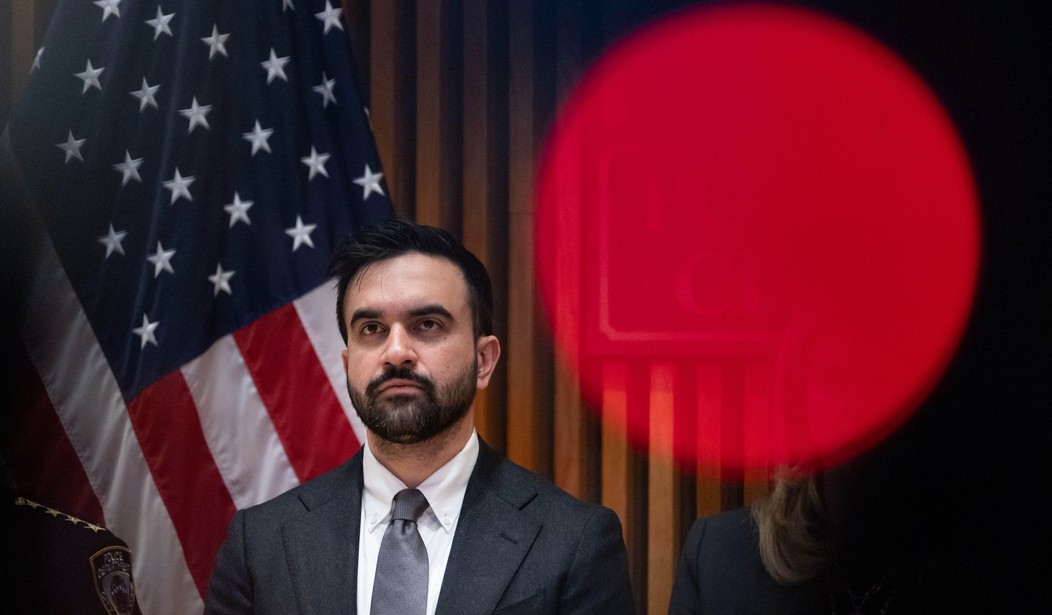
New York City Mayor Zohran Mamdani blasted the Trump administration Thursday for spending taxpayer money on waging war in Iran instead of using those same funds on Americans at home.
We are spending at least $500 million a day to bomb Iran.
— Mayor Zohran Kwame Mamdani (@NYCMayor) April 16, 2026
Imagine how many teachers we could hire, how many public housing units we could build, how many bridges and roads we could fix, if we spent that kind of money on improving life for working people? pic.twitter.com/oJ7vOCqL3P
"Our country has spent now close to $30 billion on a war in multiple countries in the Middle East that has killed thousands of people, costing at least $500 million a day," Mamdani said. "The return on that is images of our country bombing girls' schools in Iran."
The same amounts of money would be transformative for the lives of working-class people across the city, across this country. The choice instead to invest that kind of money in war doesn't just speak of a complete abdication of our political, economic, and moral responsibilities. It also speaks to a choice that will itself exacerbate this cost-of-living crisis, and that we're seeing that already in this city.
"When we speak about taxing the rich, when we speak about what we want this city to be, it's a vision of a city where working-class people can do more than struggle," he added.
This sentiment among both Democrats and some Republicans who have begun to turn against President Trump and MAGA, has become a familiar talking point: that money is always better spent on Americans than on anyone else. And while that may be an appealing idea in principle, history shows it is rarely that simple in practice.
Let’s take the Department of Education as an example. As more money has been spent per child over time, have outcomes improved or worsened? They’ve worsened. The same question can be asked of state-level efforts in places like California, whether it’s homelessness programs, addiction services, or housing initiatives, where increased spending has never translated into measurable success.

The broader point is that these issues are rarely solved by simply increasing funding. What matters more is whether programs are designed and implemented effectively to achieve their stated goals. Yet both the left and the right at times fall into the assumption that more money alone is enough to fix complex problems.
Take figures like Mamdani or Governor Newsom, for example, who have supported pouring additional resources into programs that simply have not delivered results.
But while politicians can often persuade Americans to support increased funding for various programs, they have struggled with the more important step of first establishing programs that are actually effective. At the same time, many Americans have failed to hold their elected officials accountable for those shortcomings, an issue Justice Clarence Thomas recently touched on when he called on citizens to take greater ownership of the United States.
🚨IMPORTANT: Clarence Thomas has just SOUNDED THE ALARM! Clarence Thomas has warned what could happen If We Don’t Stand Up and Take Ownership of Our Country.
— Wade (@Straighthaulin4) April 16, 2026
"We are slowly letting others control how we think and what we think." pic.twitter.com/2aVxGBkv9g
Unlike your typical Democrat, President Trump’s approach to public investment has actually been effective, but it doesn't rely on a typical government welfare program; it relies on expanding individuals’ financial flexibility through tax cuts, eliminating taxes on tips, and even proposing investment accounts for newborns. The emphasis, in his view, is on empowering people to make their own decisions with their resources.
The left, and what some are calling the "new right," simply don't think that way.
The broader point remains that simply increasing spending at home is not a substitute for effective governance. Without accountability and well-designed programs, additional funding alone will not solve these challenges. And given ongoing concerns about bureaucracy and inefficiency at both the federal and state level, it is worth asking whether existing institutions are consistently capable of spending taxpayer dollars wisely, or whether voters should prioritize reform before expansion.
What many will find is that more money is not always necessary when existing programs are actually effective.