





The Supreme Court struck down President Trump's ability impose tariffs under the International Emergency Economic Powers Act (IEEPA) in a massive blow to one of the president's signature policies. While it wipes out Trump's reciprocal tariffs, it still allows tariffs to be enacted under different statutes.
The split among the court was unique, as Justices John Roberts, Amy Coney Barrett, and Neil Gorsuch joined the liberal justices in the majority, voting against the president's tariff authority, while Justices Clarence Thomas, Samuel Alito, and Brett Kavanaugh dissented.
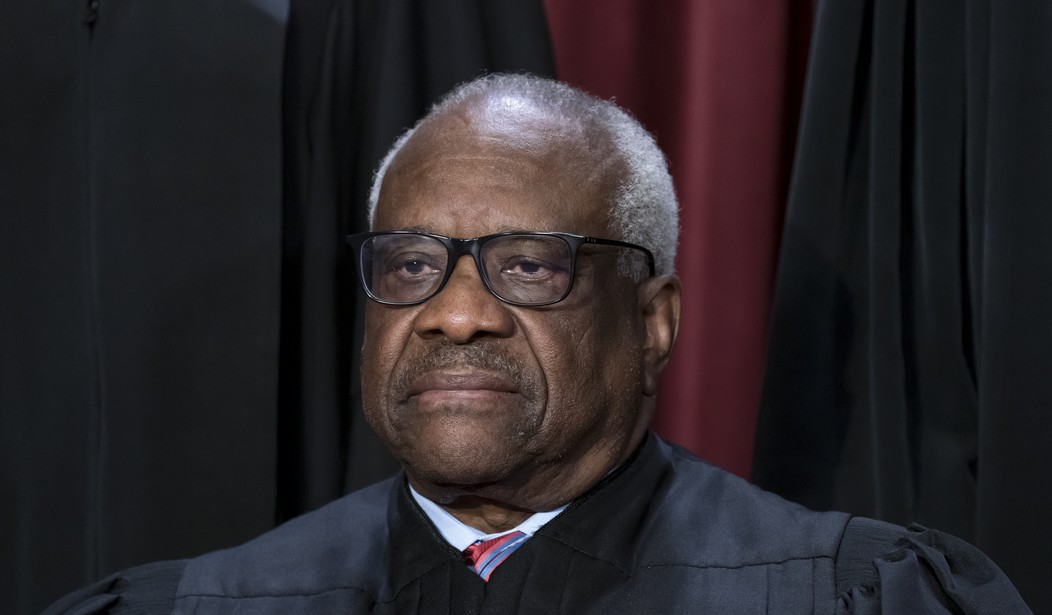
Justice Thomas, who is often considered the most conservative Justice, wrote a scathing dissent, in which he argued that had Congress delegated a core power, the move would have been unconstitutional. However, he argued that the power to regulate foreign commerce was not historically treated as a core constitutional power, and therefore was allowed to be delegated to the Executive branch.
"I write separately to explain why the statute at issue here is consistent with the separation of powers as an original matter," he wrote.
"The power to impose duties on imports can be delegated," he continued. "Power over foreign commerce was not within the core legislative power, and engaging in foreign commerce was regarded as a privilege rather than a right."
Justice Thomas went on to state that the power to regulate foreign trade is not included under the legislative branch's core powers. He goes on to note that throughout American history, going back to the Founding itself, Congress has consistently delegated the power to regulate foreign trade, including the ability to "impose duties on imports," to the Executive without the move being challenged. Even when it was challenged, he noted that the ability of the president to regulate foreign commerce was regularly upheld.
"Congress’s delegation here was constitutional," he wrote.
"In delegating the power to impose duties on imports," Justice Thomas continued. "[Congress] gave the President no core legislative power to make substantive rules setting the conditions for deprivations of life, liberty, or property."
Chief Justice John Roberts, who authored the majority decision, doesn't go as far as to claim the power to regulate foreign commerce is a "core power," but he does argue that "the power to impose tariffs is 'very clear[ly]...a branch of the taxing power,'" citing the Supreme Court Case, Gibbons v. Ogden. And because it is an extension of the power to tax, it should be considered an extension of a core power, and therefore cannot be delegated without Congress clearly articulating the bounds of the authority.
Recognizing the taxing power’s unique importance, and having just fought a revolution motivated in large part by “taxation without representation,” the Framers gave Congress “alone . . . access to the pockets of the people.” The Federalist No. 48, at 310 (J. Madison); see also Declaration of Independence ¶19. They required “All Bills for raising Revenue [to] originate in the House of Representatives.” U. S. Const., Art. I, §7, cl. 1. And in doing so, they ensured that only the House could “propose the supplies requisite for the support of government,” thereby reducing “all the overgrown prerogatives of the other branches.” The Federalist No. 58, at 359 (J. Madison). They did not vest any part of the taxing power in the Executive Branch. See Nicol, 173 U. S., at 515 (“[T]he whole power of taxation rests with Congress”).
Rather than simply striking down Trump’s action, the Court held that such broad tariff authority cannot rest solely with the Executive, requiring either clear congressional authorization or tightly defined limits on that delegated power. The president's broad use of tariffs, they argued, didn't fit those parameters.
"The President asserts the extraordinary power to unilaterally impose tariffs of unlimited amount, duration, and scope," Roberts wrote. "In light of the breadth, history, and constitutional context of that asserted authority, he must identify clear congressional authorization to exercise it."
Editor’s Note: Do you enjoy Townhall’s conservative reporting that takes on the radical left and woke media? Support our work so that we can continue to bring you the truth.
Join Townhall VIP and use promo code FIGHT to receive 60% off your membership.



Join the Conversation
VIP members get the ability to comment on articles.