





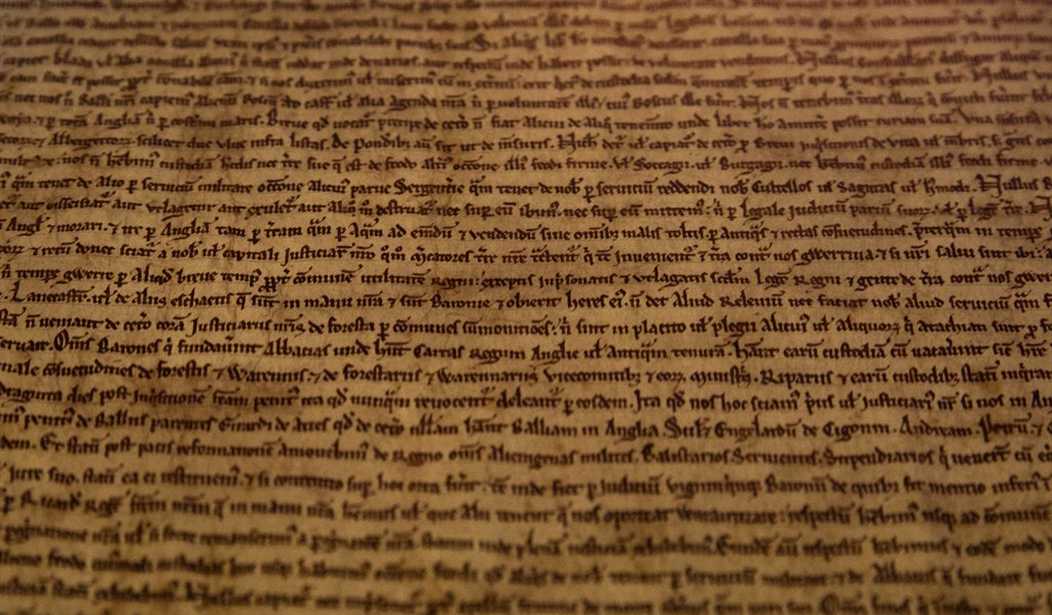
Eight hundred years ago the Magna Carta was signed and miraculously preserved for all mankind. But why does it matter to us — and why are we called to celebrate its octocentenary?
The Heritage Foundation explains:
Magna Carta – the Great Charter – is one of the foundational documents in Anglo-American legal history. Ironically, it began, not as a statement of principle, like our Declaration of Independence, but as a peace treaty. Signed on June 15, 1215, in a field at Runnymede, England, Magna Carta sought to end the barons’ rebellion against King John by forcing the crown to adhere to the laws and customs of the realm. Magna Carta was initially thought to be a failure because King John repudiated the treaty almost before the ink was dry. But time has been good to the Great Charter. In fact, it is difficult to overstate the importance of Magna Carta in the development of Anglo-American law. English law treats it as “the Bible of the English Constitution.”The American Framers used the phrases “the law of the land” or “due process of law” in numerous important contemporary legal documents, including statutes passed by colonial assemblies, resolutions enacted by the Continental Congress, the Declaration of Independence, and state constitutions. Magna Carta has come to stand as proof that a written document can make important revisions to the law, fend off tyrannical government officials, restrain even the sovereign’s power, and grant rights to the entire community, not merely to certain favored individuals – an enduring legacy that helped to establish “the rule of law.”
And of course, property rights.
Daniel Hannan, who is a bestselling author and long-serving member of the European Parliament, spoke about the importance of the charter last Wednesday at The Heritage Foundation.
Among other things, he explained why the Magna Carta was such a revolutionary invention, becoming, in some ways, indispensable to the American Founders at the Constitutional Convention in 1787.
“What happened on that reedy stretch of river, in my constituency 800 years ago, was the most important bargain struck in the history of mankind,” he intoned. “This was the first time that [the law was seen] as something bigger than the will of the king.”
“It’s almost impossible now to imagine what a revolutionary ideal that was,” he continued. “That above the king was something you couldn’t see or hear or touch or taste, but that bound the sovereign as surely as it bound [his subjects]. And in that [document] lies the seeds of all the freedoms that we now regard as modern and rational: Regular elections, jury trials, uncensored newspapers, equality between men and women, habeas corpus.”
And so, perhaps not surprisingly, he likened the great English charter to a famous foundational text, one that provides both moral clarity and legal instruction.
“I’ve always thought of Magna Carta as, if you like, the Torah of the English-speaking peoples,” he said. “It’s the text that sets us apart, while at the same time [offers] universal truths for the rest of mankind; something that happened to take place among the English-speaking peoples, but is applicable anywhere if people adopt the same precepts.”
“What an extraordinary secular miracle,” he added. “And it’s one that has a special place for all of us, wherever our ancestors came from, who now speak this language and live in common law societies.”
Nonetheless, Hannan lamented the fact that the great and imperishable charter had been neglected – and underappreciated – for centuries by the English.
"What an extraordinary oversight that there was never a monument there [in the United Kingdom] until 1957 when a pillar was finally erected...by the American Bar Association,” he said.
“At last, I am glad to say we have rectified that omission,” he went on to say. “I was very proud to have been involved with the raising of the first British memorial at the place where freedom was born.”


Join the Conversation
VIP members get the ability to comment on articles.