





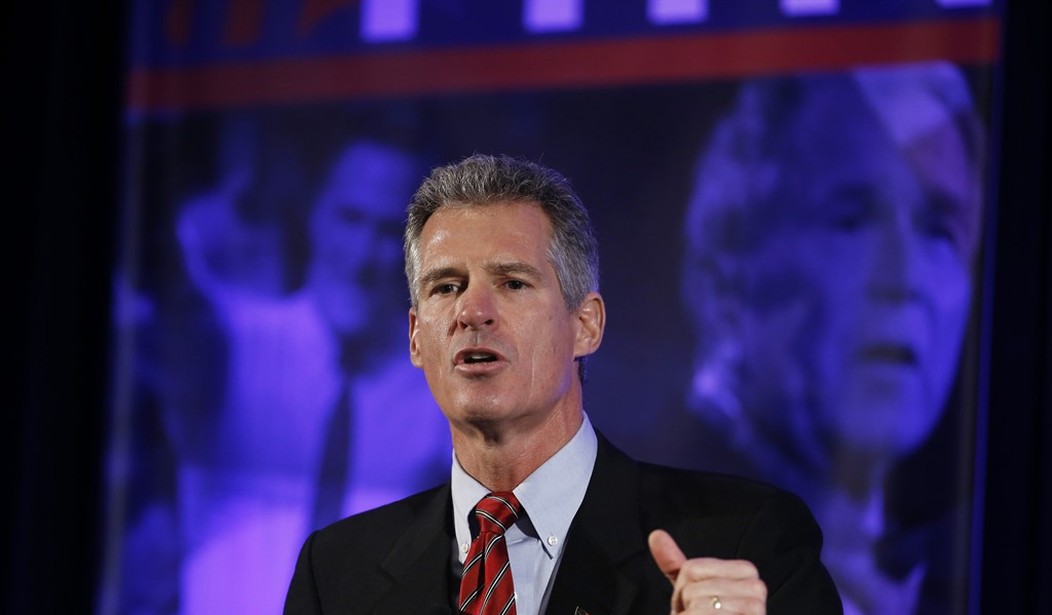
Scott Brown, the former Massachusetts Senator, is running for the Senate again, this time in New Hampshire.
Brown served in the Senate from 2010, when he won a special election to replace the late Ted Kennedy, until he was defeated by Democrat Elizabeth Warren in 2012. Since leaving the Senate, Brown also served as the U.S. Ambassador to New Zealand and Samoa.
Now he's setting his sights on returning to the Senate, but there's a problem. Brown is running on a platform of fiscal conservatism, but his record shows a troubling pattern of siding with Democrats on economic bills.
During an interview earlier this month, Brown claimed that the national debt and deficit were his top issues, telling The Conway Daily Sun:
The debt and deficit are my top issues, I support a balanced budget, like we have in our states and we have in our homes.
I support a line-item veto. I don’t care what party is in charge, because we need to do something. I believe we’re at a fiscal cliff. When I was in Washington, there was $9 trillion national debt, and now it’s what, $40 trillion? That’s unacceptable. We can’t sustain that. And having four grandchildren. It bothers me greatly.
Despite this statement, Brown's voting record has cost taxpayers more than $4.6 trillion in added deficits. Brown voted for the American Taxpayer Relief Act in 2012, which raised taxes on high-income Americans. His fellow Senator Sherrod Brown said the bill reduced the deficit; Politifact listed that claim as "half true," noting the $4.6 trillion in added deficits.
This vote also betrayed Brown's own anti-tax pledge, and it raised income taxes on high earners as well as increased capital gains and dividend taxes from 15 to 20 percent. It also raised the estate tax from 35 to 30 percent and delayed sequestration (spending cuts) for two months.
Brown's votes also added $369 billion in regulatory burdens, and $2.1 trillion in new debt.
Brown was the deciding vote on the Dodd-Frank Wall Street Reform Bill, and was one of only three Republican Senators to vote for it. The Dodd-Frank Act was sponsored by then-Rep. Barney Frank (D-MA) and then-Sen. Christopher Dodd (D-CT), who led the effort to pass sweeping financial reforms in response to the 2008 financial crisis. The financial fallout of that Democrat-sponsored bill was wide and lasting. It increased U.S. bank expenses by more than $50 billion per year; it created the Consumer Financial Protection Bureau (CFPB), which is what costs consumers $369 billion in regulations over the years, including $1,100-$1,700 in increased mortgage costs per originated loan. After the passage of Dodd-Frank, new bank charters dropped from 100 per year to just six, and almost 2,000 banks disappeared through failure or merger post-Dodd-Frank.
In 2015, French Hill, then Chairman of the House Committee on Financial Services, warned that "we're now losing one community financial institution a day."
Harry Reid once praised Brown's vote, calling him one of the "few brave Republicans who understand how important this bill is for our economy."
Brown also broke the Republicans' filibuster on Reid's $15 billion jobs bill in 2010, one of only five Republicans to vote for cloture. Brown voted for final passage of the bill, and Reid called it "the beginning of a new day" in the Senate, and NBC News praised Brown for "reviving GOP moderates' role" in the Senate.
Reid's praise of Brown didn't stop there, either. Reid said of Brown that "we both understand each other well," and that he "appreciate[s] what [Brown] did" to vote for the Democrats' bill. He also praised Brown for supporting the Democrats' "strong comprehensive Wall Street reform."
Brown didn't just align himself with Harry Reid, however. He also protected Obama's Environmental Protection Agency from a Republican effort to enact regulatory rollbacks, a move that made New Hampshire Republicans eager to ditch Brown in favor of John Sununu. This vote was a slap in the face to Republicans, who were really pushing conservative fiscal and economic policies during the Obama administration.
When Obama and Democrats wanted to extend the payroll tax cut, Brown blasted the Republicans who opposed the move. "It angers me that House Republicans would rather continue playing politics than find solutions. Their actions will hurt American families and be detrimental to our fragile economy," Sen. Brown said in a statement at the time.
Brown was the deciding vote to extend the Obama stimulus-era FHA/VA loan limits to $729,750. The measure would have failed if Brown had voted the other way.
Brown also slammed Republicans for raising the debt ceiling after he voted to raise it. He voted for the Budget Control Act of 2011, which raised the debt ceiling by $2.1 trillion, topping out at $16.4 trillion. Brown criticized Democrat Jeanne Shaheen for her votes to raise the debt ceiling, even though he voted the same way.
If voters in New Hampshire are looking to send a fiscal conservative to the Senate, they should know that Scott Brown — despite his campaign rhetoric — has time and again voted for massive Democrat economic bills. Those votes earned him praise from then Democratic Majority Leader Harry Reid, but they did nothing to reduce our debt and deficits.
Editor’s Note: The 2026 Midterms will determine the fate of President Trump’s America First agenda. Republicans must maintain control of both chambers of Congress.
Help Townhall continue to report on the Democrats’ radicalism and inform voters as our nation faces a crossroads. Join Townhall VIP and use promo code FIGHT to receive 60% off your membership.



Join the Conversation
VIP members get the ability to comment on articles.