





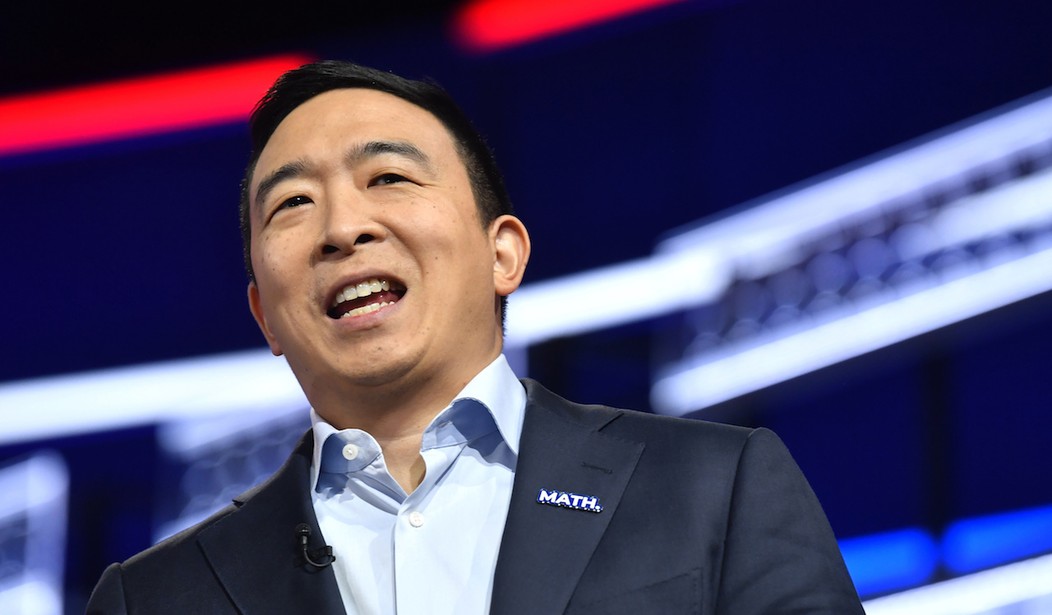
Democratic presidential primary candidate Andrew Yang famously wants to give all Americans $1,000 per month. His “freedom dividend” is a key plank in his policy platform and Yang frequently touts his plan to give away money. But the 2020 primary contender has other ideas as well.
I’m literally trying to give everybody money.
— Andrew Yang?? (@AndrewYang) November 16, 2019
Should actually be “If I were a doctor . . .“ Grammar police. ??
— Andrew Yang?? (@AndrewYang) November 25, 2019
As Townhall has previously noted, Yang advocates for getting rid of the penny, legalizing marijuana, granting the franchise to 16-year-olds and creating term limits for members of Congress and Supreme Court justices.
The candidate also wants to create a new department and impose regulations on technology companies.
In a CNN op-ed the presidential hopeful discusses the impact of heavy technology use on children and advocates for regulating technology businesses. He says that “Kids are getting hooked on apps like Facebook, Instagram and Twitter and spending too much time on digital devices,” and he proposes the creation of a new department called the Department of the Attention Economy.
“As president, I will establish a Department of the Attention Economy that will work with tech companies and implement regulations that curb the negative effects of smartphones and social media,” Yang explains.
He provides several examples of how he believes these platforms should be altered, such as placing a per-day limit on the amount of content suggested to each digital consumer.
We can start by curbing design features that maximize screen time, such as removing autoplay video and capping recommendations for videos, articles and posts for each user each day. Platforms can also use deep-learning algorithms to determine whether a user is a child, and then explore capping the user's screen hours per day.
Design features that encourage social validation should also be removed. Instagram is leading the way by testing hiding likes on the posts of some users. That's a step in the right direction and it should be implemented as soon as possible. In addition, the number of followers a person has on social media should be hidden too, as it represents a false equivalence with a person's social standing.
Among his recommendations, Yang says that “Rules and standards should be established to protect kids from graphic content and violent imagery.”
He also suggests training children, stating that, “schools can set an early standard for our kids. This requires teaching kids about responsible technology use as part of the health education curriculum. We can also teach children how to assess the quality and source of information so that they're not susceptible to misinformation when they come across it online.”
The idea that social media companies should be regulated in this manner is not a position exclusively held by those on the political left. Earlier this year Sen. Josh Hawley (R-MO) introduced the Social Media Addiction Reduction Technology (SMART) Act. According to the senator’s press release that legislation “would ban certain features that are designed to be addictive, would require choice parity for consent, and would give users the power to monitor their time spent on social media.”
Silicon Valley parents are among the most likely to say that their kids get zero screen time. That tells you all you really need to know.
— Andrew Yang?? (@AndrewYang) June 9, 2019
Yang lays out more ideas related to regulating technology companies on his website. One of the other points in his larger plan is to “Regulate the use of data and privacy by establishing data as a property right.”


Join the Conversation
VIP members get the ability to comment on articles.