





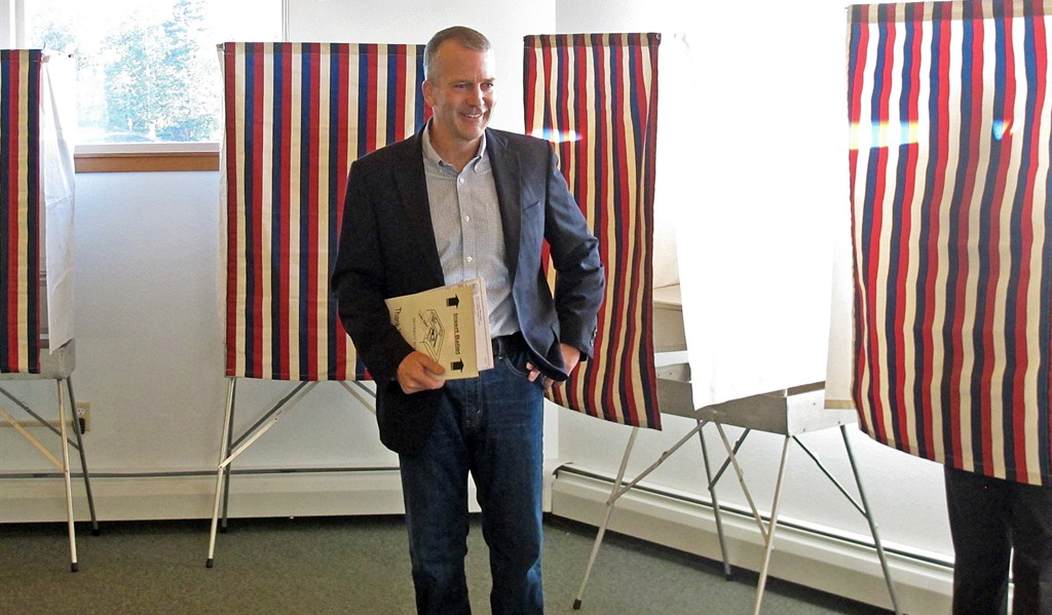
We knew it was trash from the start. Ranked choice voting, a top-four primary, and benchmarks to get on the ballot that are so low, you’d think it’s a prank. That’s Alaska, and it could cause issues for incumbent Republican Sen. Dan Sullivan, who has a man with the same name running, and both men have advanced to the next round of this circus. The Wall Street Journal’s Kimberley Strassel has called this whole process a “travesty,” and broke down this a**-backward way of electing people:
Alaska conducts elections in two stages under completely different rules. First, all candidates, regardless of party, face off in a primary, in which each voter casts a single vote. The top four finishers advance to the general election, in which voters can rank all four and their votes shift in multiple rounds of counting in which the bottom finisher is eliminated and his votes reassigned.
As with Alaska’s past races under this system, which began in 2022, there was the usual insane complexity: 17 candidates for governor, 16 for the U.S. Senate, 15 for the state’s lone House seat. This is in part a function of Alaska’s silly filing requirements, the loosest in the country. Anyone can run for office for a fee of $100—no need to gather petition signatures. That encourages frivolous candidacies in Alaska’s system, allowing attention seekers the guarantee of having their name listed next to prominent people—and free media.
Alaska’s House contest featured, again, Eric Hafner, who is serving a federal prison term in New York after pleading guilty in connection with a string of threats against government officials. He made the final ballot in 2024, and may do so this year, too. The Senate race featured his mother, Carol Hafner, and Green candidate Richard Grayson—neither of whom lives in the state. Of more than 30 candidates running for the Senate and House, few outside the incumbents or the main Democratic challenger even tried to raise money. Mr. Grayson recently explained that he was running “for fun,” that he actually supports Democrat Mary Peltola, and that if he makes the final four, he’ll quit. This is the contempt RCV encourages candidates to show Alaska voters.
At least the felon and the out-of-staters weren’t deceiving voters. The Senate race featured the last-minute entry of a retired elementary school teacher with a history of supporting Democrats, including Mrs. Peltola. He happens to be named Daniel Sullivan—the same name as the Republican incumbent—and filed, just before the deadline, to run as a Republican. The decoy insists he isn’t trying to confuse voters, and isn’t working with Mrs. Peltola or her supporters. Yet his filing documents were handled by an Anchorage Democratic consultant, and his campaign logo is a near replica of Sen. Sullivan’s.
Doppelgangers have run in other elections but, again, Alaska’s system dramatically increases the spoiler potential. In a jungle primary teeming with candidates, voters struggle to focus on individuals or disputes. Every name is dropped on one big ballot. The Sullivans were adjacent this year, with the decoy candidate listed first. How many Alaskans ticked the first box, unaware they were voting for someone other than whom they intended?
With 80% of the vote counted, Mrs. Peltola has 64,000 votes and Sen. Sullivan has 57,000. No. 3? Decoy Dan, with 3,200 votes, who didn’t campaign and has only 12 donors (not including himself). Alaskans will be even more confused when they have to “rank” the two Dans in November.
What the hell is even this system? Many have said it before, and they should keep saying it. Anyone can get on the ballot for $100, and you see the unseriousness of it all in the House race.
Nuke this method from orbit.
Editor's Note: Do you enjoy Townhall's conservative reporting that takes on the radical Left and woke media? Support our work so that we can continue to bring you the truth.
Join Townhall VIP and use promo code FIGHT to receive 60% off your membership.


Join the Conversation
VIP members get the ability to comment on articles.