
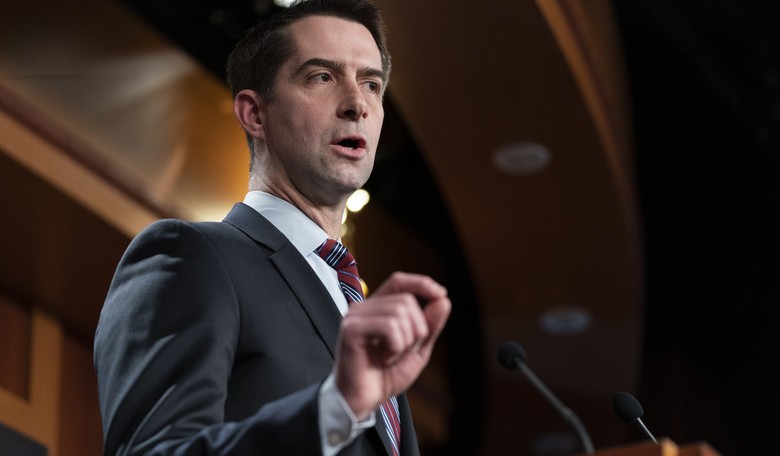
As senators pressed acting Navy Secretary Hung Cao on Tuesday on the Iran war’s human and financial costs, and its toll on American military readiness, Sen. Tom Cotton used his time to argue for seeing the war through. The United States, he said, “need[s] a victory strategy, not an exit strategy.”
Cotton’s remarks at Tuesday’s Senate Armed Services Committee hearing challenged a view shared by much of the Left and a growing number on the Right. The problem was not the decision to go to war in the first place, but the failure to follow through and secure a victory.
His questioning was largely a monologue, but it laid out his case. He criticized the memorandum of understanding signed earlier this year and challenged the notion that the war was responsible for the Navy’s budget request, asking Cao whether the absence of Operation Epic Fury would have saved taxpayers even a penny of the proposed spending.
Democrats want to end the war by surrendering to Iran, unilaterally raising the white flag, and allowing terrorists to control the Strait of Hormuz. Wrong. America needs a victory strategy, not an exit strategy. https://t.co/dccAyFTsul
— Tom Cotton (@SenTomCotton) November 17, 2026
"Secretary Cao, thank you for your appearance and your service here today. We've heard a lot from Democratic senators this morning about ending the Iran war, by which I think they mean surrendering to Iran, just simply unilaterally raising the white flag, letting Iran control the Strait of Hormuz, letting its terrorist proxies control other critical waterways in the region, letting them rebuild their nuclear weapons program as well," Sen. Cotton said. "I too would like to end the Iran war, by winning the war."
I wish we had won it in April, by allowing the military to finish its operational plan and then put in place the blockade that we've had in place over the last few months, and by forcing the Strait open, as it has been now for a couple months, we need a victory strategy, not an exit strategy. We certainly don't need another ill-advised, naive, foolish memorandum of understanding, which this summer allowed Iran to regroup and rearm and enrich itself, and probably prolong the war. We've heard complaints about forever wars, it's probably that memorandum of understanding that allowed the Democrats to characterize this conflict as a forever war. We need to end it by winning it now.
Cotton then turned to the financial argument for withdrawal. If the United States pulled out now, as Democrats and some on the Right advocated, effectively conceding the conflict and control of the Strait of Hormuz, would that reduce the Navy’s budget request and save taxpayers any money?
Acting Secretary Cao replied that the Navy had submitted its previous budget request before Operation Epic Fury began and needed the funding to rebuild a fleet worn down by earlier “forever wars.” In other words, the Navy would still need the money, whether the United States finished the fight or walked away.
Sen. Cotton’s remarks come as Republicans debate the Iran war’s role in their midterm defeat just two weeks ago. Many have blamed the war itself, rather than distinguishing it from the higher gas prices that contributed to their electoral loss. Yet much of that debate has focused entirely on the costs of military action without seriously confronting the alternative: the prospect of a nuclear-armed Iran.
Vice President JD Vance and others have been quick to call the war a mistake, and while President Trump has acknowledged that it contributed to the midterm defeat, has said he would launch Operation Epic Fury again if faced with the same choice.
Ordinary Americans do not have access to the intelligence that informed his decision, but if we accept that his decision was justified, the problem is not that America went to war. It is that Americans no longer seem to have the stomach to see even a just war through, and that is a far more serious problem than an electoral defeat.