
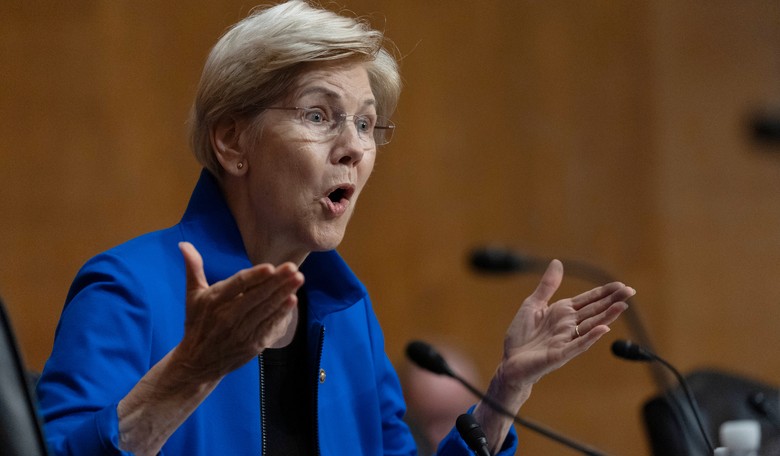
Senate Democrats, in their infinite wisdom, say they have a plan to work with President Trump to tackle affordability. Their first proposal? A bill that could effectively cut off credit card access for poor people.
In a video posted on social media Monday, Massachusetts Senator Elizabeth Warren outlined a series of bills Senate Democrats want passed to address affordability. She offered few specifics on most, promising to make housing more affordable and “protect rural hospitals.” Her opening pitch, though, was specific: capping credit card interest rates at 10 percent.
Let’s cap credit card rates at 10%. Take action on affordable housing. Protect rural hospitals. End price gouging. Democrats have the bills ready. @SenWarren says now it’s up to Trump to work with us and get things done. https://t.co/esbLIU149c
— Senate Democrats (@SenateDems) November 9, 2026
"Look, President Trump himself said that he wants to reduce interest rates on credit cards to 10 percent. I got the bill. I'm ready to go," Senator Warren said. "President Trump says he wants to do more on housing. We're ready. We have the bills ready to go. And besides that, we've got a whole bunch more that the American people have told us that they want on price gouging, on protecting our rural hospitals, on making sure that people have access to health care."
"We have a lot of work lined out that we can do. In fact, those may sound like lots of different pieces. They're not. They're all about economic power," she added. "And people have told us that's what they want. And we've got the team to deliver now."
Of course, there are a couple of problems with Senate Democrats’ proposal, mainly that if you put a price control on interest rates, you’re very quickly going to find that poorer Americans and those with bad credit increasingly find credit out of reach.
Higher interest rates are used to compensate banks for the risk of lending. Banks can’t just give out free money, and the less likely someone is to pay it back, the higher the interest rate they’re charged. That helps cover potential losses and makes lending worthwhile. Cap what banks can charge without reducing that risk, and they may simply stop lending to riskier borrowers, until, of course, Democrats push another bill to force risky lending, and then we could be looking at another recession.
But here’s what makes this even more concerning. The vast majority of Americans actually support capping credit card interest rates. According to a Wall Street Journal poll, that number is as high as 79 percent of the country. So either Americans support a harmful policy despite its consequences, or they don’t understand what those consequences are.
And we don’t have to speculate about them, we already have several case studies.
Arkansas has a cap written into its state constitution and regularly sees its stores flee to Texas. Illinois tried to cap rates in 2021, and loans to risky borrowers fell by 38 percent. There are also several international examples, and they saw massive declines in access to credit. That’s bad not just for people who need to borrow, but for the broader economy as well. Less access to credit means less spending, fewer sales, and less economic activity.
Democrats want to cap credit card rates at 10%. Sounds great. It's been tried. Arkansas capped interest at 10% for more than a century. Stores moved across the line to Texas. Illinois capped small loans in 2021. Loans to subprime borrowers fell 38%. Chile cut its cap in 2013. Nearly 1 in 10 borrowers lost access to bank loans. Kenya capped rates in 2016. Loan approvals fell from 50% to 34%. They repealed it. A price cap on credit doesn't make credit cheaper. It makes it disappear for the people with the weakest credit.
— Justin Hart (@justin_hart) November 10, 2026
While President Trump has said he plans to work with congressional Democrats, he has not signaled what economic policies he might be willing to negotiate on, instead highlighting his willingness to moderate on deportation policy. But earlier this year, the president called for a 10 percent cap on credit card interest rates, accusing banks of earning too much profit in a speech that sounded like it came straight from the mouth of a red-blooded socialist.
.@POTUS: "The profit margin for credit card companies now exceeds 50%, and they charge Americans interest rates of 28%... So, to help our citizens recover from the Biden disaster... I'm asking Congress to cap credit card interest rates at 10% for one year." https://t.co/E5QISES0hA
— Rapid Response 47 (@RapidResponse47) January 21, 2026
It is unclear if that is something the president is still willing to do, but at the very least, this should serve as a warning: this is a socialist policy, a price control, and something nobody who stands for the free market should support.