





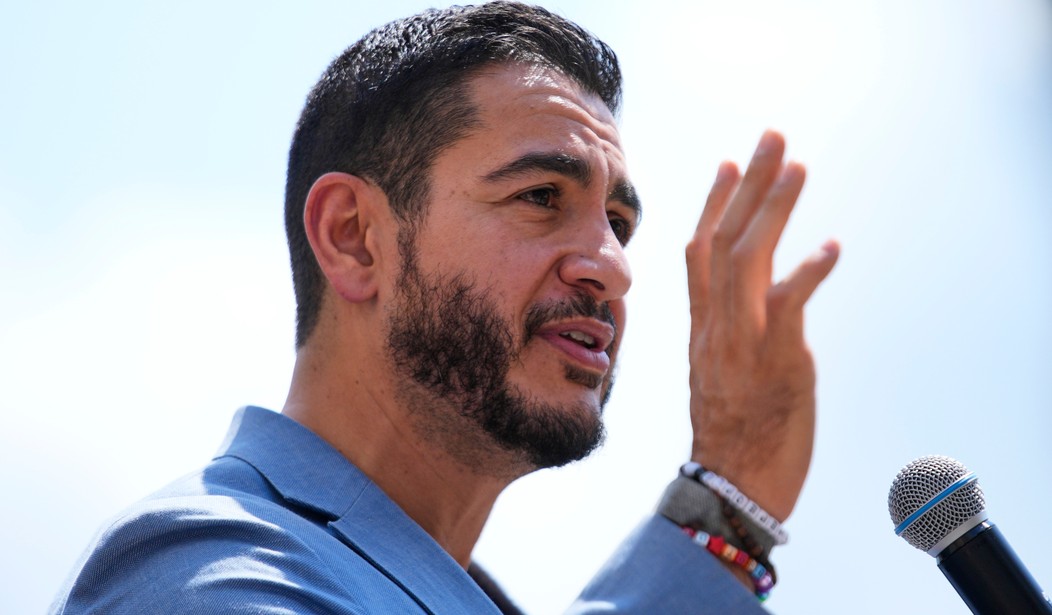
Democrat Abdul El-Sayed, who is running for the U.S. Senate in Michigan, is facing growing backlash for his insensitive and sexist comments over breast cancer funding. Last week, El-Sayed drew fire from Republican Mike Rogers after a 2012 essay resurfaced in which El-Sayed attacked the "Pink Ribbon Lobby" and wrote that breast cancer funding was prioritized because the disease affects people with "social power and privilege."
Here's some of what El-Sayed wrote in that essay, during Breast Cancer Awareness Month in 2012 (emphasis added):
The article, which explored NIH (and Department of Defense) disease-specific funding patterns in relation to changes in the density and lobbying dollars of disease-specific interest groups, suggests that interest groups can successfully lobby the NIH to increase the amount of funding allocated to their diseases of interest.
The findings are at once reassuring and deeply unsettling.
For people suffering with certain diseases, the idea that their voices, along with others afflicted with similar ailments may be heard and listened to certainly has appeal. Even as the research horizon is long, and investments may not yield tenable improvements in disease outcomes within their lifetimes, it’s satisfying to know that their advocacy may have “made a difference.”
But here’s the catch. We all get sick, and everybody dies of something. And what’s to say that one person’s cause is more important than another’s?
...
The breast cancer lobby has done an incredible job raising my “awareness” of Breast Cancer—if I weren’t an epidemiologist, it would have me believing that the women around me were in imminent danger. And perhaps they are—but the numbers suggest other diseases I should be far more worried about. In fact, women are twice as likely to die of lung cancer than breast cancer, and nearly six times as likely to die of heart disease.
...
After all, those once or currently affected by a disease are most likely to advocate for funding allocation to it. It’s also possible that advocacy is a function of the social power and privilege of those most likely to get a disease—one of the findings of the article. If so, that would mean that disease-specific lobbying would drive funding toward more survivable, less deadly diseases more likely to affect those with access to treatment.
One in eight American women will be diagnosed with breast cancer in her lifetime. This year, 42,000 women will die of the disease. In Michigan, that means 9,900 women will be diagnosed with breast cancer this year, and about 1,350 women will die from it.
Breast cancer, if caught early enough, is one of the most survivable forms of cancer, which is why the emphasis is on early detection and treatment. Abdul El-Sayed would rather that not be the case.
And he's getting tremendous backlash for these comments.
Laura Ingraham, herself a breast cancer survivor, slammed El-Sayed.
🚨 THIS ONE IS PERSONAL: El-Sayed’s breast cancer comments hit home for me 🎗️
— Laura Ingraham (@IngrahamAngle) September 18, 2026
As a BREAST CANCER SURVIVOR, I can’t get past his argument that research funding may reflect the “social power and privilege” of those most likely to get the disease.
Breast cancer is the… pic.twitter.com/QCksVyTn4o
"This El-Sayed story. It keeps getting worse. Now, he's offending breast cancer survivors, which includes yours truly," Ingraham said. "His central argument is that NIH's budget should reflect the 'public health need.' El-Sayed concludes that it's also possible that advocacy is a function of the social power and privilege of those most likely to get the disease."
"What?" Ingraham continued. "Meanwhile, in reality, according to the American Breast Cancer Society, breast cancer is the second leading cause of cancer deaths among American women, just after lung cancer and about one in 43 women will die from breast cancer."
Sen. Bernie Moreno's wife, herself a breast cancer survivor, said El-Sayed's comments are "a slap in the face to all women who have faced this brutal disease."
He also said, "My wife kicked breast cancer’s a** and is tougher than Abdul could ever hope to be."
The extremist from Michigan’s vile claim saying that funding for breast cancer research is “disturbing” is a slap in the face to all women who have faced this brutal disease.
— Bernie Moreno (@berniemoreno) September 16, 2026
My wife kicked breast cancer’s a** and is tougher than Abdul could ever hope to be.…
Alabama Sen. Katie Britt said 300,000 women will get a breast cancer diagnosis this year, including those 9,900 in Michigan.
Over 300,000 women are diagnosed with breast cancer annually. In Michigan, it’s roughly 10,000 women annually.
— Katie Britt (@KatieBrittforAL) September 16, 2026
You would think El-Sayed would support government funding to help these brave women, but apparently if your tax dollars aren’t being spent on child gender…
"You would think El-Sayed would support government funding to help these brave women, but apparently if your tax dollars aren’t being spent on child gender mutualization surgeries, then he isn’t for it. It’s nonsensical and disgusting. Michigan deserves better," she wrote on X.
Michigan Rep. Lisa McClain said it was a good thing El-Sayed never had a license to practice medicine.
And thank God he’s not one. This is the guy who called breast cancer funding “disturbing” because it helped people with “social power and privilege. https://t.co/Vcoj9NCTCX https://t.co/kiPiLboPNj
— Lisa McClain (@LisaForCongress) September 17, 2026
"And thank God he’s not one [a doctor]," McClain wrote on X. "This is the guy who called breast cancer funding “disturbing” because it helped people with “social power and privilege."
The same day El-Sayed's 2012 essay resurfaced, White House Chief of Staff Susie Wiles announced she was cancer-free after being diagnosed with early-stage breast cancer in March.
Mike Rogers released an ad blasting El-Sayed over the remarks.
This is another example of El-Sayed's long history of sexism, too. In 2019, while an associate director at Mount Sinai, El-Sayed was named in a gender- and age-discrimination lawsuit for refusing to work with "anyone over 40" and bragging about his role as a fake doctor to further promote his own career.
During the primary, supporters of Haley Stevens accused El-Sayed of being sexist after he referred to Stevens as "the least capable candidate in America" and that she was "unable to string two coherent sentences together."
Now El-Sayed thinks women who have breast cancer shouldn't get treatment or funding because of their "social power and privilege."
"Abdul El-Sayed believes women don't deserve the care men do," said RNC Spokesman Hunter Lovell. "And his history of disrespecting and degrading women has become impossible to ignore."
Editor’s Note: The 2026 Midterms will determine the fate of President Trump’s America First agenda. Republicans must maintain control of both chambers of Congress.
Help Townhall continue to report on the Democrats’ radicalism and inform voters as our nation faces a crossroads. Join Townhall VIP and use promo code FIGHT to receive 60% off your membership.
Join the Conversation
VIP members get the ability to comment on articles.