





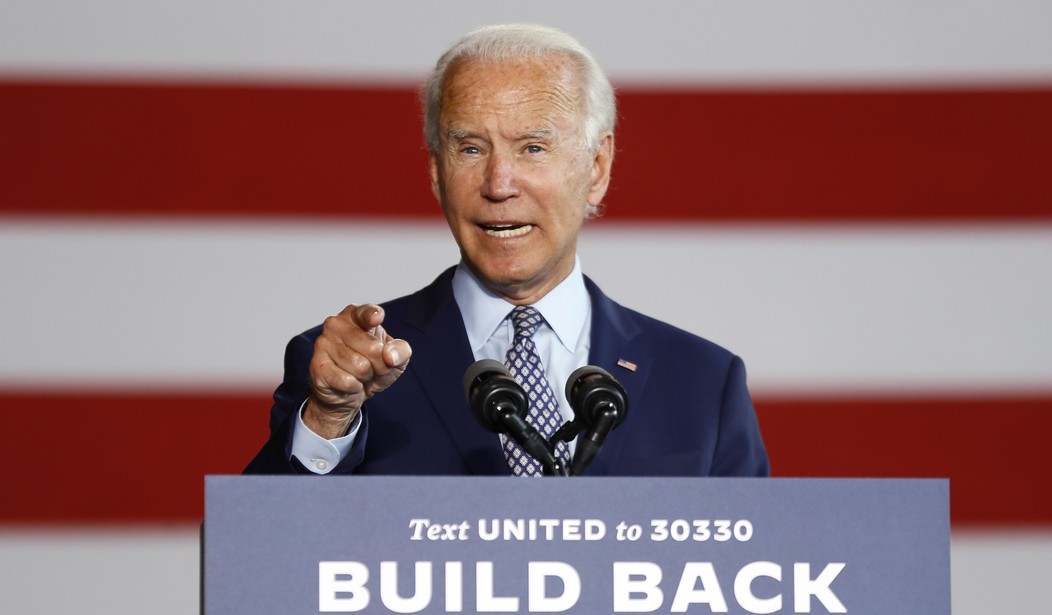
If you read presidential candidate Joe Biden’s economic plans (“Build Back Better” and “Made in America”), you get a feeling of déjà vu, of having heard it all before: “America, good. China, bad.”
If it was not sprinkled with obligatory “Trump, bad” quips you might think it was lifted from Trump’s program. The leitmotif is: “I am going to do the same things as Trump, but better.”
To be fair, there is nothing wrong with wanting a strong economy, a manufacturing presence on U.S. soil, and aspirations for American companies to become better than their foreign competitors. In these divided times, it is reassuring that, regardless of their differences, both Trump and Biden, at least on paper, want to improve the economy.
But will Biden’s Trump-ish plan actually do that?
One of Biden’s proposals is to Make “Buy American” Real. Basically, if the federal government is paying for a bridge, the contractor must get its steel, cement, and other materials from American companies. This, according to the plan, should help U.S. companies compete with foreign rivals.
This creates the impression that the main global trade issue is companies participating in U.S. public procurement and sourcing work and materials abroad.
Biden talks a lot about public procurement of steel and other construction materials. Yet, steel imports make up less than one percent of what Americans import (and that’s including all steel imports, not just steel for public procurement). Americans spend more on foreign wine, beer and other alcoholic beverages (see page 9 here) than they do on foreign steel.
“Drink American” would have a much larger impact on the trade deficit.
There is nothing wrong with wanting to have a strong domestic steel, or battery, or medical supply industry in the U.S. The issue is how to achieve it.
If we stick to the steel example, in order to qualify for “Buy American” public procurement, all the steel products would have to be “mined, melted, and manufactured” in the U.S. Which means that bolts and nuts used in construction would have to be manufactured in U.S/ from a steel melted in the U.S. from the iron ore mined in the U.S.
Once again, nothing wrong with the notion of making America a good place for an entire supply chain of the steel industry (or any industry). But just to put things in perspective, U.S. iron ore production is 20 times smaller than that of Australia, 9 times smaller than China, and constitutes a mere 2% of global production.
Is the Democratic Party ready to make the U.S. a good place for mining, smelting and making steel? Perhaps. But it will be interesting to see how this is received by the left wing of the Democratic Party with their Green New Deals (Andrea Ocacio-Cortez and Bernie Sanders each have one) proposing energy taxes, decarbonization, 100 percent renewables, and an emphasis on the environment over industry.
The plan also includes a tax credit that “promotes revitalizing, renovating, and modernizing existing – or recently closed down – facilities.” Once again, nothing wrong with a tax regime under which companies pay less taxes. But this money comes with strings attached – only the chosen ones will be able to benefit from lower taxes.
Who will be the chosen ones? The plan says “[companies with] strong labor standards, including paying workers a prevailing wage <...>.” It looks like the government might be picking the winners based on politics – their stance toward unions.
The whole plan suffers from the arrogant premise that if the government is buying something, it can pressure private companies to support certain political objectives. Government already exerts control on the economy. First, by taking a part of your paycheck (like taxes), second by spending your taxes on what they think is needed (like infrastructure). But here you have a third degree of influence – government rewarding or penalizing companies according to political beliefs. To be fair, Biden is not the only one proposing that, but this should be troubling.
To be fair, the plan is not terrible in the parts where Biden sounds pro-development and pro-enterprise. However, these vague sentiments contrast starkly with some of the measures proposed. Can you be for business, mining, and manufacturing in one paragraph, and for big-government labor and environmental policies in another?
Also, “Buy American” is a worthy slogan. But does it imply a policy where American companies produce superior products that everyone wants to buy? Or a policy where American are forced to buy American products?
One is clearly better than the other.

Join the Conversation
VIP members get the ability to comment on articles.