





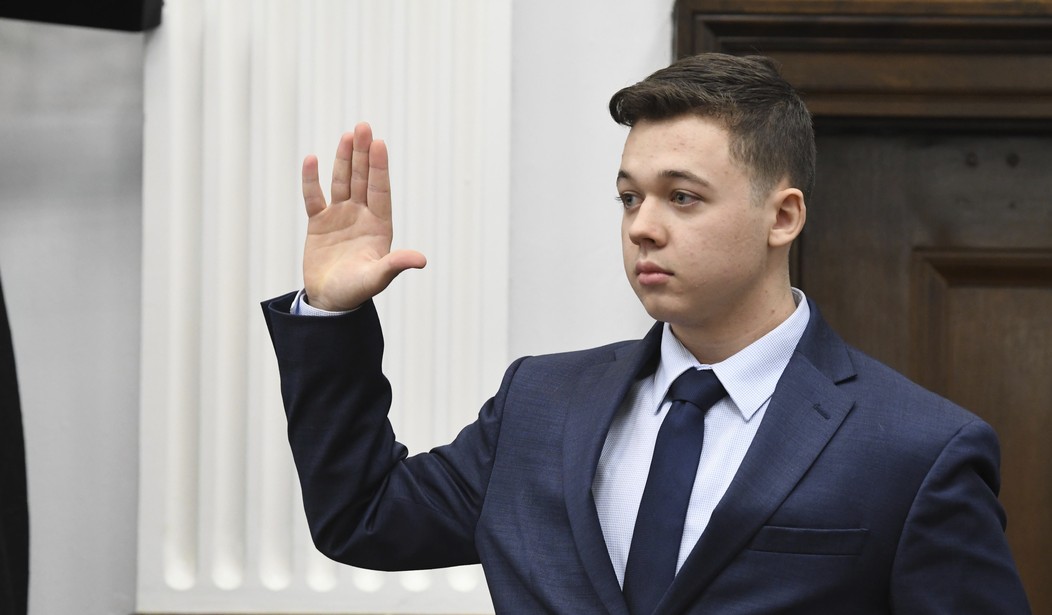
Editor's note: this piece was authored by Addison Hosner.
Regardless of your opinion on the outcome of the Kyle Rittenhouse trial, one thing cannot be denied — from a legal standpoint, the verdict was correct. You don’t have to like it, you don’t even have to tolerate it, but you have to understand: Legal decisions are not made with the emotional state of proponents and dissidents in mind — nor should they be. Unfortunately, as a nation, it seems we’re becoming less and less able to separate facts from our feelings. In order to address difficult conversations in the future regarding criminal justice, we need to do better as a society to accept that one’s own subjective feelings are not dispositive on proving a person’s criminal actions “beyond a reasonable doubt.”
The Rittenhouse trial yielded the only correct verdict the evidence could have produced. In fact, the case was so cut-and-dry that there are many criminal lawyers who’d agree it should have been settled by a judge via directed verdict and never have gone in front of a jury. Trials, as with all legal hearings, are meant to provide the presiding judicial officer with facts and evidence that will then be used to determine the appropriate causes of action and the application of law. Nowhere in a judge’s job description is it mentioned that they must consider the emotional toll on a society, individual, or group, in their hearings or rulings. That is outside of the scope of their duties and their role in the legal system. If even one judge was to take that upon themself, it would set a dangerous precedent for abuses of discretion. Allowing judges to substitute the law with their own beliefs would spell the end of the Sixth Amendment and the right to an impartial trial, but thankfully, that did not occur in the Rittenhouse case.
Kyle Rittenhouse was cleared of all six Counts brought against him, not because Judge Schroeder had sympathy or bias towards the defense, but because the application of the law to the facts led the jury to that conclusion. The instructions to the jury were clear, concise, and legally accurate — and the application of the facts to the law were correctly assessed by the jury. Whether the jury's verdict fits with the public’s subjective interpretation of justice is irrelevant. As a society we must do better to assess sensitive subjects without conflating objective and subjective thought.
You can find the actions of Kyle Rittenhouse to be grotesque; you can vehemently disagree with his decision to show up to the streets of Kenosha with an AR-15 style weapon masquerading around as a vigilante; and you can mock his display of remorse that was for all to see during his trial. However, you cannot subjectively decide that because of these actions the black letter law should be applied differently due to the societal impact and political advantages to be gleaned from this tragedy. To do so would be an insult to The Framers, who routinely espoused that subjective judicial activism would create a downward spiral that would see judicial officers substituting their own pleasure for the law of the land.
Which leads me to this point: The criminal justice system and the role of the judiciary in our society should never be used as a tool of political fanfare. This trial, as with other high profile cases, was hijacked by our media sources and mutated into an animal that catered to radical supporters and dissidents on both sides of our political aisle. Forget the fact finding process and rules of criminal procedure; instead, media attention was focused on the protests — the subjective thoughts of the most vocal members of our society. This created a perverted spectrum of opinion which completely ignored an objective reading and application of law.
Too much stake has been put on labeling Kyle Rittenhouse as a hero or villain, and not enough stake has been put on the factual narrative and understanding of what took place the evening of August 25, 2020. What to say of the two deceased individuals who engaged in assaulting Rittenhouse prior to being shot? What about the third individual who openly testified to have raised a firearm directed at Rittenhouse? Instead of focusing on the facts first and then coming to a conclusion our nation decided to come to their conclusions, pick a side, and then protest the facts.
We have a critical thinking problem in this country. If it’s not addressed soon, it will boil over and spell the end of objective reason. In law there is saying, to every case there are three sides, the plaintiff’s, the defendant’s, and the truth. Don’t like the result of this case? Then turn to enacting legislative change, not the judicial system. Courts can only work within the framework provided to them, if you can change the framework, then you can change the result.


Join the Conversation
VIP members get the ability to comment on articles.