





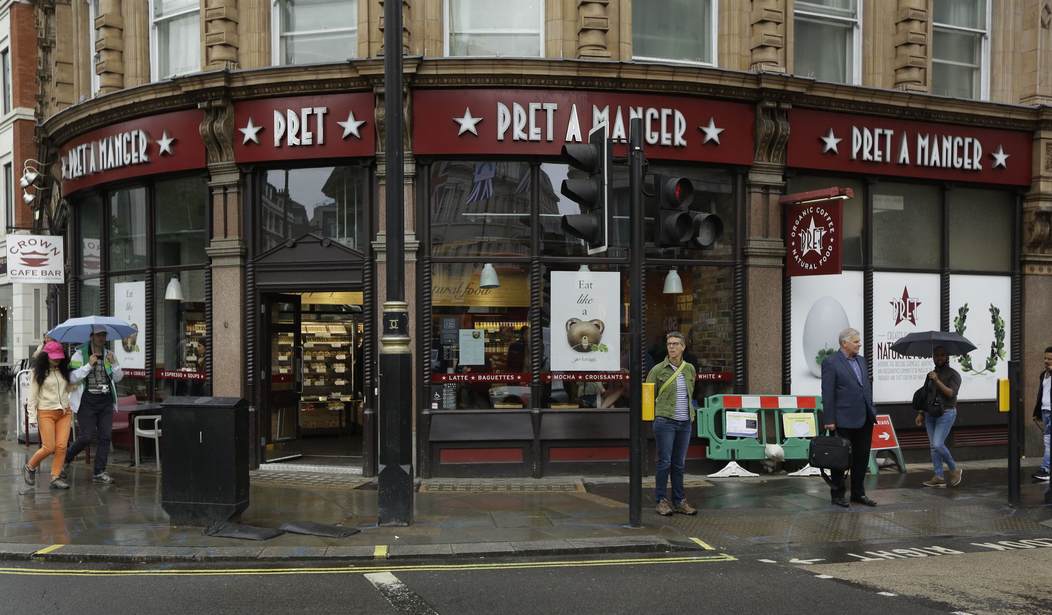
Today’s corporations must not only make the right decisions, but also ensure that they look right in the eyes of stakeholders. Shareholders and consumers expect businesses to demonstrate “social responsibility” beyond the bottom line. So you might imagine that a family-owned firm whose owners once cavorted with Hitler would make special efforts to avoid even the least appearance of antisemitism in any corner of its corporate empire. This makes the decision of JAB-owned Pret a Manger to back out of an expansion deal in Israel all the more questionable.
While most Americans have never heard of JAB (Joh. A. Benckiser) Holding Company of Luxembourg, many of its brands are household names: Krispy Kreme, Panera Breads, Caribou Coffee, Einstein Bros. Bagels, and others, plus a large stake in Keurig Dr. Pepper. It has a controlling interest in Coty Inc., a beauty company that owns dozens of brands like Clairol, Calvin Klein, Cover Girl, Max Factor, Gucci, and Tiffany’s. And in 2018, JAB bought a controlling interest in Pret a Manger, a British sandwich maker with over 60 U.S. locations, primarily on the East Coast.
JAB, it turns out, had a particularly ugly history during the Nazi era. Both Albert Reimann Sr. and his son Albert Jr. were enthusiastic supporters of Hitler, donated to the Waffen-SS, and benefited from slave labor during the war. Reimann Jr.’s adopted children still own the company; when they discovered the extent of their father’s entanglement with the Nazis, the company pledged $11 million to the Conference on Jewish Material Claims Against Germany, and the children renamed the family foundation to commemorate their own Jewish grandfather, murdered during the Holocaust.
In late 2022, as part of an aggressive program of expansion into international markets, Pret a Manger announced plans, together with the Fox Group and Yarzin Sella Group as local partners, to open up to 40 stores in Israel. Both immediately and predictably, antisemitic groups launched a campaign to scuttle the deal. After the Hamas massacre of October 7, that effort moved into high gear.
Early this month, Pret a Manger backtracked on its pledge to open in Israel, claiming force majeure, a circumstance beyond their control. The company said that due to war-related travel restrictions, their UK staff “have not been able to conduct the checks and training needed to set up Pret in a new market,” and this justified abandoning their deal. This looks reasonable at first blush, but the color quickly fades when examining the circumstances more carefully.
It is true that Israel is currently involved in a war with the Hamas terror organization, but by all estimates, the conflict is unlikely to last through the end of the year—and dozens of airlines are already flying once again into Ben-Gurion International Airport. The Pret a Manger deal was to last through the next decade, with a likely extension for at least a second ten years. A startup delay of several months is a minor hiccup on a timeline of that length; it explains a delay, but not cancellation.
Furthermore, it was obvious that boycott advocates would loudly claim the win, and say that the company succumbed to their pressure. It was obvious that Israelis would describe the situation the same way. The activism of pro-terror groups, anxious to bring back the Nazi boycott and apply it to Israel, is no secret, nor could JAB have been unaware that the planned Pret a Manger expansion into Israel was in the boycotters’ crosshairs.
So even if one accepts at face value that JAB and the Reinmann family have previously been sincere in their desire to make up for the company’s ugly past, it is almost impossible to imagine that the firm was simply unaware how the public would perceive Pret a Manger’s decision. An announcement of cancellation at this time sends precisely the message one would expect JAB to take great pains to avoid.
Unilever provided a case study in the harm done to a corporate parent and all of its subsidiaries when a particular brand goes rogue on antisemitism—as Ben and Jerry’s did in 2021. That year, Ben & Jerry’s autonomous board announced that the Western Wall of the Holy Temple, the Cave of the Patriarchs in Hebron, and all the lands the Israelis liberated from Jordan in 1967 were “occupied Palestinian territories” where its products would no longer be sold.
Although Unilever could not control the action of the Ben & Jerry’s board, the damage to the corporate parent was severe and swift: its stock shed over 25% of its value during the succeeding year. Because of the reputational and financial harm—and a desire to do the right thing in confronting antisemitism—Unilever announced in late 2022 that it had permanently sold the rights to manufacture Ben & Jerry’s in Israel to Blue and White Ice Cream Ltd., the former licensee. It did so anticipating a nasty internal fight with the Ben & Jerry’s board; the courts eventually determined that Unilever had acted within its rights.
Given its ownership of Pret a Manger, JAB similarly cannot claim that this was an independent decision over which it has no influence or responsibility—and all of its many brands are likely to suffer the consequences. Already, Jewish advocates are passing on Krispy Kreme and Dr. Pepper. Thirty-eight states now have laws and executive orders that punish companies that participate in the obsessive and hateful regimen of “Boycott, Divestment, and Sanctions” against Israel. It is clear that JAB must quickly follow Unilever’s lead, and find a way to rectify the damage done by one of its brands to the entire conglomerate.
Most of the country is not like the campuses of its formerly-elite universities. Thanks to votes from sympathetic legislators, and ordinary Americans who vote with their wallets, the U.S. remains a place where antisemitism, like all bigotry, is not tolerated.

Join the Conversation
VIP members get the ability to comment on articles.