





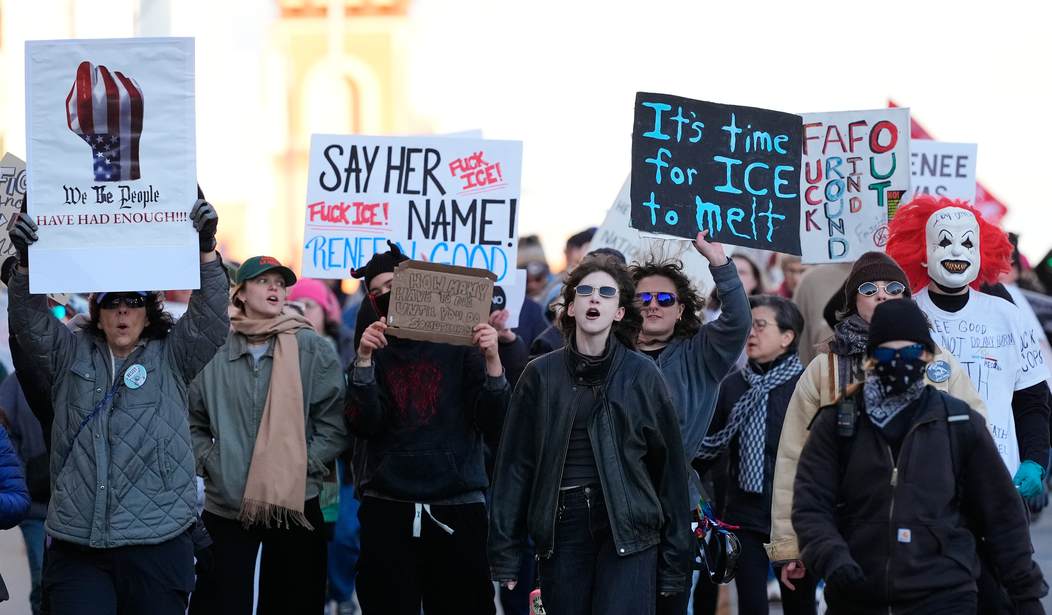
Over the past few days, videos circulating online show middle and high school students across the country walking out of class to protest ICE enforcement. In several clips, confrontations escalate. Objects are thrown at vehicles thought to belong to ICE. In one video, students—mostly girls—surround a woman, shouting accusations and hurling items. In another widely shared clip, a Georgia high school principal is knocked to the ground and struck by a group of students during a confrontation.
These incidents may be isolated. But if they are not, then they signal something deeper and troubling.
Unlike the BLM and pro-Hamas protests, which were largely driven by adults and college students, what we are now witnessing involves minors—middle and high school students leaving class in coordinated walkouts. These events appear organized, not spontaneous. And in several cases, protest quickly shifts into confrontation.
Equally concerning is the tone. Authority figures, whether federal officers, school administrators, or bystanders, are treated as moral enemies. In the most troubling clips, aggression is cheered rather than restrained.
This raises a serious question:
What happens when children are taught that authority itself is illegitimate?
What happens when emotion replaces civic literacy?
History offers a sobering perspective.
In 1966, at the beginning of China’s Cultural Revolution—a movement I witnessed as a child—teenagers were told they were on the “right side of history.” They were given simple labels to identify enemies. Teachers and principals were suddenly classified as “bourgeois reactionary academic authorities,” declared enemies of the people.
The very first victim was Bian Zhongyun, the principal of an elite girls’ middle school in Beijing. In August 1966, barely three months into the Cultural Revolution, she was publicly denounced, beaten, and humiliated by her own female students, who had organized themselves as Red Guards.
Her “crime” was not wrongdoing, but her inclusion in a newly defined enemy class. Once placed in that category, she became a target, as students were encouraged to overthrow and punish anyone who belonged to it.
Bian died at the hands of her students. She became the very first one to die during that period. No one was held accountable, not then, and not to this day. In the months and years that followed, violence spread through schools, universities, and eventually across the nation.
The Cultural Revolution did not begin with mass murder.
It began with slogans. It began with youth mobilized by emotion.
What if the Red Guards had paused to ask how teachers they had respected the day before could suddenly become enemies of the state? Had they done so, the Red Guard movement might never have gained such momentum.
What if students in America today were required to articulate five arguments in favor of immigration enforcement and five against it before being allowed to participate in a walkout? If they cannot do so, then what we are witnessing is not civic engagement. It is political mobilization fueled by emotion.
When political issues are framed as absolute moral emergencies, thinking is replaced by feeling. If immigration enforcement is presented as an inherent injustice and ICE agents as the Gestapo, then students often feel morally compelled to act rather than to evaluate. Simply put, in the absence of critical inquiry, the label becomes proof, and the slogan replaces the question.
America today is not Mao’s China—not yet. But history shows that unchecked emotion can escalate with alarming speed. When critical thinking disappears, violence is not only unleashed, it is justified. Over time, what once seemed unthinkable can become acceptable.
Mass violence rarely begins as mass violence. It begins when young people are taught that righteousness justifies action, that action may demand force, that authority is inherently corrupt, and that questioning the narrative is betrayal.
The question is not whether a handful of viral videos represent national collapse.
The real questions are these: Do we understand how indoctrination can narrow young minds and suppress critical thinking? Do we understand how it can transform children into revolutionary zealots, ready to fight for causes that may ultimately destroy their own future?
And most importantly, what must we do to protect them?
Xi Van Fleet is an anti-Communist activist and author of “Made in America: The Hidden History of How the U.S. Enabled Communist China and Created Our Greatest Threat"
Editor’s Note: Do you enjoy Townhall’s conservative reporting that takes on the radical left and woke media? Support our work so that we can continue to bring you the truth.
Join Townhall VIP and use promo code FIGHT to receive 60% off your membership.


Join the Conversation
VIP members get the ability to comment on articles.