





Wars usually end only when the defeated aggressor believes it would be futile to resume the conflict. Lasting peace follows if the loser is then forced to change its political system into something other than what it was.
Republican Rome learned that bitter lesson through three conflicts with Carthage before ensuring that there was not going to be a fourth Punic War.
Germany fought three aggressive wars before it was finally defeated, occupied and reinvented.
America defeated Nazi Germany, fascist Italy and Imperial Japan, inflicting such damage that they were all unable to continue their resistance. And then, unlike its quick retreat home after World War I, America occupied -- and still has bases in -- all three.
Does anyone believe that Japan, Italy and Germany would now be allies of the U.S. had the Truman administration removed all American military bases from those countries by 1948?
The controversial Korean War succeeded in saving a non-communist South Korea. The U.S. military inflicted terrible punishment on communist Korean and Chinese aggressors. Then, America occupied South Korea to prevent another attack from the North. The world of Samsung and Kia eventually followed.
There are still American peacekeepers in the Balkans following the 1999 defeat of Slobodan Milosevic and his removal from the Serbian government. Does anyone think that we can now pull all NATO troops out of the Balkans and expect Orthodox Christians, Catholics, Muslims, Slavs, Croats and other assorted nationalities and religions to live peacefully and not involve the world again in their brutal ancient rivalries?
In contrast, examine what has happened when the United States pounded an enemy, then just up and left.
By 1974, South Vietnam was viable. A peace treaty with the North Vietnam was still holding. But after Watergate, the destruction of the Richard Nixon presidency, serial cutoffs of U.S. aid and the removal of all U.S. peacekeeping troops, the North Vietnamese easily walked in and enslaved the south.
It was easy to bomb Moammar Gadhafi out of power -- and easier still for President Obama to boast that he would never send in ground troops to sort out the ensuing mess in Libya. What followed was a Congo-like miasma, leading to the Benghazi attacks on our consulate and the killing of four U.S. personnel.
We can brag that U.S. ground troops did not follow our bombs and missiles into Libya. But the country is now more a terrorist haven than it was under Gadhafi -- and may come back to haunt us still more.
When Obama entered office, Iraq was largely quiet. Six prior years of American blood and treasure had finally led to the end of the genocidal Saddam Hussein regime and the establishment of a constitutional system that was working under the close supervision of American peacekeepers.
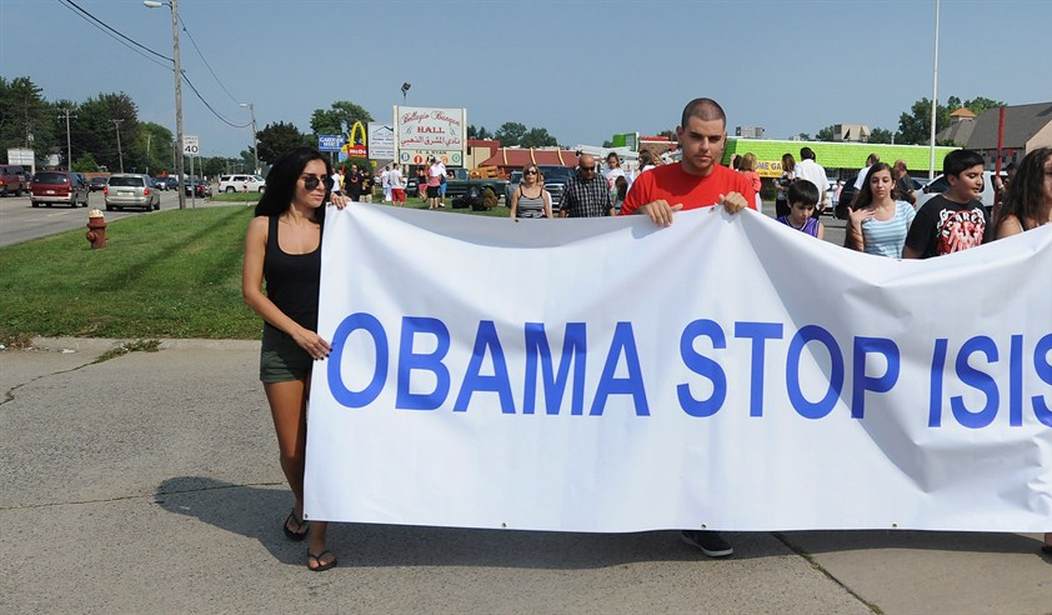
Then, for the price of a re-election talking point -- "I ended the war in Iraq" -- Obama pulled out every American peacekeeper. The result is now the chaos of a growing Islamic State.
Apparently, Obama himself recognizes his error. When our troops were still monitoring the Iraqi peace, he and Vice President Joe Biden proclaimed Iraq to be "stable" and their likely "greatest" achievement. But when the country imploded after they had bragged about pulling out troops, Obama blamed the decision on someone else.
The unpopular, costly occupations of both Afghanistan and Iraq were not, as charged, neoconservative fantasies about utopian democracy-building. Instead, they were desperate, no-win reactions to past failed policies.
After we armed Islamists to force the Soviets out of Afghanistan in 1989, we forgot about the chaotic country. The Clinton administration periodically blew up things with cruise missiles there on rumors of Osama bin Laden's whereabouts. An al-Qaeda base for the 9/11 attacks followed.
After expelling Saddam Hussein's forces from Kuwait and leaving Iraq in 1991, no-fly-zones, a resurgent and conniving Saddam, and Operation Desert Fox followed. The aim of the second Iraq war of 2003 was to end the conflict for good by replacing Saddam with something better than what we had left after the first war.
It is popular to think that America's threats can be neutralized by occasional use of missiles, bombs and drones without much cost. But blowing apart a problem for a while is different than ending it for good. The latter aim requires just the sort of unpopular occupations that calmed the Balkans, and had done the same in Iraq by 2011.
Obama now promises to destroy the Islamic State in Syria, solely through air power. And he assures that he will safely pull nearly all U.S. troops out of Afghanistan at the end of the year.
More likely, Syria will remain a dangerous mess like Libya, and Afghanistan will end up like Vietnam or Iraq.
Victory on the ground and occupations can end a problem but are unpopular and costly.
Bombing is easy, forgettable, and ends up mostly as a temporary Band-Aid.
If we cannot or will not solve the problem on the ground, end an enemy power, and then reconstitute its government, then it is probably better to steer clear altogether than to blow up lots of people and things -- and simply go home.



Join the Conversation
VIP members get the ability to comment on articles.