





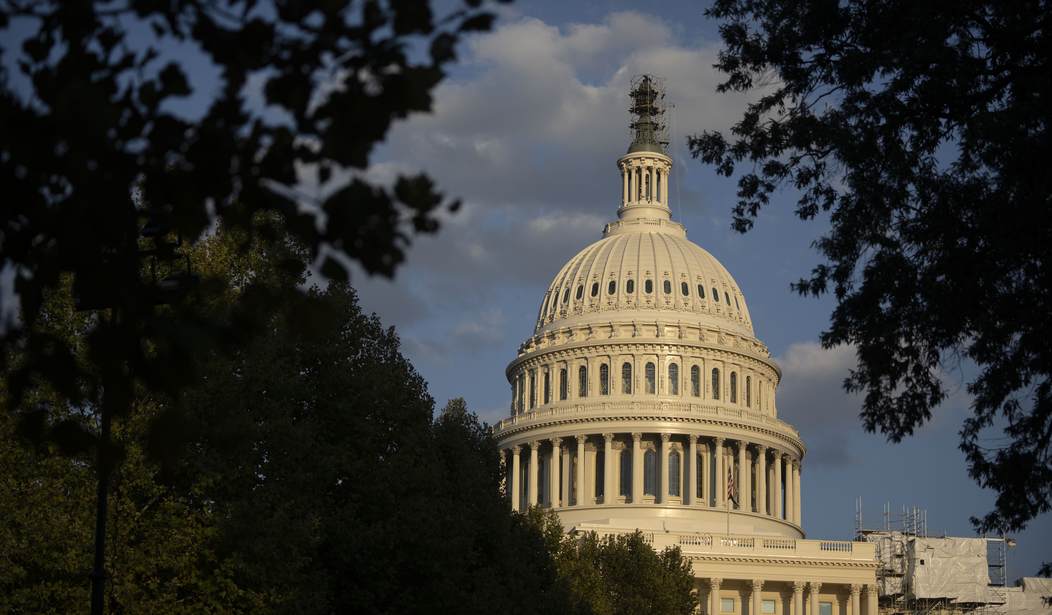
Serious problems should be met with serious solutions. We have serious problems, namely a fast-growing debt and a need to extend some tax cuts in an unforgiving environment where interest rates are high and inflation is rising again. Unfortunately, despite a new mandate, House Republicans have yet to rise to the occasion. Their latest budget blueprint shows that fiscal responsibility vanishes the moment real choices arise.
As a reminder, government debt stands at 100% of GDP. It will grow to 117% by 2034 if the tax cuts are allowed to expire as scheduled this year. It was 76.5% when the cuts were first passed in 2017.
For those wondering why deficits and debt have accumulated so much, here are some more numbers. According to Center for a Free Economy President Ryan Ellis, since 2017, tax revenues have grown by 58%, while spending has grown by 75%. These hikes weren't driven by inflation alone, which was 31% cumulatively over the period. As Ellis rightly notes, we can't blame taxpayers. The fault lies squarely with politicians' spending incontinence.
Enter the House Republican budget blueprint for a "big beautiful bill" as requested by the president. As the Committee for a Responsible Budget explains, "the budget resolution's instructions include a net $3.3 trillion in allowable deficit increases -- or nearly $4 trillion including interest in additional debt by 2034." It also raises the debt ceiling by $4 trillion.
Basically, we're talking about offsetting as much as $4.8 trillion -- mostly for tax-cut extensions -- with only $1.5 trillion in supposed spending reductions. The plan projects that additional tax revenue from economic growth will temper the debt impact.
While I've touted the potential for some tax-cut extensions to boost economic growth, this is a case of wishful thinking by Republicans. In part, it's because the plan relies on the same kinds of budget gimmicks and unrealistic assumptions we've seen before, like counting on Congress to deliver on large future spending cuts to discretionary spending and Medicaid.
It's not as if there isn't lots to cut -- there is, especially considering the unhinged government expansions of the last four years -- but it remains politically tough. As the Manhattan Institute's Jessica Riedl notes, achieving the assumed level of cuts in the plan would require Congress to deliver the lowest discretionary spending share of GDP since the 1930s while simultaneously increasing defense and border-security spending. Why would we expect Congress to have the stomach for that?
Many Republicans are putting their faith in Elon Musk's cost cutting, but it's not enough. Much of what needs to happen requires Congress, which apparently prefers to once again kick the can down the road.
The blueprint makes other questionable assumptions. I doubt we'll find $2.6 trillion in extra revenue from a highly improbable 2.8% annual GDP growth rate, considering the approximately 1.8% growth baseline.
Yes, extending the provision allowing businesses to quickly and fully deduct the cost of their investments would have a powerful, positive impact on growth. However, many of the other tax provisions have little growth oomph.
In addition, there are plenty of headwinds that will hamper growth, such as the increase of the debt itself and the uncertainty created by a president who spends his time threatening trading partners with ever more tariffs.
There's real risk that inflation may pick up again, in part because previous fiscal decadence has led to enormous interest payments on the debt, which has serious ripple effects. If Republicans decide to extend taxes without any concern for adding to the debt, they will contribute to the problem.
And indeed, it looks like that's what they are setting out to do. The saddest part is that this version of the plan will be better than whatever bargained budget congressional Republicans can get across the finish line -- especially after caving to those who want to eliminate revenue-savers from the 2017 tax reform, such as the limits put on the state and local tax deduction.
I get it: Governing is hard, so legislators tout savings and revenue that may never materialize. But glossy narratives do nothing to fix the nation's daunting debt trajectory, and budgets like this latest one push us closer to crisis. Without difficult structural reforms, debt will continue to mount, forcing harsher choices later.
To capitalize on their opportunity, Republicans must confront reality. So stop the charade and cut both discretionary spending and the growth of runaway entitlement spending. And cut any unfair tax loopholes that prevent us from paying for a slightly more modest government.

Join the Conversation
VIP members get the ability to comment on articles.