





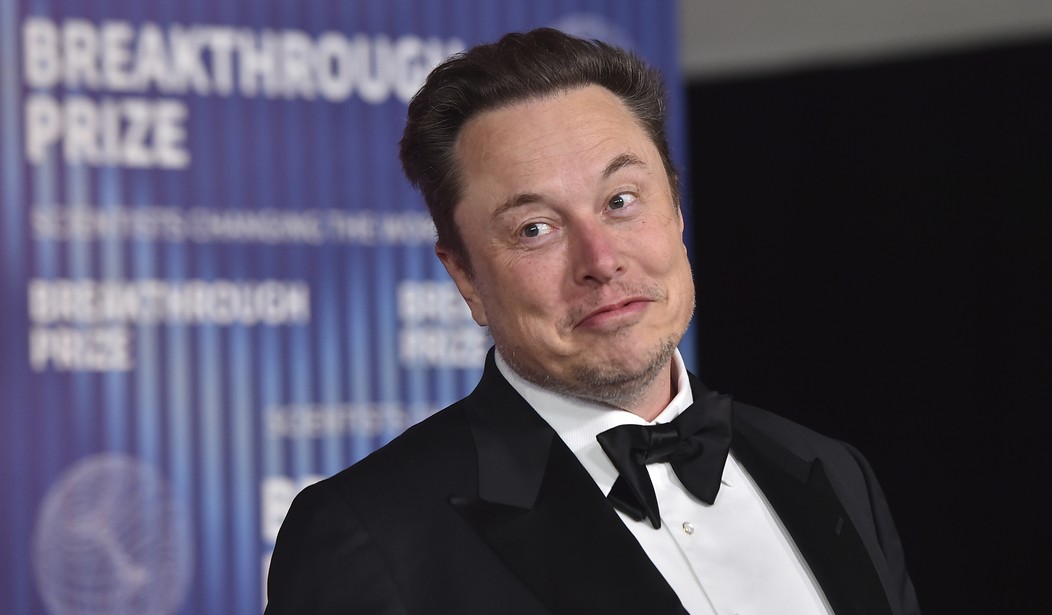
During his campaign, former President Donald Trump has proposed his share of bad policy ideas, such as a 20% tariff across the board. However, tasking Elon Musk with heading a commission to make the government more efficient is worth considering. In a speech to the Economic Club of New York, Trump said this commission would conduct "a complete financial and performance audit of the entire federal government."
Efficiency is subjective. Some believe that empowering the IRS with more power to collect more taxes is efficient. Some believe that efficiency means ending waste, fraud, and abuse. I have a more extensive definition. Yes, an efficient federal government would be free of fraud and abuse, but it also wouldn't subsidize private-sector activities like exports, manufacturing, green energy, or any other sectors.
Nor would an efficient federal government subsidize state governments for activities that are not federal in nature. Chris Edwards at the Cato Institute reports that in 2019, $721 billion went from Washington, D.C., to the states for activities that states themselves should oversee, like transportation and education. That number exploded during the pandemic. As Edwards shows, such "grants-in-aid" programs produce irresponsible policymaking as they misallocate resources and undermine accountability and democratic control. Oh, and they also produce larger deficits.
Trump's definition of efficiency is narrower. He said: "As a first order of business, this commission will develop an action plan to totally eliminate fraud and improper payments within six months. This will save trillions of dollars. Trillions."
Trillions? I doubt it. You can't balance the budget because of fraud and improper payments alone. But ending this waste is the least that government officials should do. As such, a commission stepping in where our delinquent legislators are asleep on the job is welcomed.
According to the Government Accountability Office's latest report, "Federal agencies made an estimated $236 billion in improper payments in FY 2023, and cumulative federal improper payment estimates have totaled about $2.7 trillion since FY 2003." The GAO also reports that five programs are responsible for 79%, or $186 billion, of these improper payments.
My research on this topic suggests that only 5% of the improper payments are underpayments, and most of the overpaid money is never recovered. Medicare, Medicaid, and that darling of the Right and the Left, the earned income tax credit, are all systematically at the top of the improper-payment culprit list every year.
Yet nothing happens except that the improper payments grow. It's another sign that government officials, Republican or Democrat -- probably including your own House and Senate representatives, dear readers -- have very little respect for our hard-earned dollars. We shouldn't tolerate such abuse.
This is only the tip of the iceberg. Hundreds of billions of dollars are for payments that, while neither fraudulent nor improper, fund redundant activities, do not achieve what they set out to, or even backfire.
Nevertheless, an efficiency commission is not without challenges. Political resistance is the first. Programs that shouldn't exist have strong political backing, either because they serve a particular constituency or because they benefit powerful interest groups. For instance, agricultural subsidies -- often and correctly criticized as wasteful -- persist due to strong lobbying from farming interests. Political realities make meaningful cuts or reforms difficult.
Dominic Pino at National Review reminds us that the Grace Commission under President Ronald Reagan made 2,478 recommendations to save $424 billion over three years (in 1984 dollars). Most of the executive branch recommendations were implemented, but those that required legislative action weren't, likely for the reasons laid out above. Pino writes that "the recommendations that were implemented from the commission have saved the federal government a total of $1.9 trillion between the publication of the report and 2020."
The Grace Commission was a raging success compared to former Vice President Al Gore's attempt to cut waste as part of former President Bill Clinton's plan to "reinvent government." As The Wall Street Journal reports, "the Clinton Administration abandoned the effort amid union opposition and Mr. Gore's desire to appeal to his party's left as he sought the presidential nomination in 2000."
Cutting government spending is hard work. So is sending people into space. Musk does the latter better than NASA, so he might be up for tackling the former. The only question is whether that's the best use of his time, considering that Congress will continue to be an obstacle to efficiency.


Join the Conversation
VIP members get the ability to comment on articles.