







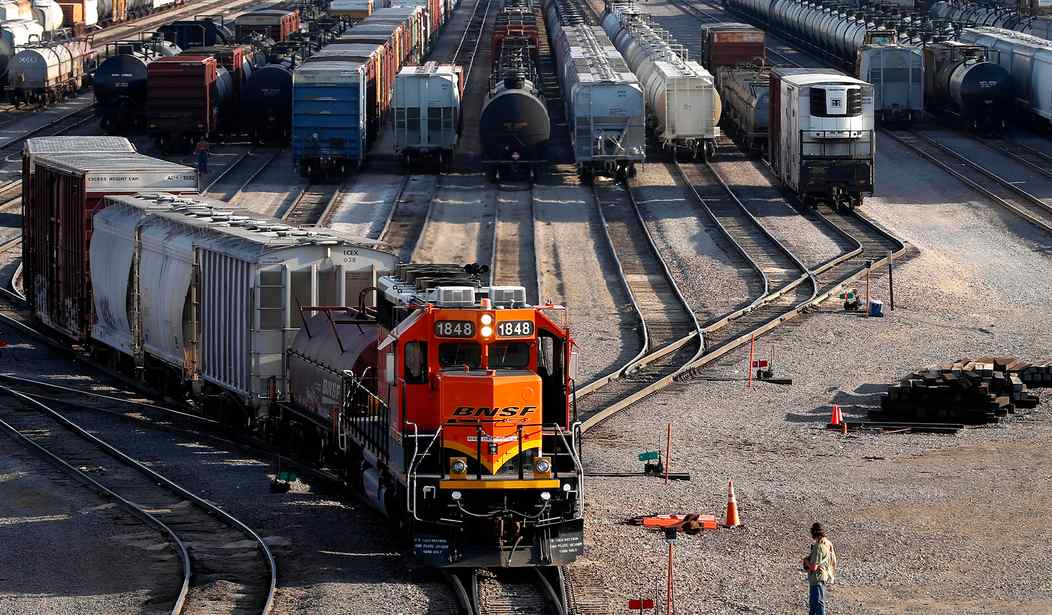
American federalism is struggling. Federal rules are an overwhelming presence in every state government, and some states, due to their size or other leverage, can impose their own policies on much or all of the country. The problem has been made clearer by an under-the-radar plan to phase out diesel locomotives in California. If the federal government provides the state with a helping hand, it would bring nationwide repercussions for a vital, overlooked industry.
Various industry and advocacy groups are lining up against California's costly measure, calling on the U.S. Environmental Protection Agency to deny a waiver needed to fully implement it. In the past month, more than 30 leading conservative organizations and individuals, hundreds of state and local chambers of commerce, and the U.S. agricultural sector have pleaded with the EPA to help stop this piece of extremism from escaping one coastal state.
Railroads may not be something most Americans, whose attention is on their own cars and roads, think about often. But rail is the most basic infrastructure of interstate commerce, accounting for around 40% of long-distance ton-miles. It's also fairly clean, accounting for less than 1% of total U.S. emissions. Private companies, like Union Pacific in the West or CSX in the East, pay for their infrastructure and equipment. These facts haven't stopped the regulatory power grab.
Most importantly, the California Air Resources Board regulation would have all freight trains operate in zero-emission configuration by 2035. At the end of the decade, the state is mandating the retirement of diesel locomotives 23 years or older, despite typically useful lives of over 40 years. Starting in 2030, new passenger locomotives must operate with zero emissions, with new engines for long-haul freight trains following by 2035. It limits locomotive idling and increases reporting requirements.
Given the interstate nature of railway operations, California needs the EPA to grant a waiver. If the agency agrees, the policy will inevitably affect the entire continental United States.
The kicker is that no technology exists today to enable railroads to comply with California's diktat, rendering the whole exercise fanciful at best.
The Wall Street Journal's editorial board explained last November that while Wabtec Corp. has introduced a pioneering advance in rail technology with the launch of the world's first battery-powered locomotive, the dream of a freight train fully powered by batteries remains elusive. The challenges of substituting diesel with batteries -- primarily due to batteries' substantial weight and volume -- make it an impractical solution for long-haul trains. Additionally, the risk of battery overheating and potential explosions, which can emit harmful gases, is a significant safety concern. As the editorial noted, "Even if the technology for zero-emission locomotives eventually arrives, railroads will have to test them over many years to guarantee their safety."
The cost-benefit analysis is woefully unfavorable to the forced displacement of diesel locomotives. To "help" the transition, beginning in 2026, CARB will force all railroads operating in California to deposit dollars into an escrow account managed by the state and frozen for the explicit pursuit of the green agenda. For large railroads, this figure will be a staggering $1.6 billion per year, whereas some smaller railroads will pay up to $5 million.
Many of these smaller companies have signaled that they will simply go out of business. For the large railroads, the requirement will lock up about 20% of annual spending, money typically used for maintenance and safety improvements.
Transportation is the largest source of U.S. emissions, yet railroads' contribution amounts to not much more than a rounding error. The industry cites its efficiency improvements over time, allowing railroads today to move a ton of freight more than 500 miles on a single gallon of diesel. Its expensive machines, which last between 30 to 50 years and are retrofitted throughout their life cycles, are about 75% more efficient than long-haul trucks that carry a comparative amount of freight.
As Patricia Patnode of the Competitive Enterprise Institute, which signed the aforementioned letter to the EPA, recently remarked, "Rather than abolish diesel trains, CARB should stand in awe of these marvels of energy-efficient transportation."
President Joe Biden talks a lot about trains, but his actions since taking office have consistently punished the private companies we should value far more than state-supported Amtrak. In this case, EPA Administrator Michael Regan and the White House need not think too hard. They should wait for reality to catch up before imposing on the rest of us one state's demands and ambitions.



Join the Conversation
VIP members get the ability to comment on articles.