







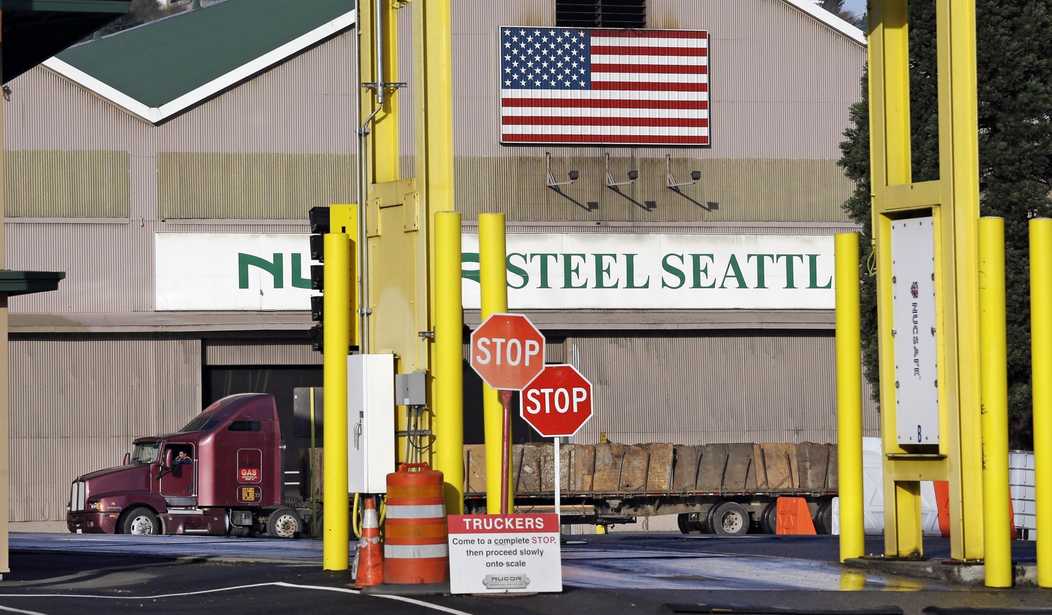
The Pennsylvania-based U.S. Steel company recently agreed to be purchased by the Tokyo-headquartered publicly traded company Nippon Steel. This deal makes sense to economists. It will encourage other foreign companies to invest in the U.S., creating wealth and new job opportunities, and further shoring up the U.S. economy, particularly amid inflation worries. More importantly, this deal makes sense to the owners of U.S. Steel.
And yet, in our age of government shoving its fingers into everything, President Joe Biden announced that he opposes this purchase for muddled, misguided reasons. Former President Donald Trump agrees, showing once again that when it comes to trade there is little difference between the two presidents.
Such government meddling is what American steel producers get for having clamored for decades -- often successfully -- that they need protection from foreign competition. The Trump steel tariffs are the latest expression of this attitude. But one stupid policy move doesn't justify a second. As soon as the announcement of Nippon's $14.1 billion deal with U.S. Steel was made public, fans of protectionism and industrial policy, including prominent policymakers, came swarming out of the woodwork to explain why the government should be able to override, or at least modify, the decision of the rightful owners of a company to sell their company to a particular buyer.
Assertions of dangers to "national security" are being used to scare Americans into thinking that a good deal for investors, employees, and the U.S. economy will somehow make America less militarily secure. This is nonsense.
Japan has been a strong ally of the U.S. for over 60 years. In a recent piece, the Cato Institute's Scott Lincicome and Alfredo Carrillo Obregon remind us that "the Defense Department doesn't currently buy from U.S. Steel, and DOD needs just 3 percent of domestic steel production to meet its procurement obligations." Furthermore, U.S. Steel, despite its historic significance, is no longer a major player in the steel industry and could benefit from Nippon Steel's investment and technology enhancements. Besides, foreign investments, including those from Japan, are typically beneficial to the domestic economy and workforce -- and the millions of Americans holding corporate shares in retirement portfolios.
According to the fearmongers, Nippon Steel, being a Japanese company, perhaps harbors secret plans to spend $5 billion above U.S. Steel's market capitalization to shutter it. Obviously, this is total nonsense. It should go without saying that investors don't purchase companies to then shut down those companies' profitable operations. Yet it needs to be said since that's one of the main fears about the acquisition. The fact is that Nippon, by saving U.S. Steel and enhancing the domestic production of steel, will bolster our national security. Opponents of the deal ignore this reality. Yet again, the facts don't seem to matter to those who use nationalist rhetoric to oppose Americans' peaceful commercial dealings with non-Americans -- in this case, even a crucial, decades-long ally.
The business practice of buyouts is not inherently bad. Nippon Steel will save U.S. Steel and make it better through new ownership. John Tamny wrote at Forbes on March 4 that "neither bankruptcy nor buyouts signal the vanishing of businesses as much as they signal the happy, pro-employee and pro-business scenario of physical and human capital being shifted into the hands of more capable stewards." Tamny is right, and U.S. Steel is in a good position, if another successful company sees value in purchasing the company to make it more efficient and productive. For all the protectionist handwringing, you'd think policymakers would recognize that this buyout will save the company from eventual bankruptcy without the deal and might secure the jobs of U.S. workers.
The merged company will be able to provide for the massive demand for high-grade steel in the United States -- demand exploding in no small part because of increased domestic production of electric vehicle motors. It makes economic sense for Nippon Steel to invest in this Pennsylvania-based company to meet the growing demand for steel in the U.S.
Nippon Steel has the potential, and the incentive, to restore U.S. Steel into a strong and leading steelmaker once again, unless the U.S. government and the hordes of economic nationalists get in the way. As meddling in the dealings of successful companies increases, the American economy will suffer the creeping statism that has hamstrung so many European economies, where intrusive government control impedes private enterprise.


Join the Conversation
VIP members get the ability to comment on articles.