





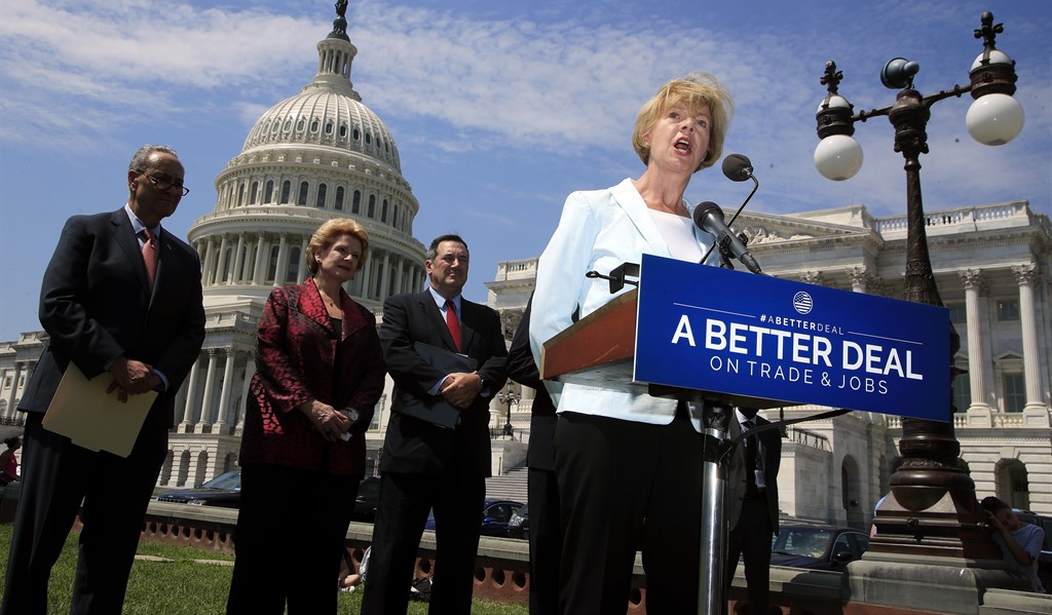
Democratic leadership made one huge gaffe when they released “A Better Deal,” a new economic plan aimed at building a strong economy. They forgot to propose policies to make it easier for Big Labor, a major campaign contributor, to get more dues-paying members.
That oversight sent the Democrats scrambling. Months later, at a November 1 press conference, Senate Minority Leader Chuck Schumer (D-NY) and House Minority Leader Nancy Pelosi (D-CA) unveiled a new component to “A Better Deal,” focused on easing organizing campaigns and granting unions more power to coerce workers to pay dues. Union bosses praised the rollout of the proposals.
One key plank in the new agenda targets state right-to-work laws, which ban forced union dues as a condition of employment. Instead, the Democratic deal wants the federal government to prohibit states from having right-to-work laws or, as the Democrats put it, “ban state laws that undermine worker freedoms to join together and negotiate.”
But right-to-work laws do not diminish workers’ right to join a union or collective bargaining – those laws give workers the choice of whether or not to pay union dues.
Equally as importantly, right-to-work laws are the number one offset to serious shortcomings of the National Labor Relations Act (NLRA), the federal law that governs private sector labor-management relations. Under the NLRA, once a union wins an election, it gains exclusive representation over all workers in a company, not just those who voted for it. This means that under federal law, individuals who vote "no" on unionization are forced to work under a contract they do not want. And in the 22 states that lack right-to-work laws, unions can compel workers to pay for this unwanted representation.
Consider, too, that it is nearly impossible to get rid of a union once in place, a problem made worse by the fact that a vast majority of workers around today never voted on the union that represents them. Under 10 percent of workers got the chance to vote on whether or not to have a union, according to Heritage Foundation research using Bureau of Labor Statistics and National Labor Relations Board data. In short, most workers inherit a union rather than choose it.
But unions and Democrats are worried about losing dues-paying members. A lawsuit before the United States Supreme Court case, Janus v. American Federation of State, County, and Municipal Employees, Council 31, could soon make right-to-work the law of the land for all public-sector workers, which now constitute the bulk of union membership.
If the court strikes down mandatory union dues, “Unions will be forced to spend larger amounts of time and money on membership maintenance instead of other more progressive union activities,” an American Federation of Teachers field director lamented to a local Baltimore teachers union, according to The 74.
Democrats, for their part, are well aware that if unions can no longer require dues payments as a condition of employment, campaign contributions from unions will decline, and that means less funding for progressive groups and causes. And Big Labor is a key contributor to the left’s agenda. From 2012-2016, the Center of Union Facts found that labor unions sent over $700 million to progressive special interest groups.
But how is A Better Deal a better deal for the average worker than for the union bosses? Shouldn’t unions, in fact, have to work as hard as they people they want to represent? Taking away right-to-work will only guarantee worker choice is undermined. It’s time the labor unions stop gaming the political system and instead provide services that are of real value to workers. That’s the best, most legitimate way to win worker confidence and earn dues-paying members.


Join the Conversation
VIP members get the ability to comment on articles.