





When the Seattle Seahawks and the New England Patriots take the field in this year's Super Bowl, there is one thing you will not see. Neither team will put a biological female on the field to play in the game.
Is this because the NFL is sexist? No.
In fact, there is no formal NFL rule that prohibits biological females from playing in the league. However, the league's official rules repeatedly use male pronouns when referring to players.
For example, one section in the NFL rulebook addresses the issue of "Offensive Substitutions." "The following," it says, "are applicable to any offensive substitute who is entering the game: (a) He must move onto the field of play or the end zone as far as the inside of the field numerals prior to the snap to be a legal substitution. If he does not, and is on the field of play or end zone at the time of a legal snap, he is an illegal substitute."
Now, what if one of the players on one of the Super Bowl teams announces just before the game that he no longer identifies as a male but as a female, and that he should be referred to as "her"? Would the NFL rules written for a "he" still apply to him?
Would he really be the first female to play in the Super Bowl?
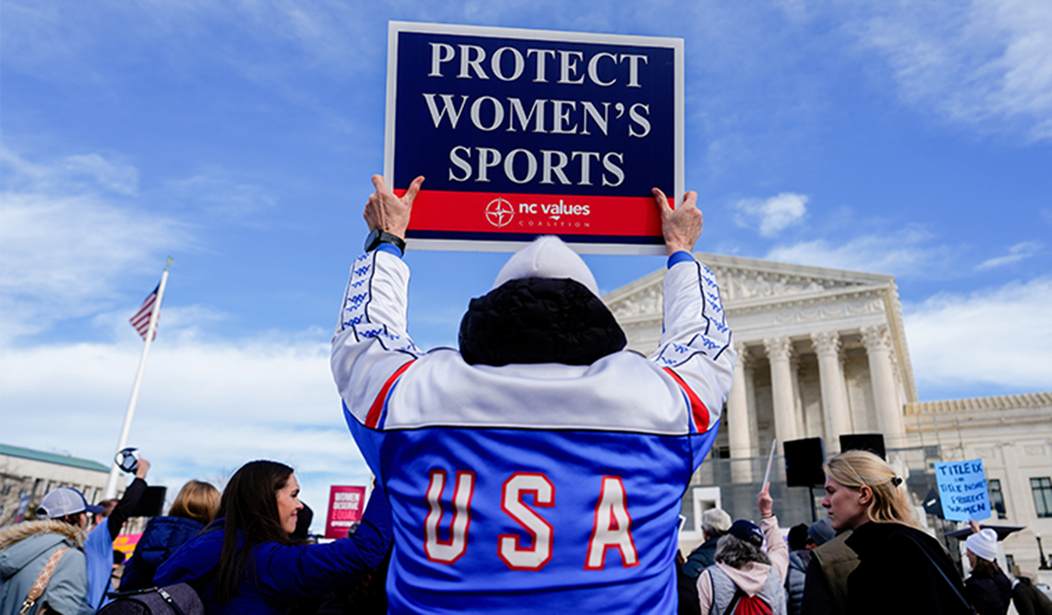
On Jan. 13, the Supreme Court heard arguments in two cases — Little v. Hecox and West Virginia v. B.P.J. — which are challenging state laws in Idaho and West Virginia that prohibit biological males from competing in all-female sports. In the oral arguments in Little v. Hecox, Justices Sonia Sotomayor and Ketanji Brown Jackson both used female pronouns to refer to a biological male who identifies as female.
"There's no question here that a male who identifies as a female, but it's a male, is being include — excluded from a female sport, correct?" Sotomayor said in an exchange with Idaho Solicitor General Alan Hurst, according to the transcript posted by the court.
"That's correct," said Hurst.
"Now what you're saying is, well she's not challenging a — males generally not playing," Sotomayor said a moment later. "She just doesn't want to be the one male excluded. So it's a subclass that she's challenging, correct?"
Jackson, in another exchange with Hurst, asked a question about the same individual Sotomayor had described as "a male who identifies as female."
"(W)hat if this decision does not come out until June and she graduates in May?" Jackson asked.
The petition that the attorney general of West Virginia filed asking the Supreme Court to take up his state's case succinctly summarized the questions these cases involve. The first: "Whether Title IX prevents a state from consistently designating girls' and boys' sports teams based on biological sex determined at birth." The second: "Whether the Equal Protection Clause prevents a state from offering separate boys' and girls' sports teams based on biological sex determined at birth."
Title IX is a federal law that says: "No person in the United States shall, on the basis of sex, be excluded from participation in, be denied benefits of, or be subjected to discrimination under any education program or activity receiving Federal financial assistance." The Fourteenth Amendment states that no state shall "deny to any person within its jurisdiction the equal protection of the laws."
The U.S. Conference of Catholic Bishops filed an amicus brief in support of both the Idaho and West Virginia laws, arguing that they violate neither the Equal Protection Clause or Title IX.
"These cases ask whether the Equal Protection Clause or Title IX forbids the States to create female-only athletic competitions," says the USCCB's brief. "Neither does, and any other answer could prove catastrophic to Catholic institutions."
"The challenged laws prohibit males -- including males who 'identify' as females -- from participating on female-only teams," says the USCCB brief. "These laws comply with the Equal Protection Clause.
"While both laws draw sex-based distinctions," says the brief, "the Equal Protection Clause permits sex-based distinctions that serve, and are 'substantially related to,' 'important governmental objectives.' ... Laws creating female-only sports pass muster. Because of the valuable lessons that sports impart, States advance an important governmental objective when they ensure that girls and women can compete. These laws serve, and are substantially related to, that objective: given the inherent athletic advantages that males possess, creating female-only teams ensures that girls and women can safely and fairly compete."
The USCCB's brief goes on to argue that if the court rules that the Idaho and West Virginia laws do violate Title IX, it could end up having bad consequences for Catholic hospitals.
"Establishing that Title IX does not prohibit gender-identity discrimination is imperative if Catholic hospitals are to continue serving their communities at current levels," says the brief. "Section 1557 of the Affordable Care Act prohibits discrimination by healthcare entities that accept federal funding, including through Medicare and Medicaid. And (Section) 1557 incorporates Title IX's prohibition on sex discrimination. If that prohibition extends to gender-identity, (Section) 1557 may be read -- and has been read by previous administrations -- to mandate the provision of 'gender-affirming care.' Catholic hospitals are not permitted to provide such care. Thus, they would have to stop accepting Medicare and Medicaid -- to their communities' detriment -- if not exempted from any such mandate. But it is uncertain whether any religious exemption applies to hospitals otherwise bound by (Section) 1557."
The Supreme Court needs to return common sense to school sports. Biological boys are boys, and biological girls are girls, and states have a right to recognize that fact in their laws.
Editor’s Note: Do you enjoy Townhall’s conservative reporting and opinion? Support our work by joining Townhall VIP! Use the promo code FIGHT to get 60% off your VIP membership!


Join the Conversation
VIP members get the ability to comment on articles.