
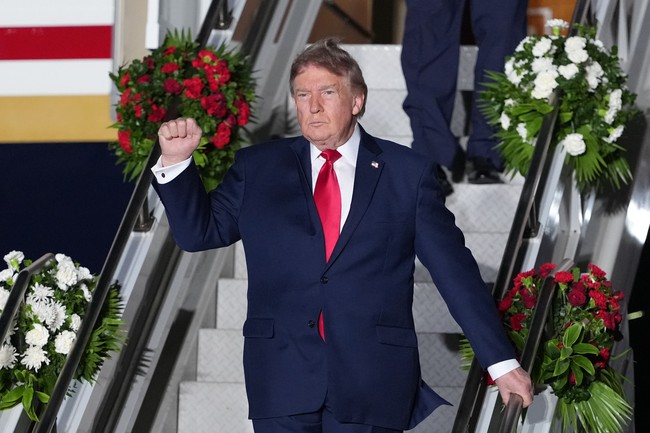
When President Trump sits down with Chinese President Xi Jinping and Russian President Vladimir Putin on Thursday, he’ll do something no American president has done before: hold a summit with the leaders of China and Russia at the same table.
Trump is scheduled to attend the Asia-Pacific Economic Cooperation leaders’ session and meet separately with Xi before the three-way talks later this week. U.S. officials have said the talks will cover nuclear arms and the war in Iran. And while the war in Ukraine wasn’t originally slated to be a topic of discussion, Trump said before departing that he plans to raise the issue.
This week’s meetings will put on display one of Trump’s most underrated foreign-policy strengths: he’s willing to deal directly with leaders he disagrees with, make audacious demands, and keep bargaining toward an agreement all parties can sign.
In his first term, Trump’s administration helped broker the Abraham Accords, which established formal relations between Israel and two Arab states, the United Arab Emirates and Bahrain. Those new ties later helped Israel negotiate a trade deal with the UAE in 2023 that reduced tariffs on goods traded between the two countries. For Washington, the deal brought longtime U.S. partners into good standing with Israel.
Maybe it’s the businessman in him. Trump’s ability to make far-fetched requests and work toward terms that advance a particular American interest is remarkable. His push to acquire Greenland paved the way for an Arctic defense agreement with Denmark and Greenland that lays out the potential for two new U.S. defense areas. The agreement, which Greenland’s parliament approved earlier this month, also authorizes an expansion of operations at the existing U.S. base.
Trump’s dealings with Mexico show another element of his foreign policy successes — his ability to leverage. In 2019, after Trump threatened tariffs on Mexico, the country agreed to deploy its National Guard to aid in guarding the border. In response, he suspended his plans to enforce tariffs. Later, in February 2025, he and Mexican President Claudia Sheinbaum struck a similar deal. Mexico agreed to send 10,000 National Guard personnel to its northern border, and Trump delayed tariffs for a month. That September, the two governments agreed to a border program that targets drug trafficking, arms trafficking, and organized crime.
The effects of those policies have reached American soil. In the first fiscal year of Trump’s second term, Border Patrol reported a 58 percent decrease in arrests on the border, recording only 98,700 apprehensions.
Trump’s recent dealings with Venezuela are also a testament to his smart use of leverage. After U.S. forces captured Nicolás Maduro in January, the administration reached an oil-sales arrangement with the government led by Delcy Rodríguez, easing restrictions on Venezuelan crude. By July, U.S. imports from Venezuela had reached 701,000 barrels a day, the highest level since 2017. The U.S. also became the largest buyer of Venezuelan crude in 2026, after China took most of Venezuela’s exports the year before.
Trump certainly has an opportunity to bring home a specific win from Shenzhen, too. U.S. officials have already pressed Beijing on rare-earth minerals, and Trump likely has an opportunity to negotiate a timeline for easing export bottlenecks. On the other hand, setting a date for another round of arms-control talks would put Washington, Beijing, and Moscow on a good path to future talks of peace, potentially setting Trump up for future major foreign policy wins.
This week’s scheduled talks will be historic in and of themselves. Whatever deals Trump brings home will only add to his lengthy foreign policy legacy.