
On the last weekend of September, protesters crashed a 600-person data center party in Washington, D.C. Multiple outspoken protesters stormed the stage to criticize alleged exorbitant water usage and pollution. Chants included, “You’re killing the world!”
This existential dread is surprisingly common. According to a poll by the Associated Press/ NORC, 47 percent of Americans think data centers do “more to hurt” than help the environment. But the popularity of this data center lie may stop conservation breakthroughs altogether. The dissenters could single-handedly prevent the implementation of revolutionary AI conservation technologies.
The alarmist claim of water use killing the world is a dangerous lie that hides data centers’ actual minimal impacts on nature. Data centers built in the 1960s and 1970s did, indeed, consume more freshwater than today’s proposed data centers due to their open-loop evaporative cooling system. However, the proposed build-outs of data centers have a closed-loop system that keeps water in the system and consumes 70 percent less water than early data centers. In reality, data centers use less water than many (less valuable) staples of American cities and towns. For instance, on average, data centers consume five times less water than golf courses.
Meanwhile, AI tools hold great promise for helping preserve water, not just expend it. AI algorithms can vastly enhance local governments’ ability to detect leaks, optimize water pressure in pipes, and allocate water efficiently. The city of Tucson, Arizona, population 542,000, has already implemented AI and machine learning tools into its water management systems to discover patterns from historical pipe failures. It seems likely that other cities will do the same in the years ahead.
Farmers are reaping the benefits of AI, too. For example, Spanish farmer Miguel Ferrer reduced his annual water use by as much as 50 percent while increasing his harvests after using AI to process weather, soil-moisture and satellite data. Imagine the water conservation benefits when more farms use AI for precision agriculture.
AI can equally solve, or at least alleviate, the so-called biodiversity crisis. Biodiversity, an index for the diversity of all life forms, is declining as species are disappearing. Yet, the University of Arizona reports that 16,000 new species are discovered annually. Some say that the world is in the sixth and final mass extinction. Extinction patterns are certainly alarming. Today, the extinction rate is 1,000 times faster than fossil records from pre-human times. If this is true, then humans, as part of the ecosystem, would also suffer from decreased biodiversity levels.
Luckily, AI is a godsend for conservation of all life forms. It optimizes efforts to combat biodiversity loss by tracking poachers, aiding in habitat preservation and restoration, monitoring endangered species, and helping researchers work with more data to make better conclusions about the state of global biodiversity.
The World Wildlife Fund (WWF), the world’s largest independent conservation organization, uses AI to strengthen the protection of nature. Annually, the illegal wildlife trade earns between $7 billion and $23 billion, making wildlife crime a lucrative illegal business. WWF stopped 63.3 million online illegal wildlife listings between 2018 and 2025. Nearly 63 percent of the online listings were stopped between 2024 and 2025 thanks to newly deployed AI technology. The WWF also used AI to detect 50,000 tons of ghost fishing nets that kill marine life. With this new knowledge from satellite analysis, cleanup organizations know exactly where to remove nets.
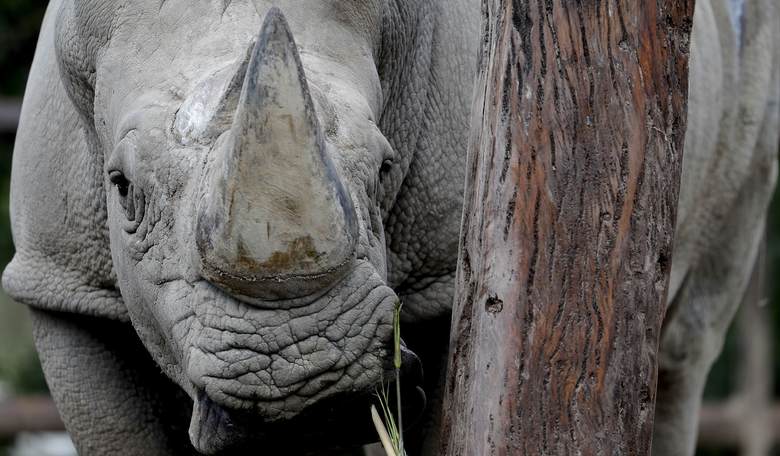
Lastly, via AI monitoring, endangered species can be saved. The WWF halted all rhino poaching in Kenya at 11 distinct sites that collectively account for 80 percent of Kenyan rhinos. The black and white rhinos are both classified as critically endangered in Kenya. In 2025, there were only 2,000 left. Rhino-horn poaching, a serious problem throughout Africa, could decimate the population if unchecked. AI paired with thermal-vision cameras has resulted in zero rhino poaching incidents at all 11 sites since 2023. Why? Humans can’t filter out millions of false alarms; humans get distracted; and ranger shortages limit the number of rangers who can detain the poachers. AI is clearly a powerful option.
Outside of remote conservation, AI can prevent literal crashes between wildlife and high-risk infrastructure. One company, actively operating, uses AI to influence animal behavior before they clash with airports, railways, the electric grid, and wind turbines. As more infrastructure gets built, it’s important that the habitat of endangered and non-endangered species can adapt. Flox Intelligence, a Swedish-based company that operates in the U.S., allows that by thwarting animal collisions, playing species-specific acoustic warnings. The benefits are too good to ignore. Flox has logged over 60,000 deterrence events across its deployed infrastructure since its founding in 2020. Meaning, 60,000 wildlife-infrastructure crashes were stopped between 2020 and 2026.
Businesses and researchers are increasingly reliant on AI to collect, process, and analyze large sets of data. AI’s conservation applications can create more environmental benefit than the alleged harm that misinformed Americans believe occurs. Movements to pause AI are anti-American as well as anti-conservation. There is no grey area. The in-use applications are just the tip of the iceberg.
Instead of wasting time on how to delay its development, policymakers should be focused on AI’s applications–with safety guardrails–for saving all types of life. And protesters would do well to educate themselves on the true nature of AI and conservation. That is true superintelligence.
Sydney Rodman is a visiting fellow at Independent Women’s Center for Energy and Conservation. Follow her on X at @EnergySyd.